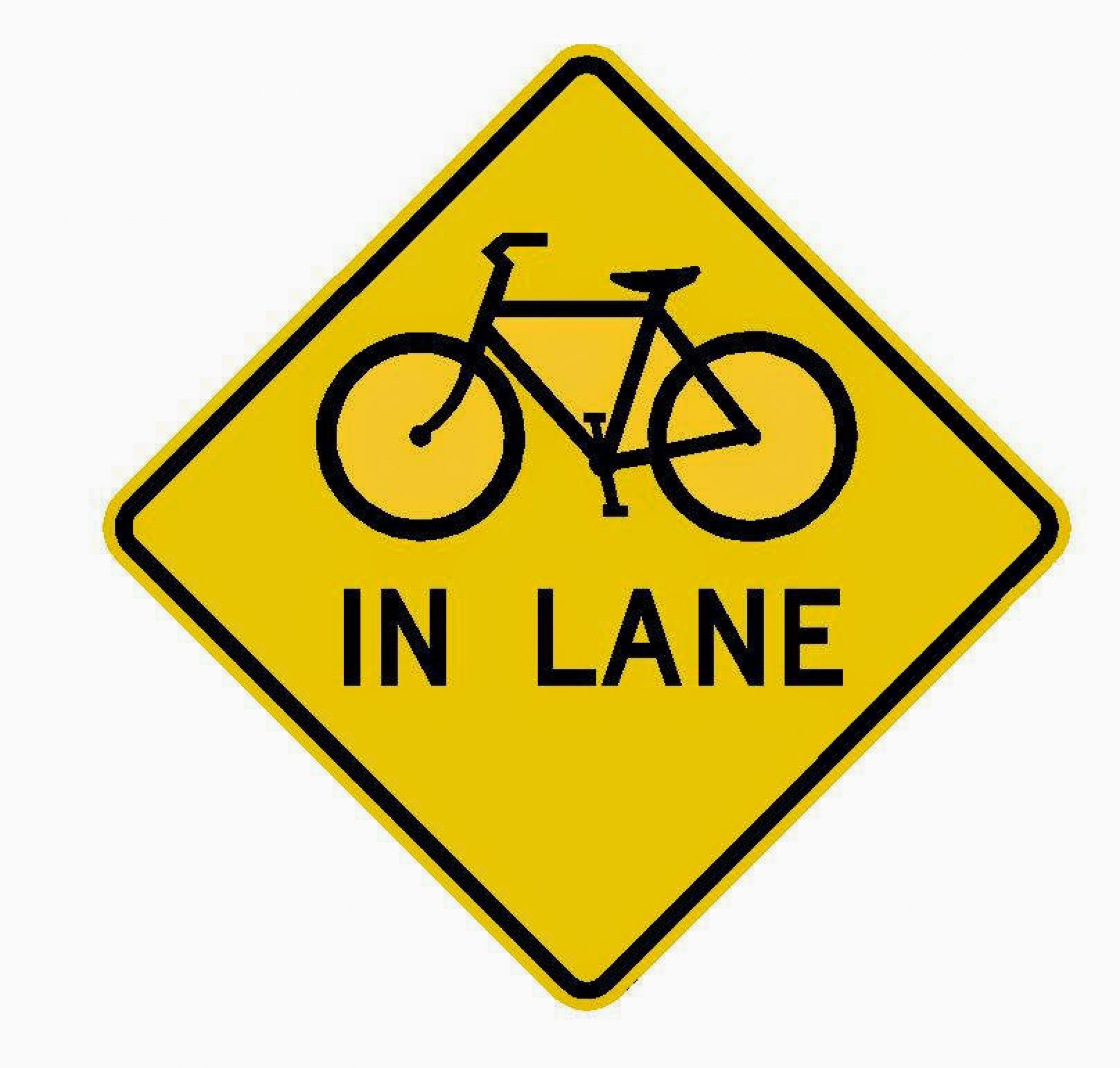
[B’ Spokes: Things like this happen all over yet there still is the persistence that distracted pedestrians are the problem. I will further assert if this is a typical pedestrian experience (which I think it is) it is no wounder more and more pedestrians are choosing to cross mid-block. We need to enforce traffic laws on BOTH pedestrians and motorists.]
Don’t Pass Me Yet, Bro!
By William Smith, Frederick News Post
Dear Motorist Person,
In your haste the other afternoon to pass me as I was riding my bicycle, you came fairly close to hurting or killing someone. You see, my mom always told me, “Don’t start a pass you can’t finish.” She was not discussing driving, but the point was well-taken.
You might recall that, at the time you chose to begin your pass, there was a hill just ahead of us that hid the oncoming car from your view, but not mine since I was forty feet in front of you. I imagine that you chose to go completely across into the other lane on this skinny country road in order to provide sufficient room to pass me, which in some circumstances could be quite appropriate and desirable, but not in this case. Your haste to pass me created a situation where, had I not intervened, was going to either
- cause you to have a head-on collision with the unseen oncoming car (perhaps killing one or both of you)
- force the oncoming car off the road into the trees (perhaps killing her),
- lead to you swerving to the right in order to avoid the oncoming vehicle (crashing into and possibly killing me).
I hope you did not mind that I decided to quickly move into the center of the roadway to prevent you from passing me and that my frantic waving and yelling “NO!” did not alarm you to a large degree. Fortunately for all of us, you chose to take my actions seriously and pull back into line behind my bike. Also pleasing was the fact that you then waited ten seconds for me to signal “clear” and wave you on so that you could pass safely. Not as pleasing was the one-finger salute that followed, despite the likely crash that my attentiveness prevented. A “thank-you” would have been more appropriate. I imagine it was the last token of affection displayed when one realizes that he/she has done wrong and needs to proclaim victory and withdraw.
Sincerely,
Bill
I see this type of situation often enough. With decades of bicycling experience and a fine mirror mounted on my helmet, I can usually spot a potentially dangerous situation brewing and take action in time to avoid the danger. Motorists will unsafely pass bicyclists for various reasons, some of which are: (a) impatience, (b) incompetence, (c) anger, (d) inattention and (e) misjudging the speed of the bicyclist. On every bicycle is a human being such as myself. A motorist’s haste to more quickly reach his/her destination does not override the rules of the road, nor the courtesy that we should extend to each other, nor is sufficient reason to put another person’s life in danger.
Sometimes I hear the common motorist rant, “He was riding in the middle of the lane!” There is often a reason for this. If the lane is too narrow for a motor vehicle and bicyclist to safely share (think Rosemont Avenue or 7th Street), the bicyclist should move far enough to the left to dissuade the motorist from passing in the same lane. If the bicyclist does not move left, the motorist will be tempted to try to squeeze past the bicyclist, often passing within a few inches, setting up a dangerous situation. In 2012 it became law in Maryland that a motorist must pass a bicyclist with at least three feet of clearance space.
So – please, my motorist friends – be patient and pass safely.
Another situation that a bicyclist must be careful to avoid is called the “right hook.” This is when a motorist passes the bicyclist and then immediately executes a right-hand turn in front of hm/her, causing the bicyclist to (a) get pushed off the road, (b) get crushed underneath a tire or (c) if fortunate, quickly slam on the brakes in order to avoid a collision. To avoid the situation, I will move into the center or center-left of the lane as I approach an intersection where there is a potential for a trailing car to perform a right turn. This persuades the motorist to execute the correct and safe maneuver of remaining behind the bicyclist and turning right behind him/her instead of in front.
The following link shows how these situations can be avoided under the caption “How to Not Get Hit By Cars”: https://www.bicyclesafe.com/ There are ten situations covered here, accompanied by some very good advice on how to ride safely in traffic. Every bicyclist and motorist should read this web page. We would all be safer as a result.
See you out there. And always listen to your mother. She also requested that we all use our turn signals.
A Rustwirian Travel Guide: Baltimore in a Few Days
By: Jeff La Noue, Comeback City
…
Action Oriented
I wish our town had a well-marked sightseeing loop for bicyclists, but sadly we don’t. Therefore, the best way to see Baltimore by bicycle and not get lost is to time your visit with Tour Dem Parks or Tour Du Port, two well-organized rides that show off a lot of the city. The new Baltimore Bike Party offers riders a short dusk/night-time ride and takes places the last Friday night of the month. It departs from the Washington Monument and generally ends at a brew pub. Check ahead to see what the theme for the ride is. Bicycles can be rented at Light Street Cycles and Race Pace Bicycles, both in Federal Hill or Twenty20 Cycling in Hampden.
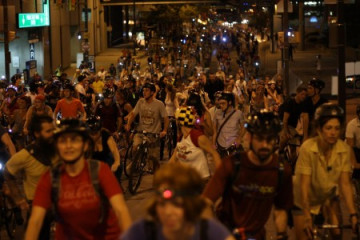
Baltimore Bike Party (Last Friday of every month)
…
https://comebackcity.us/2013/02/23/a-rustwirian-travel-guide-baltimore-in-a-few-days/
Designing Communities for Longevity: The Blue Zones Project
by Angie Schmitt, Streets Blog
Is your neighborhood designed to make people healthy or sick? With the right characteristics, the place where you live could add years to your life.
…
The team boiled down their research to nine principles for longevity and health. The number one principle? “Move Naturally.”
“The world’s longest-lived people don’t pump iron, run marathons or join gyms,” the researchers wrote. “Instead, they live in environments that constantly nudge them into moving without thinking about it.”
…
https://dc.streetsblog.org/2013/02/08/designing-communities-for-longevity-the-blue-zones-project/
**********************************************************************************************************
[B’ Spokes: Note that Maryland ranks 33 in terms of longevity (below average.) Ref: https://en.wikipedia.org/wiki/List_of_U.S._states_by_life_expectancy ]
10 Ways to Boost Your Immunity
By Laurel-Lea Shannon, Womens Cycling
1. Exercise but don’t overtrain
…
10. Laugh — a lot!
https://www.womenscycling.ca/blog/health-tips/10-ways-to-boost-your-immunity/
How to change car culture into one of respect

Complete Streets in the States: A Guide to Legislative Action
Every county needs this, not to mention it might be a good idea to review the states legislation as well. Though I’ll note there are issues I would tweak from my experiences with the Maryland. If I have the time and the encouragement I might do a critique but this is a good start.
https://www.smartgrowthamerica.org/documents/cs/resources/cs-aarp-statelegislationtoolkit.pdf
How highway expansion works in one simple picture

The Bike Helmet Paradox
[B’ Spokes: Is The Atlantic chiming in on our mandatory helmet bill? While they don’t come out and say it, it sure is timely on our issue. I’ll note the pro-helmet embedded video cracked me up, it basically says "I play a sport and I wear a helmet so you should too." Well all our bike clubs (those that do bicycling as a sport) require a helmet, so we have that covered. But then comes a (sport) car driver that wears a helmet and says you should wear one too. ROFLMAO our point exactly, helmets can make car drivers safer, so wear a helmet when you drive. 😉 ]
**********************************************************************
By James Hamblin, MD, is The Atlantic’s Health editor.
…
Cities like Washington, D.C., have great bike-share systems, where bicylces are everywhere for the taking. Decisions to hop on a bike are often impromptu. Who among us is never without a helmet? Or wants to carry one all day after a one-way ride — which is a common use of bike shares. Guilt, and safety concerns that surround helmet-less biking, make many in that situation choose to drive instead. Is that better?
…
On that note, imagine we had to wear helmets while jogging. We would be safer. The helmets would inevitably save some lives, even if only by deflecting an occasional errant meteorite. But if we started ticketing all un-helmeted joggers, or giving stern looks to people running without helmets, what would that do for public health on the whole?
…
Yes, there are studies that show that if you fall off a bicycle at a certain speed and hit your head, a helmet can reduce your risk of serious head injury. But such falls off bikes are rare — exceedingly so in mature urban cycling systems. On the other hand, many researchers say, if you force or pressure people to wear helmets, you discourage them from riding bicycles. That means more obesity, heart disease and diabetes. And — Catch-22 — a result is fewer ordinary cyclists on the road, which makes it harder to develop a safe bicycling network. The safest biking cities are places like Amsterdam and Copenhagen, where middle-aged commuters are mainstay riders and the fraction of adults in helmets is minuscule.
…
Manfred Neun, president of the European Cyclists Federation and outspoken helmet law detractor, made a similar point in The West Australian newspaper last spring, arguing that dedicated bike lanes and reducing car speeds in urban areas would do more to protect cyclists than helmets.
…
https://www.theatlantic.com/health/archive/2013/03/the-bike-helmet-paradox/273555/
