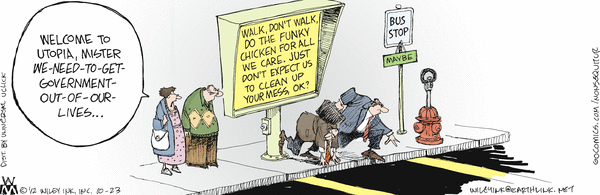
https://wpcomics.washingtonpost.com/client/wpc/nq/2012/10/23/

Biking in Baltimore
Cycle Maryland
The Maryland Department of Transportation, along with the State Highway Administration and the Motor Vehicle Administration will be holding a community meeting for the bicycle and pedestrian community on Monday, November 5th beginning at 4:30 PM in the Harry Hughes Suite of the Maryland Department of Transportation, 7201 Corporate Center Drive, Hanover, MD 21076.
This is designed to:
• Introduce Acting MDOT Secretary Darrell B. Mobley:
• Hear from MVA Administrator John Kuo and SHA Administrator Melinda Peters
• Present recent and planned initiatives designed to promote bicycle and pedestrian access and safety
• Receive feedback from the public on concerns regarding bicycling and walking in Maryland
Continue reading “A meeting for the bicycle and pedestrian community”
Using inmate work crews to save money and a $90,000 grant for signal light for a trail crossing… just a couple of highlights.
https://www.mdcoastdispatch.com/articles/2012/10/26/Top-Stories/Salisbury-State-Formalize-Bike-Path-Details
[B’ Spokes: America’s obsession with "safe crashing" has gotten so perverse. Just as cycling should NOT be just wear a helmet, end of story, driving a car should not be about "I need a safe car to protect me from all the other idiots out there." We need harder driver licence test and we need stricter traffic enforcement with zero tolerance of traffic fatalities. Death should not be acceptable just so people can go really fast on roads that are not freeways.]
****************************************************************************************
By eric, Eric Peters Autos
The government enacts laws – or issues regulatory fatwas – requiring that new cars comply with various “safety” standards. Ironically, the result of these standards – in terms of vehicle design and otherwise – may just be cars that are less safe to actually drive.
…
But reduced glass area means decreased visibility
,,,
it is very hard to see cross traffic coming at you from either side – making it much more dangerous to enter a busy intersection. Blind spots are larger, too
…
But that Band-Aid [back-up cameras] causes its own slew of problems, including limited peripheral view and a distorted view relative to what a functioning human eye connected to an operating human brain would otherwise perceive. It is much harder (if not impossible) to see a kid on a bike coming down the sidewalk into the path of the backing-up car – because the camera has a limited field of vision. It can’t “see” the kid until the kid is within its narrow field of vision. By which time, it is already too late.
…
Driving around on three normal-sized tires and one skinny minny often results in a very evil-handling (and braking) car. … But, your car got one-tenth of an MPG better gas mileage.
…
https://ericpetersautos.com/2012/10/24/how-safety-requirements-may-make-your-car-less-actually-safe/
[B’ Spokes: I’ll start off with this: The cheapest and best time to add bike lanes is when the street “goes dark” during resurfacing.
Yet a bikeway was not recognized by the State Highway Administration. That is to say during resurfacing SHA removed the bikable shoulder from one half of the roadway when they could for the same money center the new striping to accommodate cyclists on both sides of the road. The short version is SHA has a policy that they don’t have to think about cyclists when resurfacing (but at least we get the requirement to accommodate cyclists on new projects where practicable and feasible.)
My point here, just as cyclists led the Good Road Movement in the 1880’s that lead to the creation of paved roads, we need to put pressure to keep the roads in good repair by more frequent repaving. It’s not just that cyclists love a good smooth road (we do) but roads in poor condition can cause injuries and law suits.
A Mill Valley man who fell off his bicycle during a charity ride through Petaluma last August is suing the city and says that the poor condition of the road is directly responsible for his injuries.
…
Claims and lawsuits against the city for road conditions make up roughly 25 percent of all legal actions by residents, a number that increased by 70 percent between 2009 and 2010, according to Ron Blanquie, the city’s risk manager.
…
https://millvalley.patch.com/articles/mill-valley-man-sues-petaluma-after-bike-incident
And it’s not just cyclists Potholes, Poor Roads Cost Motorists $335 Per Year
And the most damning of all, not keeping the road in good repair wastes tax payer money, as the following article points out.
Conclusion: We need to demand a fix it first mentality when it comes to our roads and we need to demand that they reverse decades long of ignoring cyclists in ALL road projects. It just makes economic sense to think about accommodating cyclists during road resurfacing projects then the current SHA policy of non-requirement to think about cyclists when doing a resurfacing project.
(Note the following was found via Envision Baltimore, subscribe to their newsletter.)]
by Brad Plumer, Washington Post
…
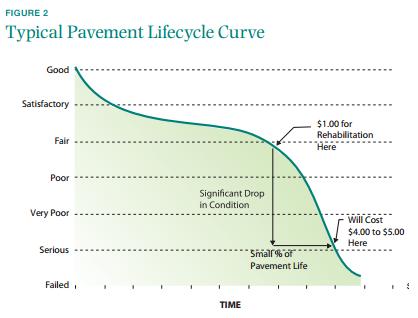
Among other things, there’s a solid economic case for making repairs a much higher priority. As Kahn and Levinson explain, road pavement tends to deteriorate slowly at first but then more quickly over time. It’s much, much cheaper to repair a road early on, when it’s still in “fair” condition, than when it drops down to “serious” condition. And that’s to say nothing of data suggesting that poor road conditions are a “significant factor” in one-third of all fatal crashes , and cause extra wear and tear on cars.
…
Continue reading “‘We don’t need to build more highways out in the suburbs’”
| Motorcycles | Motor Scooters | Mopeds | Bicycles | Motorized Minibikes, Pocket Bikes, etc | |
| Defined as Motor Vehicle? | Yes 11-135a | No 11-135b | No 11-135b | n/a | Yes 11-134.4 |
| Defining Characteristics | Motive power, seat or saddle, no more than 3 wheels, designed for speeds > 35 mph, is a type that must comply w/ all m/c Fed Motor Vehicle Safety Standards 11-136 | Seat, step-thru chassis, 2 wheels 1 wheel = 10” = 2.7hp or = 50cc auto transmission Excludes off-road vehicles 11-134.5 | 2 or 3 wheels Pedals drive rear wheels, 1 wheel >14” = 1.5hp or = 50cc See Bicycle 11-134.1 | Designed to be human powered 2 or 3 wheels, rear drive 1 > 14” 11-104 | 2 or 3 wheels not a motor scooter, moped, or farm tractor 11-134.4 |
| Titling Required? | Yes | Yes, Effective October 1, 2012 | Yes, Effective October 1, 2012 | No | No |
| Registration Required? | Yes | Titling Decal Required to be affixed to the rear of the vehicle | Titling Decal Required to be affixed to the rear of the vehicle | No, but locals can 25-102a8 | No See locals permits 25-102a 15 |
| Drv’s Lic Required? | Yes Class M | Drv License or Moped Oper Permit 16-101b | Drv License or Moped Oper Permit 16-101b | No | No |
| Helmet Required? | Yes 21-1306b | Yes, Effective October 1, 2012 | Yes, Effective October 1, 2012 | If < 16 yrs Also Locals 21-1207.1 | No |
| Passenger Allowed? | If designed, & has seat & foot rests, for passenger 21-1302 & 1305 | If designed, & has seat & foot rests, for pass 21-1203 | If designed, & has seat, for passngr 21-1203 | If designed, & has seat, for passenger 21-1203 | |
| Liability Insurance Required | Yes | Yes, operator must provide proof of insurance upon stop | Yes, operator must provide proof of insurance upon stop | No | No |
| Allowed on Public Roads? | Yes, except if =< 1.5hp or < 70cc prohibited from control access hwys & where SL > 50 mph 21-1303.1 | Not on expway, Not on roadway if SL > 50mph or a smooth shoulder or a bike lane, w/exceptions 21-1205.1 | Same as for Motor Scooters | Same as for Motor Scooters | No 13-401b |
| Road Position Requirements | Same as other MVs | Far right w/exceptions 21-1205 | Far right w/exceptions 21-1205 | Far right w/exceptions 21-1205 | Not permitted on roadway |
| Allowed on Sidewalks? | No 21-1103a | No 21-1103a | No 21-1103a | By local ordinance 21-1103b | No 21-1103a |
| Allowed on Paths & Trails? | No 8-409e | No 8-409e | No 8-409h | Yes 8-409e | No 8-409i |
| Vehicle Equipment | 21-1305 & Title 22 | 21-1207 | 21-1207 | 21-1207 | |
| Other | Operator must sit astride the cycle 21-1302d | Max speed 30 mph 21-1205.1c |
Continue reading “Selected Vehicle Characteristics, Requirements, and Restriction in Maryland Law”
University of Maryland has come close to winning the Sikorsky Prize, a $250,000 grant awarded to any group that can build a human-powered helicopter
Read the full story here: https://www.npr.org/2012/10/14/160670295/flight-club-human-powered-helicopter
By CHARLES MAROHN, Strong towns
After sixty years of the Suburban Experiment, we have a conditioned response to congestion on our streets: we add automobile capacity. We widen streets, add turning areas, remove parking and add additional lanes. Economists tell us that congestion costs us billions of dollars a year. What if that was backwards? What if congestion was the essential ingredient our cities needed to prosper?
…
We also intuitively understand the economic impact of fighting congestion. With each increase of automobile mobility, we see new investments occurring. Strips malls, big box stores and new housing subdivisions, all signs of progress made possible by increasing automobile mobility. Investment responds to the increase in mobility and coalesces where it can be put to most efficient use. This means the big box retailer is able to compete at a lower price than the corner hardware store. The chain grocer is able to offer a wider selection than the corner grocer. The national coffee shop is able to offer the brand recognition not available to ma and pa.
…
Need a gallon of milk? In an America of Strong Towns, you can get in your car and drive or — if the cost in terms of your time or quality of experience is worth more to you than you would choose to give up in dollar wealth — you can walk down the street to the corner grocer. Today that is considered quaint, but stop wasting enormous sums of money fighting congestion and now that becomes a real choice. Am I going to sit in my car for half an hour on clogged streets to save two dimes on milk or will I just walk up the block?
…
And please understand what I’m saying: We can actually spend lots less, have a government that is smaller and more effective and see a ton of local investment — stuff that will make a city wealthier and more prosperous over the long run — while providing small business opportunities and a growing, stable and diverse workforce. This is a vision for a New America, one much more closely tied to the best of our heritage than the current consumption-centric, faux incarnation of the American Dream.
https://www.strongtowns.org/journal/2012/10/23/embracing-congestion.html
Very tongue in cheek especially the "Mitt-style dog bike rack." but some nice picture of candidates on bikes:
https://www.bikemag.com/blog/dirty-words-election-2012-who-is-bikier%E2%80%9D/
