Baltimore County Pedestrian and Bicycle Access Plan Newsletter May 31, 2012

PLANNING BOARD ADOPTS WESTERN PLAN
__________________________________________________

The Baltimore County Planning Board unanimously approved the Western Baltimore County Pedestrian and Bicycle Access Plan on April 19, 2012. The plan has been transmitted to the Baltimore County Council for adoption as an amendment to the County master plan.

Planning office staff thanks the many people who took the time to attend the public hearing held earlier in April. The Planning Board made two changes based on the comments they received. The amendments revised the location of a recommended bicycle route in the Villa Nova community and a shared use path in the Woodlawn area.

The approved plan is available at www.baltimorecountymd.gov/westbikeped.

____________________________________________________

BIKE ROUTE/LANES PROPOSED ON EDMONDSON AVENUE
____________________________________________________

The Baltimore County Department of Planning has been awarded a Maryland Bikeways Grant to install bike lane striping and bike route signs along Edmondson Avenue in Catonsville. Together with the existing striping and signage west of Dutton Avenue, the new improvements will provide a continuous bike route from the No. 9 Trolley Trail to the Gwynns Falls Trail.

A citizen input meeting on the proposal will be held:

Wednesday, June 13, 2012 at 7 p.m.
Fellowship Hall, Christian Temple Church
5820 Edmondson Avenue
Catonsville MD 21228

If you have any questions, or would like more information, please contact Kathy Schlabach at kschlabach@baltimorecountymd.gov or 410-887-3521.

Is placemaking a "new environmentalism"?

[B’Spokes: I’ll note that in my opinion in successful place making you’ll see cyclists, they may not be central to the design but they will be present. My assertion is that a place needs to focus on accommodating people and when there is a balance between accommodating pedestrians and cars, cyclists fit in comfortably as well.]


from Kaid Benfield’s Blog

Can placemaking – in short, the building or strengthing of physical community fabric to create great human habitat – be a “new environmentalism”?  The question is posed by a provocative short essay, which I first discovered last summer.  Written by Ethan Kent of the Project for Public Spaces, the article has recently resurfaced, perhaps in honor of yesterday’s celebration of Earth Day.  The essay influenced my own writing last year (“The importance of place to sustainability”), and I’m returning to it today because the issues Ethan has raised continue to be important.

My answer, by the way, is a qualified yes:  creating the right kinds of places for people, particularly at the neighborhood scale, has indeed become a new approach to environmentalism and one to which I am deeply committed.  But I qualify my answer because placemaking is by no means the only important aspect of today’s environmentalism (not that Ethan suggested that).  In addition, I think the physcal building of community can become even stronger as an environmental tool by becoming somewhat more explicitly environmental in its content.  I’ll get into all that in a minute.

https://switchboard.nrdc.org/blogs/kbenfield/is_placemaking_a_new_environme.html

Like car drivers and passengers, cyclists deserve to be able to ride two abreast

[B’ Spokes: I touched on this topic previously: Father and son ride comfortably on Wabash buffered bike lane]


By: Peter Smith, googlemapsbikethere.org

Had that thought yet again (and it’s not a new argument) when I was trying to have a conversation with a friend this weekend in SF on my way to Sunday Streets. Every time I or my friend snuck up on the side of each other so we could actually have a discussion — or just point out something interesting — we got chased back into the bike lane by zooming motor vehicles. Being forced to single-file it everywhere can make biking a lonely experience — we deserve better.

Many of the harmful effects of loneliness are well-known, aside from the fact that being lonely just sucks. Depriving people of social contact is just one of the many ways we can effectively torture people. And we know that poor urban design can increase loneliness.

Being forced to ride single-file, and therefore being disallowed to communicate while we ride, is not torture, but it is a significant deterrent to biking when compared to driving and taking public motorized transit. If we care about putting more people on bikes, we need to advocate for the ability to ride two-abreast. And even if we don’t care about putting more people on bikes, we cyclists still deserve the right to ride two abreast, just like drivers and their passengers.

If I want to hang with a friend — all other things being equal — if I can’t talk to them while we’re moving about, I’m driving. That decision is simple. I want to be able to talk to my friends while we’re riding our bikes around. Cars do not deserve two to three times the asphalt just because they’re wider. If people are really dedicated to getting around by individual private motorized transport, they can go buy a Tango ‘single-file’ car:
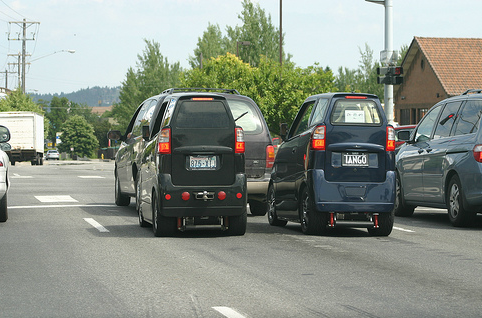
‘Single-file’ cars — not as space-wasteful

Drivers and their passengers don’t have to deal with this ‘single-file’ nonsense, why should we? And look where this single-file biking was being forced to happen – one side of the street even has two lanes for motor vehicles, so two sets of drivers/passengers can have a decent conversations with each other, while bikers are forced to ‘get in line’.
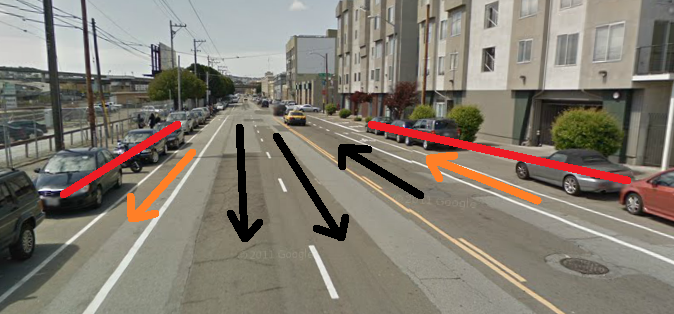
5 (fat) cars lanes, two (skinny) bike lanes

Shoot — even pedestrians on the sidewalk have to deal with this all the time – except most of the time it’s inanimate objects like traffic lights and parking signs and fire hydrants and trees and an assortment of other obstacles which force walkers to ‘single file it’ on the sidewalk time and again.
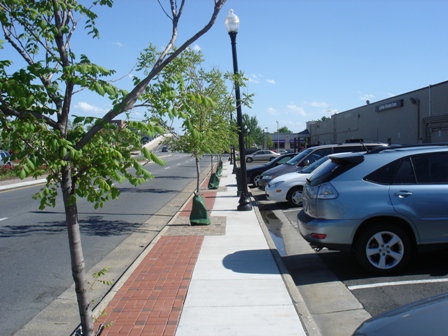
Pedestrian slalom course

The new Prospect Park West (PPW) street design in Brooklyn New York City is going to replace some unused, restricted road space — currently in line with a ‘parking row’ — with some pedestrian islands. The key benefit being touted is ‘increased pedestrian safety’. The islands probably will do that, if only slightly. If we were really concerned with pedestrian and biker safety, though, we’d two-way the street, and provide more room for people to bike.

Why would we want to allow cars to travel in the same direction, in separate travel lanes, while allowing bikers only single-file access?

And why would we want to continue to apportion the street 80/20 in favor of cars?

It doesn’t make any sense.

Maybe it’s not politically feasible at the moment to two-way PPW, but the proposal to fix this street fully and correctly should now be on the table, and that includes giving cyclists the ability to ride two-abreast. It goes without saying that walkers should be afforded this same luxury.

Here is the current PPW design:
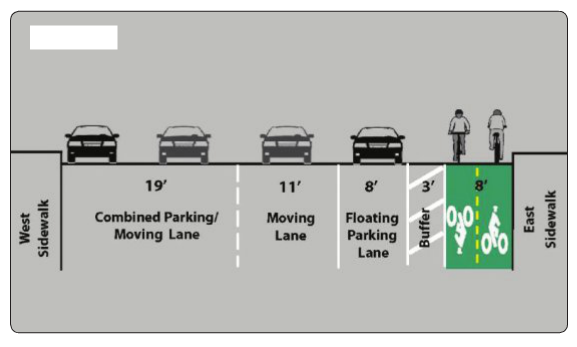
Cyclists not able to ride two-abreast

Here is the proposed design (not much different):
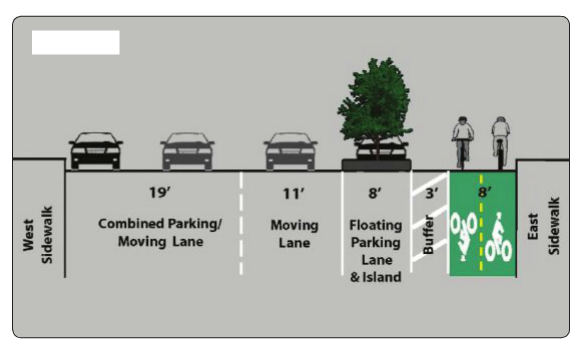
Nice trees, but bikers still cannot ride two abreast


This is closer to what it should look like — a two-way PPW:
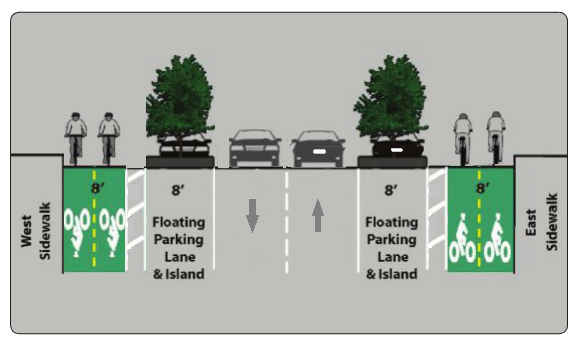
Now bikers can ride two abreast

And if we proceed apace we can imagine a time in the not-too-distant future when cars will no longer be tolerated. If any type of motorized mode of transport can be substantially shown to be in alignment with the goal of a Vision Zero policy, then we can consider allowing them to continue to be used among the population. That could be cars, trucks, trains, buses, NEVs, etc. The burden of proof of safety, of course, remains on those wanting to use these modes of transport.

Continue reading “Like car drivers and passengers, cyclists deserve to be able to ride two abreast”

Cities With the Most Highway Miles: a “Who’s Who” of Decay

by Angie Schmitt, Streets Blog

This is fascinating. Using data from the FHWA, the esteemed Patrick Kennedy at Network blog Walkable Dallas Fort Worth has cobbled together a list of the American cities with the highest number of estimated highway lane miles per capita.

See if you notice any similarities (this is per 1,000 people):

1. Kansas City – 1.262
2. St Louis – 1.070
3. Houston – .822
4. Cleveland – .816
5. Columbus – .779
6. San Antonio – .759
7. Jacksonville – .745
8. Providence – .742
9. Pittsburgh – .731
10. Baltimore – .724
11. DFW – .719

“It’s like a who’s who of decaying or soon to decay cities,” says Kennedy.

https://streetsblog.net/2012/04/20/cities-with-the-most-highway-miles-a-whos-who-of-decay/

The Bike Issue – City Papper

[B’ Spokes: A very nice article by Michael Byrne which I’ll highlight the conclusion. If it catches your interest follow the link for the whole article as it gives a nice overview of where we are and how we got here.]
************************************************************
By Michael Byrne, City Paper


Overall, we’re at the crucial tipping point in Baltimore where cars will have to start giving things up, starting with budget dollars, but also road space. City government caved pretty fast last year when drivers complained about a new bike lane on Monroe Street replacing a car traffic lane, giving back the car lane with nary a protest and giving cyclists the finger. The same might happen on Mount Royal Avenue too, with resistance to the loss of a car lane to bikes coming from the Maryland Institute College of Art. Bikemore, is already fighting that battle (see page 12). And those battles will get more heated in the future as more necessary bike improvements in the city present themselves as things that are not free. The challenge for cyclists is to return fire with the economic (and beyond) benefits of that give and take. That is, cyclists have to demonstrate how we can’t afford to not make those compromises. And then do it again and again and again.

https://citypaper.com/news/the-bike-issue-1.1301561

Culture of Fear [video]

[B’ Spokes: While the topic of this video is not something I focus on in this blog but it does get into relative risk at the 45:00 mark, which is something I have touched on in the past. I would love to see agents of the US stationed at fast food drive through to prevent unnecessary deaths or how about TSA pat downs before we get into our cars? Anyway I would love to see something like this done to show how the real risk of cycling is not any where near the perceived risk that society thinks it is.]


Transportation Officials Who Are Changing the Game

[B’ Spokes: Just to highlight one of the many great folks at Planning in Maryland.]


by Angie Schmitt, Streets Blog

Richard Hall

Secretary of Planning, State of Maryland

Richard Hall has led Maryland to the forefront of state-level smart growth planning. Photo: Flickr

Politically, you can’t give enough credit to Governor Martin O’Malley for Maryland’s new state-level smart growth plan, PlanMaryland. O’Malley stood up to rural opposition and muscled legislation through late last year to put in place what may be the most progressive state-level land use planning in the country.

But you also can’t separate the governor’s successes from the man behind the scenes, turning policy positions into reality: Richard Hall. With Hall’s help, for decades Maryland has been laying the groundwork to be a national leader in smart growth.

Hall started at Maryland’s Department of Planning in 1992. He worked his way from principal planner to director of land use planning to head of the agency, a title he has held for five years.

All the while he was helping move the state toward this moment. Hall’s work contributed to the state’s Smart Growth Act in 1997, which established “priority growth areas” for the state and set the stage for PlanMaryland.

Now, under Hall’s leadership, Maryland will decide which areas of the state will be prioritized for development. The process, by its nature, divides places into winners and losers and is sure to be a thorny undertaking, full of political hurdles. But the work of PlanMaryland has always been thorny.

Hall doesn’t shy away from facing the critics head on. “Some lawmakers contend they want to ‘save rural Maryland’ from PlanMaryland,” he said in a local forum recently. “But their aim seems to be to ‘pave rural Maryland.’”

Hall and O’Malley both recognize that for too long Maryland’s system was already dividing the state into winners and losers, as the interests of cities and existing communities were supplanted by unplanned, sprawling development. It will take strong leadership to change the dynamic. But these two are up to the task.

Continue reading “Transportation Officials Who Are Changing the Game”

Specialized Turbo electric bike launch [video]

[B’ Spokes: First, it’s a shame that this bike is illegal in the US but I think this is such a great idea, as we have hybrid gas/electric vehicles why not hybrid human power/electric vehicles? I love the concepts behind this bike, you still have to pedal and you can go fast with just moderate exertion. We need more transportation options especially ones that don’t burn gas.]


Trails in Maryland – Maryland Department of Natural Resources

Trails provide many economic benefits to local communities and create a wide
range of jobs, from B&B’s to bike shops. They also help tell the wonderful
stories of Maryland and its rich history. And hiking and bicycle trails are for
the whole family. They make us all healthier and happier while opening up the
natural world around us.

The Maryland Department of Natural Resources (DNR) is currently working
closely with the National Park Service, the Maryland Department of
Transportation, State Highway Administration, Department of Planning, Office of
Tourism, local governments, trail groups, and volunteer citizens on a wide
assortment of trails throughout the state.

Check out some of the cool trails we
are working on:

  • The Potomac Heritage National Scenic Trail (PHNST)

    DNR is partnering with the Potomac Heritage Trail Association and the National
    Park Service to evaluate an alignment for hiking between Point Lookout State
    Park and Marshall Hall, potentially connecting 11 DNR-managed lands, including
    Chapman’s Landing (Chapman State Park), Smallwood State Park, Chicamauxen WMA,
    Nanjemoy Natural Resource Management Area, Wilson Farm, Purse State Park, Chapel
    Point State Park (on Port Tobacco River), Cedar Point (1,737 acres), New Towne
    Neck (776 acres) and St. Inigoes (985 acres). A natural-surface, mostly off-road
    trail in the Potomac River corridor, if feasible, would be a significant part of
    a multi-use trail network between the Chesapeake Bay and two northern
    termini—Point State Park in Pittsburgh and the northern terminus of the Laurel
    Highlands Hiking Trail near Johnstown.

  • Garrett Trails

    Governor O’Malley has put $300,000 in his proposed budget for trail design
    and environmental upgrades on state lands in Garrett County. DNR recently
    finalized a Trail License Agreement with Garrett Trails in Western Maryland for
    the proposed Meadow Mountain section of the Eastern Continental Divide Loop
    Trail (ECDL), from I-68 to just south of Frank Brennerman Road.

    The ECDL will eventually connect to the Greater Allegheny Passage (GAP) in Meyersdale,
    Pennsylvania and run through Savage River State Forest, Deep Creek Lake,
    Oakland, Herrington Manor and Swallow Falls State Park, Friendsville, and then
    back into the GAP at Confluence, PA.

    The International Mountain Bike Association (IMBA) and the Mid-Atlantic Off Road Enthusiasts (MORE) are also assisting
    Garrett Trails in building sustainable mountain bike trails on The Wisp and
    closing rogue (illegal) trails throughout the county.

  • Western Maryland Rail Trail Phase IV

    The Maryland Department of Transportation and State Highway Administration
    have appropriated funds through the Transportation Enhancement Program to add
    another 4.7 miles to the 20-mile-long Western Rail Trail that is managed by DNR
    and currently runs from historic Ft. Frederick State Park, through the town of
    Hancock, and ending along the Potomac River at the forgotten canal town of
    Pearre. Over 135,000 visitors rode this very popular trail last year.

    The new trail extension will bypass the 106-year-old Indigo Tunnel located ten miles
    southwest of Hancock, MD within the Chesapeake and Ohio Canal National
    Historical Park. This abandoned railroad tunnel is one of the largest and still
    healthy hibernaculums, or roosts, in the state and is home to five species of
    bats including the Eastern Small-footed bat listed by Maryland as endangered and
    the Indiana bat on the federal endangered species list. In order to reduce any
    chance of introducing White Nose Syndrome which has decimated bat populations
    along the eastern seaboard, the trail will bypass the tunnel.

    The National Park
    Service is the lead on this project and is currently conducting an environmental
    assessment. The public is welcome to comment. For more information:

    https://www.journal-news.net/page/content.detail/id/578996/Trail-focus-of-meeting.html?nav=5006

  • The September 11th National Memorial Trail

    The September 11th National Memorial Trail is a planned 1,140-mile on-road
    and off-road trail connecting the three 9/11 memorial sites in New York City,
    the Pentagon, and Shanksville, Pa. The trail will be a tribute to all those that
    perished in America’s single worse terrorist attack and serve as a symbol of the
    resiliency and character of the communities in which the victims and their
    families lived and worked. The patriotic volunteers at the Memorial Trail
    Alliance are hoping to create a multi-use, hiking, biking, and driving
    pilgrimage that will officially be designated by the federal government as a
    national trail. The Maryland segment, running along the C&O Canal Trail, is
    already in place all the way to Cumberland and beyond.

  • W3R Trail

    The Washington-Rochambeau was designated a National Historic Trail in 2009,
    and follows the rambling route taken by General George Washington’s Continental
    Army and French soldiers led by General Jean-Baptiste de Rochambeau, starting in
    Newport, Rhode Island and ending in Yorktown, Virginia where British General
    Cornwallis surrendered. The Maryland segment of what is primarily a driving
    trail will include army encampments at Head of the Elk River, Lower Ferry,
    Bushtown, White Marsh, Baltimore, Annapolis, Scot’s House, Spurrier’s Tavern,
    Snowden’s Iron Works, Bladensburg, and Georgetown. There will be an official
    National Park Service website up and running in early 2012, followed by Facebook
    and Twitter presence, and a blog for highlighting events, stories, and
    interactive discussion.

Like the flowers of spring, all sorts of interesting and colorful trails are
popping up all over the state, from Chesapeake City up near the Delaware Line to
way down in St. Mary’s County at the mouth of the Potomac River, and the
Maryland Department of Natural Resources is proud to help provide new and
rewarding recreational opportunities for our citizens and visitors alike. So now
that winter is over and spring is back in town, enjoy a Maryland trail. It’s
guaranteed to make your day!


Continue reading “Trails in Maryland – Maryland Department of Natural Resources”