Abstract
This study examined the effects of a 1-year high-visibility pedestrian right-of-way enforcement program on yielding to pedestrians at uncontrolled crosswalks, some of which received enforcement and some of which did not. The program included four 2-week enforcement waves supported by education and engineering components that increased the visibility of enforcement. The study produced five results: (a) enforcement led to a slow and steady increase in the percentage of drivers yielding the right-of-way to pedestrians over the year; (b) the program produced a large change in yielding over the course of the year; (c) the program produced higher levels of yielding to natural pedestrian crossing than to staged crossings, and the changes in both were highly correlated; (d) the effects of the program generalized to crosswalks that were not targeted for pedestrian right-of-way enforcement; and (e) the amount of generalization to unenforced sites was inversely proportional to the distance from sites that received enforcement.
https://trb.metapress.com/content/4674380022131506/?p=fefc4e0168fd4b73a109ff63418aaa2a&pi=4
***************************************
[B’ Spokes: Just something I would love to see around here rather than harassing just pedestrians for wearing headphones (not illegal) and jaywalking (not necessarily illegal). You can NOT improve safety by addressing only one side of the problem.]
What went wrong with the traffic engineering profession?
by Steven, Cycle Space
The other night I tweeted: “Since the end of conscription, it has been the offices of traffic engineers causing the deaths“. A fellow blogger and cyclist, but from the civil engineering side of the fence, objected that engineers are just servants of politicians. As we all know politicians represent a public that wants to go faster in cars and are blithely accepting of the daily movement of ambulances attending the deaths of pedestrians, cyclists and indeed, many car users. But in this do engineers really have no volition?
I’m imagining how the medical profession would respond if politicians passed a law requiring them to deny treatment to certain kinds of patients.
…
https://cycle-space.com/what-went-wrong-with-the-traffic-engineering-profession/
Per capita VMT drops for ninth straight year; DOTs taking notice
By Chris McCahill, State Smart Transportation Initiative
Estimates released by FHWA on Friday suggest that per capita vehicle miles of travel dropped again in 2013, making it the ninth consecutive year of decline (Figure 1). Total VMT in the United States increased by 0.6 percent from 2012, hovering just below 3 trillion, and per capita VMT dropped to 9,402 (the prior year’s initial estimate was revised to 9,412).

Figure 1. VMT trends for the United States through 2013. Source: FHWA and Census Bureau.
…
Maryland is an example of this trend. In 2009, the state’s long-range plan projected statewide VMT growth of 2 percent per year through 2030 (Figure 2). The plan dismissed the recent decline as a temporary consequence of high fuel prices and the economic downturn, asserting, “there is no clear evidence that Marylanders will continue to drive less in the future.” However, in its updated plan released just last month, the agency has left out projections entirely, declaring that “a return to strong annual VMT growth is unlikely and per capita VMT […] is actually decreasing.” A handful of other states have either dampened their projections or shifted their focus toward VMT reduction goals and transportation demand management efforts.

Figure 2. VMT in Maryland and projected VMT from state long-range plans. Source: FHWA and Maryland Department of Transportation
…
https://www.ssti.us/2014/02/vmt-drops-ninth-year-dots-taking-notice/
BIKE MYTHS DEBUNKED
by Kristin Butcher, People for Bikes debunks these myths:
MYTH: Roads were created for cars.
MYTH: Riders are safest on the sidewalk.
MYTH: You can’t get a decent bike for less than a gazillion dollars.
MYTH: Bicyclists think they own the road.
MYTH: Bikes are just kids’ toys.
https://www.peopleforbikes.org/blog/entry/bike-myths-debunked
Why Are We Killing Our Children with Cars?
by Walker Angell, Streats MN
The good news is that the trend has indeed continued downward since the number killed peaked in 1972. Nationally, only 33,561 people were killed in 2012 and 2.36 million were injured.
This all sounds pretty good. Until we stop being insular and comparing ourselves to only ourselves.
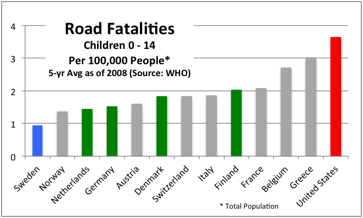
This chart shows the rate of children under 15 killed by motorists per year averaged over a 5 year period. Bars indicate the number of deaths per 100,000 total population for each country for each year.
…
https://streets.mn/2014/03/25/why-are-we-letting-drivers-kill-our-children/
No Crime, No Punishment
Why do dangerous drivers receive more protection from the law than their victims do?
By Bob Mionske, Bicycling
When a dangerous driver injures somebody, or takes another person’s life, we pretend that it’s somehow normal. We’re all so aware of our own driving mistakes that we do everything we can to avoid holding other drivers—even dangerous drivers—accountable when somebody dies. We call it “an accident.” We blame the victim. We worry about how the driver must have suffered. Our system of traffic justice is so broken that, for the victims of dangerous drivers, there is often no justice at all.
Instead, our legal system shields dangerous drivers from any real consequences. With the exception of DUI, motorists can get away with just about anything. Consider a few recent examples.
…
[B’ Spokes: Things he points out make my blood boil.]
https://blogs.bicycling.com/blogs/roadrights/2014/03/26/no-crime-no-punishment/
BWI Bike Rental
Opening weekend March 29-30. Now to cross our fingers for a clear day above 50 degrees. Spring hours are 9am-2pm, weekends only. Let’s get our move on!
$$ (10-30) · Bike Rental & Bike Share
2301 Dorsey Rd Suite 111, Glen Burnie, Maryland 21061
(443) 351-8009
State Senator Brian Frosh, a Democratic candidate for Attorney General of Maryland
[B’ Spokes: As usual with these kind of posts, I like people who bike. And in an effort to become the all powerful bike lobby I like sharing with you who I have met with and am impressed with. And I encourage you to get involved with your local politicians and if they are supportive of cycling let me know and I will try and promote them.]
Update
Dear Friends,
I would like to share with you an upcoming opportunity you don’t want to miss with State Senator Brian Frosh, chairman of the Senate Judicial Proceedings Committee and a Democratic candidate for Attorney General of Maryland.
This Sunday, March 30, the campaign will host a reception in Lutherville and you’re invited! Brian will discuss his legislative priorities and share why he is running to be the next Attorney General. Please join us for an afternoon of good conversation and refreshments and learn why so many Democratic leaders in our state are standing strong behind Brian’s campaign.
There is much work to be done and Brian can’t do it alone. Please join us March 30 to share your voice and get involved in our campaign. Details of the event are listed below. Please feel free to share this invitation with friends and family!
What: Meet & Greet with Brian Frosh, Democratic candidate for Maryland Attorney General hosted by Kathleen Birrane
Where: 501 Surrey Road Lutherville, Maryland 21093
When: Sunday, March 30 from 1:00 PM to 3:00 PM
RSVP NOW to Christa Burton at (847) 409-5889 or christa@brianfrosh.com
High-viz jackets don’t affect how close motorists pass cyclists
By Sam Dansie, Bike Radar
Whether you wear a big notice saying you’re a total cycling newbie, look like a Tour de France pro or just put on a straightforward high-viz jacket, the distance at which UK cars will overtake remains roughly the same: 117.5cm.
That’s the result of an academic study investigating what difference a cyclist’s clothing choice may have on how close motorists pass them when overtaking during peak rush hour.
It means, say the researchers, there is little cyclists can do with their wardrobe to influence motorists’ behaviour once they’ve been seen.
…
The only jacket that appeared to make a meaningful difference to the average passing distance was a jacket with the word ‘police’ written on it.
…
"It’s those close buzzes that make cycling feel unsafe," said Walker. "If it doesn’t feel safe people won’t do it."
…
https://www.bikeradar.com/commuting/news/article/high-viz-jackets-dont-affect-how-close-motorists-pass-cyclists-39136/
