
Seriously, does this say motorists slow down, motorists stop for pedestrians or simply pedestrians watch out for cars? Image from TBD, link after the fold.
Continue reading “StreetSmart safety campaign: ‘Graphic imagery’ says it best”

Biking in Baltimore
Seriously, does this say motorists slow down, motorists stop for pedestrians or simply pedestrians watch out for cars? Image from TBD, link after the fold.
Continue reading “StreetSmart safety campaign: ‘Graphic imagery’ says it best”
Q: What’s the definition of an angel?
A: A slow pedestrian.
Well that seems to be the case in Maryland the 2009 fatality data has been released and Maryland has moved up the ranking from #6 to #4 highest pedestrian fatality rate in the Nation.
Continue reading “Maryland now #4!”
By John Del Signore
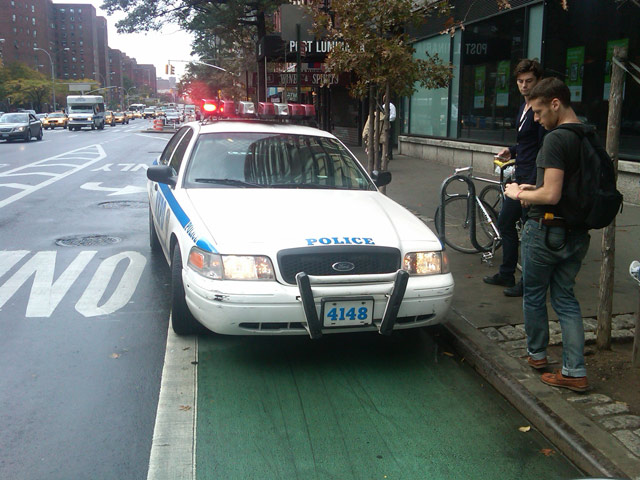
Sometimes the NYPD’s inanity is so perfect, so immaculately risible, that you just want to burst into applause and toss a bouquet of roses onto the hood of a squad car. Today is one of those days. According to a tipster, a cop parked in the bike lane on First Avenue near 23rd Street proceeded to write tickets for cyclists who weren’t using the bike lane, because they had to ride around him to get by. This is presumably part of the new crackdown on scofflaw cyclists, and hey—sometimes you have to destroy a bike lane in order to save it. (How come there’s never a clown cop around when you need one?)
…
Continue reading “Cop Blocks Bike Lane To Ticket Cyclists For Not Using Lane”
When the contractor who was supposed to install the traffic signal to makes things safer for pedestrains gets killed as a pedestrian.
Continue reading “You know things are bad when…”
This from the Bike Baltimore blog is interesting especially in light of some our our behind the scenes efforts for more on-road bike accommodations and better driver education.

Continue reading “What should be Baltimore’s top priority?”
In 1997 Vermont’s pedestrian fatality rate was 2.04 per 100,000 population and Maryland’s was 2.10 not a whole lot of difference. In 2008 (latest year) Vermont’s pedestrian fatality rate was 0.16! While Maryland made a modest improvement of 2.06.
If you look at the trends on FARS you see that other states are making progress while Maryland is basically staying the same. So Maryland’s ranking among the other states keeps going up to our current rank of the 6th highest pedestrian fatality rate.
I’ll see if I can dig up more info on this and thanks to one of our readers for bringing this to my attention.
Continue reading “Once upon a time in Vermont”
Patrick Maynard of the Baltimore Sun asks "I knew about this group, but it’s tough for me to say how much general-public exposure they really got. Were you familiar with them? Do you think the new name will help?"
And I’ll highlight a comment by Chuck "I think the group is great. im not a biker but i have friends who tell me about how rude and disrespectful drivers are to them when they bike around the city. So thumbs up to this group. I think work needs to happen on both the city level as well as driver eduction. The city is not very bike friendly. Plus Greg Cantori is a rock star in the nonprofit world. "
If you have any thoughts follow the link after the fold.

Copenhagen’s campaign run by the city’s public health office.
Continue reading “You’re safer on the bicycle than on the sofa!”
[B’ Spokes: Another great article by By Bob Mionske. While it focuses on the effectiveness of the bike box in Portland I’m going to pull out the bit about trucks turning right and the police bias in memory of Jack Yates, a Baltimore cyclists killed by a right turning truck that didn’t signal yet was not found at fault because "I didn’t see him."]
***************************************************************************
Three years ago this month, Portland, Oregon was rocked by a tragic death. On October 11, 2007, after taking a lunch break at her apartment, 19-year-old Tracey Sparling, a student at the Pacific Northwest College of Art, was riding her bike back to campus. A few blocks from the college, she stopped at a red light. She was in the bike lane. To her left, also stopped, was a cement truck. When the light changed, the truck driver, who was unaware that Sparling was in the bike lane next to his truck, turned right, his truck cutting an arc across the bike lane. Sparling was knocked from her bike and killed.
Portland’s cyclists were still grieving when, 11 days later, tragedy struck again. On October 22, Brett Jarolimek, a popular local racer and bike shop employee—and a talented artist who had graduated from the same art college Sparling had been attending—was riding downhill in the bike lane when he was passed by a garbage truck. At the bottom of the hill, the truck stopped, preparing to make a right turn. As Jarolimek approached the truck, the driver appeared to be yielding to him, but then, suddenly, the driver made his right turn, too late for Jarolimek to stop. Jarolimek, 31, was killed instantly. The truck driver, whose damaged mirror was held on with a bungee cord, never saw Jarolimek.
Portland’s cyclists were shocked by these deaths. But their grief was mixed with outrage at the response of the Portland Police Bureau, which seemed to be bending over backwards to absolve the drivers of any responsibility for these deaths. Yes, both drivers had not seen the cyclists before they turned into them, but under Oregon law, they were required to look before turning—and the police were refusing to issue citations to the drivers. Their reasoning: When the cement truck driver turned into Tracey Sparling, police determined that “there’s just no way he could have seen her,” because she had been stopped next to his truck, in his blind spot. That explanation didn’t quite address the question on everybody’s minds—“Why didn’t the driver look before turning?”—but police attempted to address that doubt when they declined to cite the garbage truck driver who turned into Brett Jarolimek. As police explained, “…yielding the right of way, and determining whether a traffic violation has occurred, comes down to a matter of perception. Basically, the driver has to perceive he has to yield the right of way.” However, if they thought that would calm the furor, they were wrong. They were also wrong on the law.
The problem lay in the traffic investigators’ interpretation of the law. In their view, if the driver did not intentionally violate right of way, or just didn’t bother to look, there was no violation. If the driver simply said the magic words “I didn’t see him,” the police would not cite the driver. However, there was no such intent requirement in the law, no such absolution for not bothering to look. If a cyclist (or a motorist) runs a stop sign, and says, “I didn’t see it,” the cyclist can still be ticketed; there is no requirement in the law that the cyclist had to have intended to violate the law. If a motorist (or a cyclist) is speeding, and says, “I didn’t see the speed limit sign,” the motorist can still be ticketed; the police don’t have to prove that the motorist intended to speed. Similarly, a citation for “failure to yield” does not require proof of an intent to break the law. It is the act, regardless of intent, that is prohibited.
But in the autumn of 2007, Portland police seemed determined to shift the blame away from the drivers involved. And then, almost unbelievably, it happened again—on November 6, another cyclist was right-hooked, at the exact same spot where Jarolimek had been killed just ten days before. The cyclist, Siobhan Doyle, was more fortunate; she survived the crash, although she sustained a broken arm and other serious injuries. And once again, Portland cyclists were outraged by the police response. Police refused to investigate the collision, because Doyle did not suffer trauma-level injuries—and because they refused to investigate, the driver was not cited. The Police claimed they did not have the manpower to investigate collisions resulting in non-trauma-level injuries. But when they refused to investigate the collision that resulted in Doyle’s injuries—despite eyewitness accounts that the motorist had been driving recklessly just prior to colliding with Doyle—they were not saying that policy prohibited them from investigating. Instead, they were just saying that they were choosing not to investigate—even though they were standing right there at the scene.
…
Continue reading “I didn’t see him”
Smart Growth Around America’s article really hit the spot IMHO and I quote:
If The Onion were covering last week’s TIGER 2 announcements, the headline would be: “DOT to replace the deteriorating Kittery-Portsmouth Memorial Bridge; other 70,997 bridges out of luck.”
Continue reading “Why I don’t cover TIGER grants”