Streetsies 2011: Who’s Naughty, Who’s Nice?

from Streetsblog Capitol Hill by Tanya Snyder

The laws of supply and demand went haywire this year, when it came to transit.

In 2011, the low economy and high gas prices helped showcase the need for affordable transportation options, and people flocked to transit – only to find troubled systems facing budget cuts, fare hikes, and service reductions.

The American Public Transportation Association reported a bump of nearly 86 million transit trips over the first six months of the year. Did Congress respond by thanking transit agencies for doing yeoman’s work to keep American households above water during a time of economic hardship? Not on your life! Congress kept flailing and bickering over a transportation bill that keeps slipping further and further out of reach while hardworking transit agencies withered on the vine. According to APTA, more than half of U.S. transit agencies have raised fares or reduced service in the past year, and many more are planning to do so soon.

Somehow, increased ridership didn’t translate into more robust funding or even a little begrudging respect.

Continue reading “Streetsies 2011: Who’s Naughty, Who’s Nice?”

A Car Named Haig

from an article by Ted Johnson

I nicknamed the car Haig, after Reagan’s Secretary of State.
(It was General Alexander Haig, old people will recall, who contributed to the “vital national interest” rationale for military action in order to protect America’s access to all the world’s yummy oil. …)
https://www.commutebybike.com/2011/12/28/a-car-named-haig-driving-seen-decreasingly-as-compulsory/
******************************************************************
And now my tangent:
[B’ Spokes: When I moved to NYC in the 80’s they had a diabolical scheme in "the vital city interest" to get me to leave my car at home and take mass transit. This scheme was simply to offer a discount on tokens purchased in bulk. And once you pre-purchased a bunch of rides you were likely to use them. So each morning I would look at my car and look at my mitt full of tokens and think "I really should use some of these up." and the car would stay home.
This is much the way the lure of a car works, you prepay for everything so you dissociate all those prepaid costs with the trip you are about to embark on as it’s already paid for.
But let’s imagine for a moment something different, a car where you pay just for the miles driven and nothing is prepaid beyond your current trip. So on your 18th birthday the state would deliver your free car to your door with a slot for dollar bills. If you want to go somewhere you simply put in a dollar per mile* for the trip you intend to take and off you go.
Under this scheme a trip to the local store just a mile away for a loaf of bread would cost you $2 (there and back.) We use a car for short trips because it is "so convenient" which doesn’t look so convenient under this scheme. Under our current scheme we prepay that $2 through, car payments, insurance payments, fill the tank payments and repair and maintenance payments and we then dissociate all those costs with this "simple" trip to the store done over and over through the life of the car. But non the less this is what we pay one way or the other for the convenience of using the automobile for everything under the sun for our own personal transport.
But more to the point I want to highlight is that policies around motoring in the United States could be simply put to keep the cost per mile driven as low as possible for each user. We spend trillions on wars just so we can have access to "cheep" oil but then talk about cutting social security to help pay for those wars so we can have cheep gas. On the state level we talk about cutting education, recreation and mass transit budgets to help pay for roads.
The result is we "need" more road capacity then we have the ability to pay for. We "need" more money spent for the benefit of personal auto travel then what we have the willingness to pay for. This alone should say volumes about our policies and the need to get the cost per mile traveled by personal automobile to reflect more accurately the true costs incurred by driving or reduce demand for auto travel to what we can afford.
Reducing demand will happen through high gas prices (eventually), congestion and traffic delays due to accidents are other factors that are already at play that will reduce demand proved that there is a choice of travel mode.
So it is becoming increasingly important that alternate transportation be given it’s fair share of due consideration.]
* The dollar per mile figure comes from here: https://commutesolutions.org/external/calc.html
Continue reading “A Car Named Haig”

Crosswalk carnage: Why do cops still ignore drivers who won’t yield?

Once again, Seattle Police seem to be targeting jaywalkers and ignoring crosswalk-charging drivers, while collision numbers climb.
By Eric Scigliano
… Another car wheeled off Denny onto Boren and straight in my path. I pivoted and waved madly, and it slammed to a stop a foot or two from my front wheel and 10 feet from the cop. As I reached the far curb, he rolled down his passenger window, leaned over, and told me, “You’re lucky.”
“Lucky?” I replied. “That was a crosswalk!”
“Yeah, he was completely at fault,” the officer said, and drove off before I could ask, “So why didn’t you bust him?”

The result: More than two-thirds of Seattleite pedestrians killed or fatally injured by vehicles were where they were supposed to be, in crosswalks or even on sidewalks. Just 3 to 4 percent of the people involved in collisions are pedestrians, but 36 percent of those killed or seriously injured are. By contrast, drivers are by definition involved in 100 percent of collisions but compose just 42 percent of the victims. Pardon my saying so, but what would Jesus drive? He’d walk, because then he’d have a chance to die for somebody else’s sins.

But Seattle’s police have reverted to their old ways — to that familiar 6:1 ratio. In 2010 they issued 1,570 jaywalking tickets, up from 1,274 in 2009, and just 197 failure-to-yield citations, down from 406.
If that approach reduced accidents, it would make more sense. But it didn’t. According to the Seattle Department of Transportation, the number of collisions with pedestrians rose 10 percent in 2010, to 529, even as the total number of collisions fell 11 percent, reflecting a decade-long pattern of decline. In 421 of those pedestrian collisions, the drivers failed to yield in crosswalks.

Recently, I flagged down another police car that came barreling at me as I crossed Rainier Avenue at night. “Don’t you know that’s a crosswalk, and the pedestrian has the right of way?” I asked.
“Yeah, but that doesn’t mean you have to be out in it!” that officer snarled, and roared away.
Continue reading “Crosswalk carnage: Why do cops still ignore drivers who won’t yield?”

Best of Blog: Do we really care about children?

Excepts from Strong Towns Blog by Charles Marohn

I had a city council member last week say that people did not want walkable neighborhoods because they were afraid of child abductions, that people prefer the "safety" of their cars. Sad to say, but I think he is right, despite being completely ignorant of the facts. In a single year, the U.S. has around 7,000 children die in auto accidents (many, many more injured severely) but only around 100 children kidnapped.
We love our cars but, like all one-way relationships, our obsession has made us completely irrational.

After perinatal conditions, which are problems that occur near or in the immediate months after childbirth, the leading cause of death amongst children ages 0 to 19 is auto accidents. For accidental causes of mortality, there is no close second. Even drowning, which we are militant about here in terms of baths, pools and time at the lake, is just a fraction of auto accidents. Imagine two 9/11 attacks each year that killed just kids and you still would not have the number of child fatalities America has each year from auto accidents.

… but what I am doing putting them in a car so often?
The answer is that I am an American, so I drive everywhere. In my town I really don’t have an alternative. Even the people who live in the traditional neighborhoods have to drive out to the edge of town to get groceries (don’t worry, the city has spent millions making that trip fast and easy). But is this really acceptable?
If we are serious about wanting what is best for kids, shouldn’t we be doing everything we can to reduce the number of auto trips people are required to take each day?

The best thing we can do for the safety of our children is to get them out of the car by building mixed-use, walkable neighborhoods.

Continue reading “Best of Blog: Do we really care about children?”

Fixing suburbs with green streets that accommodate everyone

from NRDC

We’ve made such a mess of the suburbs we constructed in the last fifty or so years that one wonders whether they can ever be made into something more sustainable.  Strip malls, traffic jams, cookie-cutter subdivisions, diminished nature, almost no sense of outdoor community.  We all know the drill: there are nice places to be in America’s recently built suburbs, but we have to know where they are and drive to them through a visual and environmental mess to get there.

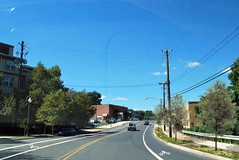
One of the most challenging aspects of suburbs, and of the prescriptions for improving them, is the character of their roadways.  Most of us take the poor design of our streets – the most visible part of most suburban communities, if you think about it – so much for granted that it never occurs to us that they actually could be made better for the community and for the environment.  Consider, for example, main “arterial” streets so wide that pedestrians can’t cross them, even if there is a reason to; little if any greenery to absorb water, heat, or provide a calming influence; or residential streets with no sidewalks.

This is where Montgomery County, Maryland’s new streetscape initiative comes in….

Here’s how the county’s web site describes the initiative:
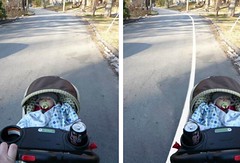
striping signals a pedestrian zone to drivers (courtesy of SvR Design)“Streetscapes and public rights-of-way are valuable real estate, although people often forget they are not just about moving motor vehicles. They are also the front doors to homes, schools and businesses. As Montgomery County urbanizes and its spaces become more constrained, planners are re-considering how to create more value from our streetscapes.

“The Planning Department conducted a year-long project on environmental site design (ESD) focused on street edges. ESD integrates site design, natural hydrology, and other controls to capture and treat runoff.

“In addition to collecting drainage and wastewater, roadsides accommodate utilities, as well as provide space for pedestrians and off-road bicyclists, but trees and natural vegetation have often taken a back seat to other uses.

“This project has resulted in plans for retrofitting road sections in suburban and urban areas to better handle stormwater and improve the environment for pedestrians and cyclists in addition to motorists. Planners are working with County agencies and the County Council to establish policies to encourage ESD practices along county roads.”
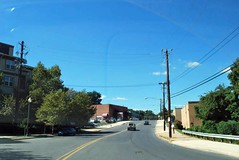
  completing a street: before (courtesy of SvR Design)  completing a street: after (courtesy of SvR Design)

  an unpleasant walking environment (courtesy of SvR Design)  improved with wider sidewalk, street trees (courtesy of SvR Design)


Continue reading “Fixing suburbs with green streets that accommodate everyone”

TEN Webinar: Launching 2012 Transit = Jobs Campaign


TEN Webinar: Launching 2012 Transit = Jobs Campaign

Thursday, January 12th , at 3pm CT, TEN will offer a free webinar introducing TEN’s 2012 Transit = Jobs Campaign. January’s webinar will cover our 2012 strategy for creating jobs, getting people to work, and fighting voter suppression.
Our webinars are aimed at community leaders, activists, advocacy organizations, and anyone who wants to learn more about organizing for transportation equity.
Our greatest strength is our solidarity – join the fight for transit, jobs, and voting rights in 2012.
Join us Thursday, January 12th to learn about our 2012 Transit = Jobs Campaign.
Title: TEN in 2012: The Transit = Jobs Campaign
Date/Time: Thursday, January 12th, 2012, 3:00 p.m. CT (1 hour)
Panelists: Representatives from TEN and Key Congressional Offices
Transportation Equity Network
4501 Westminster Place, 3rd Floor
St. Louis, MO 63108

National Center for Safe Routes to School Announces 26 Spring 2012 Mini-grant Recipients

**To view this announcement on our [their] website, visit www.saferoutesinfo.org/about-us/newsroom/spring-2012-mini-grants.
(CHAPEL HILL, N.C.) December 21, 2011 — The National Center for Safe Routes to School announced today the selection of its newest mini-grant recipients — a program made possible through the federal Safe Routes to School program. Twenty-six schools, municipalities and organizations from across the country will receive $1,000 to support projects designed to encourage students and their families to safely walk and bicycle to school. The mini-grant activities, many of which are driven by students, will occur during the spring semester of the 2011-2012 school year.

MARYLAND
–Rodgers Forge Community, Inc. (Baltimore, Md.) will work with Rodgers Forge Elementary School to produce and distribute educational materials that encourage parents to allow their children to participate in walking school buses, to volunteer in walking school buses, and to organize "bike trains" for parents and children in the spring. These education and encouragement materials will also target increases in driver awareness, such as the need for drivers to look both ways for pedestrians and cyclists who may be coming from an opposite direction. Lawn signs will be posted at key locations throughout the community to enhance driver awareness and promote caution for children walking and biking to school. A new bike rack will also be installed in order to accommodate a recent increased demand for bicycle storage.