
What Cyclists Need to Know about Trucks

By Keri, Commute Orlando
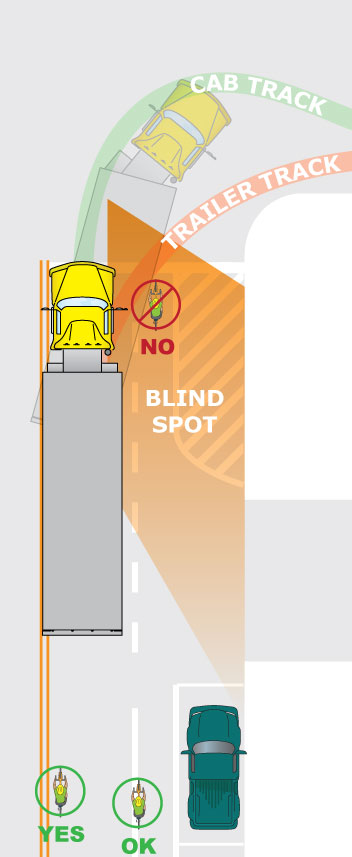
Trucks have huge blind spots. Truck drivers cannot see little things in their huge blind spots. Large vehicles off-track when turning, so they will appear to be going striaght and often swing wide before making a right turn.

Trucks have huge blind spots. Truck drivers cannot see little things in their huge blind spots. Large vehicles off-track when turning, so they will appear to be going straight and often swing wide before making a right turn.

Cyclists hit by turning trucks is a repeating news story which highlights the most serious deficiency in our system — education of cyclists. Sometimes these crashes are caused by the truck driver passing a cyclist prior to turning right, but very often they are caused by the cyclist passing the truck on the right. In both cases, the cyclist has the power to avoid the crash.

Here’s how YOU can keep this from happening to you:

  • Do not stop at an intersection on the right side of a truck. If you have already stopped in a bike lane and a big rig pulls up next to you, don’t assume the driver has seen you. Get off your bike and move it to safety (your life is worth the inconvenience). It’s better to stop in the middle of the general traffic lane if you arrive first. (In many cases it’s safer to stop in the line of traffic than to pass the queue.)
  • Do not linger next to a truck on any side, in any lane. If you are riding near the same speed, slow until you are behind the truck. (This is taught to motorcyclists, it applies to all vehicle drivers, even car drivers!)
  • If a truck passes you, slow down and let it get ahead of you ASAP. If you are approaching an intersection, merge to the left and ride near the center line to avoid the moving blind spot (see Left Cross in the Blind Spot).
  • If you are in a bike lane and passing stopped traffic, do not pass a truck unless you can be clear of it before approaching any intersections or driveways and before traffic begins moving again. (This is a case where bike lanes offer a false sense of security that can get a cyclist killed.)
  • Or, just don’t pass a truck on the right at all. And be cautious when passing on the left, too.

Trucks make wide turns. They cannot physically make a right turn from the right curb, so they will often leave a large, inviting opening on their right prior to a turn. They will also move straight into the intersection before starting to turn. When a truck turns right across your path, it is almost impossible to escape its rear wheels. So don’t get caught in a spot where this can happen! Be aware of what kind of situation can lead to a potential crash and avoid it.

Here’s an example of how blind-spot awareness saved my life last year.

An expanded view of blind spots. Illustration from AAA Driving Survival.

A plan view of all blind spots (the rear no-zone is expanded for highway-speed following distance). From AAA Driving Survival.

I was riding North on Magnolia through downtown. I was in the bike lane. Approaching Concord, I saw a slow-moving truck in the right traffic lane. I slowed and hung back. We continued to Colonial, where the light was red. The bike lane is properly-striped to the left of the right-turn-only lane, so it would be correct for me to ride in it to the intersection. But the truck was in the right thru-lane and I don’t ride next to trucks. I decided to pull into the thru-lane behind it. Just as the truck reached the Colonial intersection, the light turned green. The truck driver turned on his right turn signal and turned right — across the bike lane and the right-turn-only lane. Yes, he made an illegal turn. He probably checked his mirror for cars in the turn lane, but he would not have seen me. He never did see me, I nonchalantly passed him on the left and went on my way. But it was not lost on me what would have happened had I made a different decision. And I wondered how many other cyclists would have made the same decision.

Acute awareness of vehicle blind spots was taught to me in motorcycle safety school. Perhaps if bicycle advocates and the bike industry put as much emphasis on education as the motorcycle industry does, I wouldn’t keep seeing articles like the following:

Here are 2 crashes from this month. Both of these cyclists were very fortunate to survive.

11/25/08 Elderly bicyclist injured in crash with big rig

[The cyclist] and the big rig were both stopped in the street waiting for a train to pass prior to the crash. Once the train passed, the big rig made a right turn from Lemon Avenue onto a side street, striking the still stationary bicyclist.

Note: the satellite view shows what appears to be a wide curb lane. Wide curb lanes allow cyclists to ride on the right of traffic, but cyclists should still be cautious about passing stopped traffic. If you suddenly find yourself in a situation where traffic is stopped and you are next to a big rig. Get off your bike and get off the road.

11/18/08 Cyclist Down: Fillmore and Fulton

The cyclist’s description: “I was cruising down Fulton eastbound and saw the truck ahead of me. I sped up a bit so I’d stay within range of his rearview mirrors. If I were too far back, the box part of the truck would block me. We approached the intersection and I was keeping an eye on his turn signal because I was passing the cars. I was going about 20 and there was no turn signal. As I came towards the intersection, I saw he was turning and hit the brakes. I skidded into the side of the truck and he kept turning, which pulled me under.”

Note: Fulton street has downhill bike lanes which are dangerous because cyclists can travel at motoring speeds. Any time you are traveling at downhill speed, you should be in the traffic lane. You need way more room to maneuver than a bike lane provides. If you are traveling faster than traffic, it is safer to pull into the traffic lane and slow to the speed of that traffic than to fly past it on the right. This allows you to easily pass right-turning vehicles on the left, instead of being hit by them as they cross your path.

Here are 4 more that have happened in the last 14 months. These cyclists were not so lucky. (All of these crashes involved cyclists in bike lanes.)

Cyclist, 22, Dies After Being Hit by Truck Near Dupont Circle

Cyclist killed in crash well known in Portland

Full cement truck drives over and kills cyclist ‘in an instant’

Bicyclist killed in dump truck crash identified

John Allen lists a bunch more in this article about mindless passing on the right (and how bad bike facilities encourage it while we educators are trying to discourage it).

When you know how to be safe around trucks, it won’t happen to you!

UPDATE:

Here is a video for cyclists by the Portland Water Bureau.

I also found this video from the trucking industry. This is aimed at motorists and highway driving, but it has some good blind spot images in it.
Continue reading “What Cyclists Need to Know about Trucks”

Testimony on Transportation Infrastructure

[B’ Spokes: I can’t help but comment on our 32 minute average commute time, is our life really going to be so much better when that drops by 5 minutes to be more in line with everyone else? Granted people want more infrastructure then what we can afford and that is a problem but I have to ask when will our infrastructure https://www-fars.nhtsa.dot.gov/States/StatesPedestrians.asp”>stop killing so many pedestrians?

I’m personally sick that the State is too cheep to even paint decent crosswalks (most of the time) let alone take steps to ensure the safety of vulnerable road users. Will more money help with this? I can only hope.]


March 14th, 2012

Here’s a PDF version of the speech.

Thank you very much for the opportunity to testify today.

As we consider the urgent question of transportation funding, let me begin with three facts about our shared reality:

  • Fact #1: As a State, we now have the longest average daily commute in America,… Longer than New York.  Longer than New Jersey.  Longer than Illinois.  Longer than California1.
  • Fact #2: These ever growing congestion costs are the direct result of an ever declining revenue source – a flat, fixed rate per gallon tax.  Meanwhile, the real purchasing power of the gas tax has declined by 80% since 1992.  And it now costs more to paint the Bay Bridge than it did to build the first span2.
  • Fact #3: Even if we were to apply the 6% sales tax to a gallon of gasoline, Marylanders will be paying a smaller portion of their gas bill to taxes now than we were in 19923.

We  Pay for That Too,…

Progress is a choice;  job creation is a choice; allowing worsening congestion to rob of us of ever greater amounts of our time and of our money and of our productivity,… this too is a choice.  We make our own future, we govern ourselves; and to govern is to choose.

A couple of days ago, I was talking to a businessman from Southern Maryland who was in Annapolis for Leadership Maryland, and he said to me: “Governor, let me just say: I’m against all taxes,…but we pay for that too.”

Indeed we do,…  We pay for that too.

None of us wants to pay more at the pump.  We do not have to do this.  But, you here know, that if we don’t,… we will pay for that too.  Inaction has a cost.

We don’t have to widen 301,… but if we do not, inaction has a cost, and we’ll pay for that too.

We don’t have to move forward on congestion relief at Indian Head Highway,… but if we do not, we’ll pay for that too.

We don’t have to rebuild the Dover Bridge,… but if we do not, we’ll pay for that too.

We don’t have to do the Corridor Cities Transit Way, the Red or Purple lines… we don’t have to repair the bridges that feed the Port of Baltimore,… but if we do not, inaction has a cost and we’ll pay for that too.

Roads do not upgrade or maintain themselves.  Bridges do not repair themselves or rebuild themselves. Minneapolis, Kentucky, Ohio are not the only places where bridges crumble as they get older.  Our transportation infrastructure here in Maryland does not grow broader or stronger with age.

The Ever-Increasing Cost of Doing Nothing

No one has wanted to address this problem for twenty years, and every year therefore our people are paying an increasing cost for this inaction,…and in so many different ways.

As the Baltimore Sun editorialized: “Higher prices at the pump may be unwanted, but a deteriorating transportation system is costly, too. Not only in mere congestion but also in lost economic opportunity.”

It is the cost of time lost sitting in traffic when we should be at home with our families. It is the cost of gasoline and money lost idling in bumper to bumper beltway traffic that looks a lot more like a parking lot than it does like a highway,… in  at rush-hour and at non-rush-hour as well.  It is the cost of lost productivity at work,…

… It is the ever increasing cost of  damage to our air and environment.  It is the cost we incur to our very quality of life,… all of which effects our economic competitiveness as a people and as a State; that is, our ability to attract and retain more and better jobs for ourselves and our children.

How Much Less Would Be Good for Maryland?

As we search for common ground and a way forward, as we look for the good intentions of one another, let’s ask ourselves, if doing less will address this problem?

Let’s ask ourselves if getting along with less will help us avoid these ever escalating costs?

With our increased population, how many fewer highway lane miles do we need? How many fewer MARC trains?  How many fewer Metro lines do we need; how many can we shut down?  How many fewer jobs do we need?  How many of those 106 structurally deficient bridges do we no longer need; how many of them can we shut down?  How many fewer hours do we need with our families, or at work?

Everything has a cost.  There is no way to construct a $100 million bridge for $10 million.  There is no way to buy a 2012 model hybrid car for 1991 prices.

We cannot maintain, or build out, a 21st century transportation system for a population our size with a level of investment that was fixed 20 years ago.

Yes we are all against taxes,…but we pay for that too; and in this case, doing less will actually cost us more.

Our  Proposal

Through the years, there have been many recommendations on funding options. Most have gathered more dust than support.

Our proposal would phase in —  at no more than 2% a year over the course of the next several years — the current State sales tax of 6%.

Our proposal protects consumers with a braking mechanism should the price of gas spike beyond 15% in any given year.

It protects new revenues from being used for priorities other than their intended transportation purpose.

It helps our county and municipal governments by restoring some of the funding lost when State grant programs were cut in the final budgets of  the recession.

It protects the health and safety of every citizen in Maryland not only through more structurally safe bridges and roads, but also with an investment in the Maryland Emergency Systems Operations Fund,…

Finally, it  puts 7,500 moms and dads back to work (mostly) in our hard hit construction trades – building needed roads, and public transit throughout our State.  And it paves the way for future job creation, economic growth and opportunity in  Maryland that is smart, green, and growing.

Less traffic, better transit, and an upgraded infrastructure and a better quality of life make a big difference for our top priority of retaining, attracting and growing jobs in Maryland; it makes a big difference in terms of the expanded opportunities we are able to give our children

The bill you consider will create jobs and improve the conditions that allow businesses to create and save jobs; it will allow us to better protect the public’s safety on highways and bridges; and, it will allow us to grow our economy, create better jobs, and expand opportunity to greater numbers of our people.

Forward or Back?

In conclusion,.. to create jobs, a modern economy requires modern investments; investments that we can only make together;  investments by all of us for the benefit of all of us.  That’s not a Democratic or a Republican idea; it’s an economic and historic truth. It was true for our parents, it was true for our grandparents, and it is a truth that has built our State and has built our country.

Progress is a choice.

None of us want to look back someday – as bridges start collapsing and closing in our own State – and tell our kids that we could have done something, but we chose not to,… we chose instead to simply kick the can down the road.

Yes, we’re all against taxes,… but we pay for that too.

Given the shared realities we face, the cost of inaction is greater than the cost of action,…

So let us move forward.

For greater jobs and greater opportunities, for a better quality of life for Maryland, the choice is ours.

________________________________

1 According to the U.S. Census Bureau, Marylanders have an average daily commute of almost 32 minutes, passing New York and
New Jersey for the longest average daily commute nationally in 2011.

Estimates based on the highway and street construction specific portion of the Producer Pricing Index (PPI) project an approximate 80 percent decline in the purchasing power of motor fuel revenue from 1993-2015.

3 State and federal taxes would amount to 17 percent of the per gallon cost of fuel should the sales tax be applied to gasoline
purchases, below the effective motor fuel tax rate at the time of the last transportation revenue increase in 1992.

Continue reading “Testimony on Transportation Infrastructure”

Goodbye-ways: The downfall of urban freeways

By Greg Hanscom, Grist

“Cities are not removing all highways because of a sudden awakening of environmental consciousness or realization that car culture is bad,” the report says. Instead, they’re doing it because they can’t afford to keep aging freeways from crumbling, and they’re realizing that the space these roads take up is a hell of a lot more valuable, both socially and economically, when it’s used for houses, businesses, and parks. And then there’s the raft of studies showing that freeways don’t relieve traffic congestion — they actually make it worse.

https://grist.org/cities/goodbye-ways-the-downfall-of-urban-freeways/

Grand Prix won’t fully pay its way; Pratt joins Young in opposing race

The city will foot about $500,000 for police, fire and other overtime pay for the upcoming Grand Prix.

https://www.baltimorebrew.com/2012/02/22/grand-prix-wont-fully-pay-its-way-pratt-joins-young-in-opposing-race/
******************************************************************************************************************************
B’ Spokes: I just wanted to note a major obstacle in getting Baltimore’s Sunday Streets programming going is the amount of money the city charges for over time police while they give the same service free for an event for people that don’t live here, that does not seem right to me. I read about city closing pools and rec centers, certainly indicators that the quality of city life for residents is on the decline yet the vibe from City Hall is let’s focus on tourism, again, this does not seem right.

The other thing I want to mention for our Sunday Streets the City insists that there is a police officer at every little street and that the event organizers pay time and half for someone to pick up the slack the barricades might miss, just in case (you might read that as having to pay top dollar for someone to do (next) nothing.) We need the option of just barricades and signs where appropriate, volunteers with reflect vests where appropriate and finally police officers just where needed. And please let’s start charging the criminals time and half for their use of the police force and work to remove unnecessary financial barriers for wholesome events that benefit the city residents.

Two Wheels, Two Words…True That!

by marla, Bike Maryland

Two wheels will always keep you rolling.  But when they fail to be true, two words can really make up the difference.

During a recent kids bike safety rodeo at Patterson Park Rec Center, things were not rolling perfectly.  We had more than 60 kids show up at our after school bike rodeo, a free event hosted by Bike Maryland.  But the bikes were an hour late, and the kids were restless!

Katie and I did try to entertain the group as much as possible, being the good Bike MINDED coordinators that we are.  But try explaining how to strap on your helmet safely, how to check the A, B, C’s of your bike, and how to ride safely following the rules of the road when the entire audience just want to ride.  That video we presented of the guy wearing his helmet backwards did little to draw a chuckle from the group.

But finally, when the windowless room’s humidity reached indoor swimming pool thickness, we heard the truck and trailer pull up out back.  YES!

The bikes arrived!  Some of the kids rushed outside to help us unload, and it was two-wheeled game on.

Chaos aside, rodeo course cones managed to get set up on the indoor basketball court, including the little stop sign.  Tires pumped, helmets correctly strapped, and selected rides were straddled.

One last-second rush trip to the trailer outside to lock things up, and I noticed the key had broken off inside the padlock.  Geez!
Then I heard the two little words:  “Thank you”. 

I turned around a saw a little boy around 8 years old standing alone on the sidewalk.  He said the two words again, but louder and added, “My mama told me to always say that.”

I just smiled and thought, two wheels may keep you rolling, but when all else fails, those two words really keep you going!

Continue reading “Two Wheels, Two Words…True That!”

Bike Lanes: The New Job Creators?

by Mark Plotz, from Pro Walk / Pro Bike® 2012 Newsletter Issue 5

Govern + Invest is a theme that will be explored at Pro Walk/Pro Bike® 2012: Pro Place. A question that will be examined is how bicycling and walking investments can add value to a community by creating economic activity, creating jobs, and improving quality of life.

Already we know that when it comes to jobs created per million dollars, bicycle facilities are one of the most efficient transportation investments. But once the paint dries and the asphalt cools, are there lasting economic effects? Can bicycle infrastructure build bicycle culture that will build a bicycle economy?

The answer seems to be yes-at least in the case of Long Beach. More than 20 new bicycle-related or bicycle-inspired businesses have opened at last count. I toured some of these business with Charlie Gandy and Melissa Balmer, during a recent trip to Long Beach, to meet these entrepreneurs, and prospect for locally-sourced goods and services for our conference. Twenty new businesses is a lot, especially in this economy, so you may be skeptical of these numbers (I
was); but after meeting some impressive young people, I can assure you that it’s all real.

Pedestrian-Involved Collision Rates and Bicyclist and Pedestrian Demand at Multi-Lane Roundabouts

B’ Spokes: In this study "Identifying Factors that Determine Bicyclist and Pedestrian-Involved Collision Rates and Bicyclist and Pedestrian Demand at Multi-Lane Roundabouts" by UC Berkeley Safe Transportation Research & Education Center I’ll highlight this point:
"• European studies have shown that pedestrian and bicyclist crashes account for only 1 percent of the total crashes at roundabouts. By contrast, bicyclist and pedestrian crashes in the case study roundabouts accounted for a much larger percentage of total crashes (12 percent at Santa Barbara, 55 percent at East Lansing). This suggests that European roundabout design, bicycle and pedestrian facility design, or driving, walking and biking behavior may have a role in reducing the number of bike and pedestrian collisions."
So now I have to ask once again why is Baltimore doing one of these at Key Highway and Light Street? For pedestrian safety? (Ref: https://www.baltimorespokes.org/article.php?story=20120125151838526 )
The whole report: https://www.altaplanning.com/App_Content/files/pres_stud_docs/Multi-Lane-Roundabout-demand-collison.pdf

Complete Streets and Bicycle and Pedestrian Facilities Design Training through NHI

Across the country, states, cities, counties and  local agencies are adopting policies that require pedestrian and bicycle facilities on roadways. Design knowledge is critical to implementing these policies, particularly in settings of constrained rights-of-way and budgets.    
Sprinkle Consulting staff teach  these courses to DOT and local agency staff around the nation. Please click on the link for more information. Bicycle and pedestrian facility design workshops.
 
Click here to go to the NHI website and schedule a course for your agency.