
By DAVE McMILLION, Herald-mail
WILLIAMSPORT — Tom Perry has packed nature, faith and music into his 77 years.
Perry and his wife, Linda, are trained to remove an invasive plant along the Chesapeake & Ohio Canal known as garlic mustard, and he volunteers to take church groups and others on guided bicycle rides on the towpath.
…
He has been described as “the key person” who made the restoration of the Big Slackwater section of the Chesapeake & Ohio Canal National Historical Park a reality, and he was honored for his efforts recently during a ceremony hosted by the Berkeley County, W.Va., Chapter of the Izaak Walton League of America.
…
The Big Slackwater section of the C&O Canal was closed after flooding along the Potomac River in 1996. That 2.7-mile section was closed for about 10 years, and was the only broken link in the popular hiking and biking path, which stretches 184.5 miles from Cumberland, Md., to Washington, D.C.
Not only did Perry believe it was important to restore a part of history that led to Washington County’s prosperity in the 1800s and early 1900s, but he wanted Big Slackwater restored for safety reasons.
Because of the closed Big Slackwater section, hikers and bikers were forced to take a hazardous 4.5-mile detour along Dam 4, Dellinger and Avis Mill roads, which have no shoulders. Two years ago, the National Park Service determined that over a five-year period, there were 35 accidents along the detour in which someone was taken to a hospital.
As a member of the Big Slackwater Restoration Committee, Perry and others sought support for the restoration of the deteriorated section of the canal. Organizations were asked to support the restoration, and Perry and others contacted homeowners in the area and users of the towpath to get their input.
In August 2006, Perry and others organized a boat ride on the Potomac River to take elected officials and others down to Big Slackwater to show them the damaged sections.
“That really caused it to sink in,” recalled former state Sen. Donald F. Munson, R-Washington, who was on the trip.
Munson said he had been pushing for two bills in the Maryland General Assembly that would have set aside roughly $800,000 for the restoration of a railroad lift bridge and Lock House 44, which are two historic C&O Canal structures in the Williamsport area.
Munson said Perry’s passion for the restoration of Big Slackwater convinced him to instead seek the $800,000 for Big Slackwater.
Funding for the restoration of Big Slackwater came together. The bulk of it — $12.8 million — came from the American Recovery and Reinvestment Act of 2009, commonly known as the stimulus package.
The State of Maryland provided $4.4 million through its Transportation Enhancement Program, and the C&O Canal Trust and the C&O Canal Association also contributed.
The new Big Slackwater stretch of the park now has eight wide bridges, or elevated walkways, along a 1.5-mile stretch, anchored by 121 columns bolted into rock. A ribbon cutting at the site has been scheduled for Oct. 13, Perry said.
…
Continue reading “Williamsport man the ‘inspiration’ for Big Slackwater restoration”
Man hurt in bicycle accident
Capital Gazette
A 53-year-old man was taken to Maryland Shock Trauma Center in Baltimore after he fell off a bicycle Saturday afternoon.
Lt. Cliff Kooser, a spokesman for the county fire department, said the accident happened around 2 p.m. at Crain Highway and 5th Avenue SE in Glen Burnie.
The man suffered injuries that were serious but not life-threatening.
But, but, jaywalking isn’t illegal
By JACK BARTHOLET, John Hopkins News-Letter [excerpt]
“Not to be overlooked [is that] city police have initiated warnings and issuance of citations for jaywalking violations in an effort to educate and direct pedestrians to cross at the proper locations. This past weekend, 40 warnings were issued by city police officers for jaywalking during late evening hours. These initiatives are part of the coordinated state, city, and university effort to introduce improved traffic engineering, enforcement and education measures recommended by university and city consultants targeting improved pedestrian safety,” Kibler wrote. [Major George Kibler, the Hopkins Campus Safety and Security officer in charge of operations]
https://www.jhunewsletter.com/2012/09/27/construction-to-enhance-safety-underway-85181/
********************************************************************************************************
B’ Spokes: Ummm, jaywalking is not illegal. See this for full explanation: Surprising Aspects of Pedestrian Laws https://www.baltimorespokes.org/article.php?story=20120724122923346
Given: Multi-lane roadways made uncontrolled pedestrian crosswalks unsafe. The motorist yielding compliance rates were less than 2% overall at these crosswalks.
Ref: Case Study: Rectangular Rapid Flashing Beacons in St. Petersburg (baseline) https://www.baltimorespokes.org/article.php?story=20120917210334134
I will strongly assert that with yield rates that low it is safer to cross mid-block.
It makes no sense to me for the police to solely target pedestrians for something that is not even a violation while letting speeding, rolling through stops and unyielding cars that could kill or maim go off scot free. I will strongly assert that proper safety enforcement should have at least 10 motorist tickets to one pedestrian ticket [There are a lot more motorists then pedestrians.] And no mention of having even one motorist ticketed or warning issued… well that is just wrong!
Again see: Does Hopkins get pedestrian safety or are they playing the blame the victim game? https://www.baltimorespokes.org/article.php?story=20120908155605576
And this got National blog attention: Hopkins, this is how you do it. https://www.baltimorespokes.org/article.php?story=20120918004011869
Hopkins is clearly not getting what makes for pedestrian safety, if you are inclined, write or call:
Major George Kibler 410-516-6628 kibler@jhu.edu (And just a reminder, be polite, these maybe new concepts to him.)
********************************************************************************************************
An additional thought:
Oregon gets 20 mph speed limit on streets to make them safer and less deadly while doing 40+mph on a 35 mph street is the norm and no accountability for drivers who put others in danger.
Ref: Speeding and its negative impacts on community safety https://www.baltimorespokes.org/article.php?story=20120922154522375
Highlight from the comments:
Per https://stko.maryland.gov/LinkClick.aspx?fileticket=q18ZFLd3XN4%3d&tabid=190&mid=1039
Baltimore represents 32% of the state’s pedestrian crashes and 31% of the injury crashes, that’s huge!
I will also note in my 2006 crash analysis Baltimore stood out as having 50% pedestrian crashes at intersections and 50% mid-block. I am not convinced that "crossing in designated areas" will help one bit.
Give Bicyclists Three Feet of Space!
via SHA’s newsletter
|
Give Bicyclists Three Feet of Space!
Sharing the road with bicyclists safely
 Beautiful Maryland autumn weather and roadways beckon bicyclists to the road. SHA and partners are urging motorists to share the road and be on the lookout for cyclists. On roads where shoulders end, SHA is installing newly approved signs that picture a bicycle with the words: “May Use Full Lane.” The purpose of these signs is to notify drivers that cyclists may be moving into the travel lane. Locations are being inventoried and finalized, and sign installation has begun in some locations in Montgomery and Prince George’s counties. Bicycles are considered vehicles, and deserve the same respect as traditional motorized vehicles on the road. When coming up on a cyclist, a driver should slow and carefully pass a cyclist when it is safe to do so, giving at least three feet of space. Likewise, bicyclists are subject to the same vehicle laws as drivers and should adhere to signs and traffic lights and signal their intentions to drivers when braking or turning. Bicycle safety is a two-way street, and cyclists are reminded to follow the rules of the road, to stay visible and wear a helmet. Beautiful Maryland autumn weather and roadways beckon bicyclists to the road. SHA and partners are urging motorists to share the road and be on the lookout for cyclists. On roads where shoulders end, SHA is installing newly approved signs that picture a bicycle with the words: “May Use Full Lane.” The purpose of these signs is to notify drivers that cyclists may be moving into the travel lane. Locations are being inventoried and finalized, and sign installation has begun in some locations in Montgomery and Prince George’s counties. Bicycles are considered vehicles, and deserve the same respect as traditional motorized vehicles on the road. When coming up on a cyclist, a driver should slow and carefully pass a cyclist when it is safe to do so, giving at least three feet of space. Likewise, bicyclists are subject to the same vehicle laws as drivers and should adhere to signs and traffic lights and signal their intentions to drivers when braking or turning. Bicycle safety is a two-way street, and cyclists are reminded to follow the rules of the road, to stay visible and wear a helmet. |
|
|
MOTORISTS’ FRONT OF JUDEA: What Have The Cyclists Ever Done for Us? [à la Monty Python]
via Roads Were Not Built for Cars
REG: Cyclists have bled us white, the bastards. They don’t pay road tax, they run red lights. And what have they ever given us in return?
XERXES: Pneumatic tyres.
REG: What?
XERXES: Pneumatic tyres.
REG: Oh. Yeah, yeah. They did give us that. Uh, that’s true. Yeah.
COMMANDO #3: And ball bearings.
REG: Yeah. All right. I’ll grant you pneumatic tyres and ball bearings are two things that the cyclists have done.
MATTHIAS: And the roads.
REG: Well, yeah. Obviously the roads. I mean, the roads go without saying, don’t they? But apart from pneumatic tyres, ball bearings, and the roads…
COMMANDO: Lightweight steel tubing.
XERXES: Chain driven differential gears.
COMMANDOS: Huh? Heh? Huh…
COMMANDO #2: Dust-free highways. Tractors. And spark plugs.
COMMANDOS: Ohh…
REG: Yeah, yeah. All right. Fair enough.
COMMANDO #1: And central Government administration of roads.
COMMANDOS: Oh, yes. Yeah…
FRANCIS: Cars and planes.
REG: Cars and planes?
FRANCIS: Yeah, America’s first car was built by the Duryea brothers: they were bicycle builders first. And powered flight, Reg, that was developed by the Wright Brothers: they owned a bike shop and built bikes.
REG: All right, but apart from the pneumatic tyre, ball bearings, differential gears, roads, motoring, and aviation, what have cyclists ever done for us?
+++++++++++++
REFERENCES…
Continue reading “MOTORISTS’ FRONT OF JUDEA: What Have The Cyclists Ever Done for Us? [à la Monty Python]”
5th Annual Bicycling Advocates Bike HoCo Ride — Sunday October 14
5th ANNUAL BIKE HOCO RIDE
(Formerly the BAHC All-Club Ride)
Hosted by: Bicycling Advocates of Howard County (BAHC), APL Cycling Club, Glenelg Gang, Ho Co Cyclists, and the Mid Maryland Triathlon Club
It’s that time again to join other Howard County cyclists and enjoy a GREAT Fallride and social. This is the fifth year that BAHC has organized this ride. Last year over 120 Howard County riders participated.
Date & Time: SUNDAY, October 14, 2012
· Check-in/Registration begins at 8:30am
· Rides start at 9:00am sharp!
Location: The Johns Hopkins Applied Physics Laboratory
· Start/Check-in: APL Softball Field Parking Lot
· Post-Ride Social: APL Picnic Pavilion
· Navigation/Google maps location: Across from 7150 Sanner Road, Clarksville, MD
General Information:
* We will have 63/45/34/26 mile routes. BAHC has cue sheets and GPS data file on its web site: https://bikehoco.org/cue-sheets/(paper copies will be available at check-in).
· Sign in 8:30 am (ALL riders need to sign waiver to participate) — staggered ride start at 9am (faster Metric riders first and slower 26 mile riders last).
· Princeton Sports will again provide SAG support.
· We areplanning a rest stop for the longer rides at the Glenwood Community Center on Rt 97 (MMTC is hosting) with the metric stopping there twice and the 45 mile route stopping there once.
* All riders are invited to participate in a post-ride social at the APL Picnic Pavilion (on the other end of softball ball field from the parking area) after the ride. BAHC will set up grills and supply water/Gatorade and snacks. All Clubs and individuals are welcome to bring their own picnic supplies (use the grills) and drinks. Bring your own beer and some to share (especially if it is a good micro brew). Beer/ alcohol may only be consumed in the picnic pavilion area not in the parking lot.
* We will need volunteers are need help run check-in and prep/clean up the picnic area.
Donation:
· BAHC is a §501(c)4 tax-exempt organization. We are requesting a minimum donation of $5 a rider to help fund our efforts as advocates for the cyclists of Howard County. This is our only 2012 fundraiser.
A Matter of Life and Death
By Bob Mionske, Bicycling
Cyclists ride for a lot of different reasons. For some, it’s for the love of sport. For others, it’s is an economical way to stretch a tight budget. There’s also the environmental benefit.
And of course, many people ride for their health. A new study, published in the British medical journal The Lancet, identifies physical inactivity as one of the leading causes of premature death. How bad is it? Consider these statistics:
• Inactivity causes 5.3 million deaths per year—from diseases such as diabetes, heart disease, and breast and colon cancer.
• That’s more than the number of deaths caused by smoking.
• Inactivity is the cause of 1 in 10 deaths.
• People in higher-income countries are the least active.
According to the Centers for Disease Control and Prevention (CDC), Adults should engage in moderate exercise—for example, brisk walking, cycling, or even gardening—for at least 150 minutes each week. In the U.S., 43 percent of us don’t meet that minimum requirement. In Europe, it’s 35 percent. Worldwide, one-third of all people live a sedentary lifestyle—and for teenagers, the number rises to over 80 percent.
Pedro Hallal, a professor who led the Lancet study, said “The global challenge is clear—make physical activity a public health priority throughout the world to improve health and reduce the burden of disease.”
Which brings us back to—what else?—bicycling. Want to get some exercise in every day? Try bike commuting. If someone you know wants to ease into getting around by bike, the 1-Mile Solution is the perfect way to get started.
But despite cycling’s many benefits, there’s one big problem we must contend with when we’re trying to get people off their couches: The roads we ride on can be a hostile environment. There are several reasons for this.
First, road infrastructure is usually biased towards the automobile, and often fails to take cyclists into account at all. Even though it is legal to ride on most roads, the more biased towards automobile traffic the road infrastructure is, the more intimidating the road will feel to all but the most intrepid of cyclists. As Professor Lindsey Davies (president of the UK Faculty of Public Health) observed in response to the study on inactivity, “We need to do all we can to make it easy for people to look after their health and get active as part of their daily lives. Our environment has a significant part to play. For example, people who feel unsafe in their local park will be less likely to use it.” The same goes for our roads.
Second, our laws are usually biased towards motorists. Consider, for example, the driver who passes dangerously close to a cyclist, and injures or kills the cyclist. In too many states, the motorist will at most be ticketed for a relatively minor offense, like making an unsafe pass. And that only happens when an officer is concerned enough to write a ticket.
When a motorist is severely injured or killed in a traffic “accident,” the circumstances are usually so extreme that serious charges may be filed. But all it takes to injure or kill a cyclist is a moment’s inattention, a bit of bad judgment, a careless act. An “accident.” The message sent to drivers and cyclists alike is that our lives are worth little to nothing. “Was the cyclist wearing a helmet?” people ask, subtly shifting the blame from the careless driver to his victim. In contrast, in countries where cyclists’ lives are valued, the law places the burden of safety where it belongs—on the driver. This makes the roads safer for cyclists and drivers alike, and is one factor in getting more people on bikes.
Third, too many motorists, including many law enforcement officers, have only vague notions of what the laws on bicycling are. They may, for example, think you are breaking the law by riding on the road instead of the sidewalk, or by taking the lane. This confusion raises the hostility level of motorists, and too often results in unjust law enforcement by officers who aren’t really sure what the law is.
Finally, many motorists feel entitled to threaten us, and even jeopardize our lives, with hostile and aggressive behavior, simply because they do not believe that we have any right to use the roads.
….
https://bicycling.com/blogs/roadrights/2012/09/28/a-matter-of-life-and-death/2/
THICK SKIN
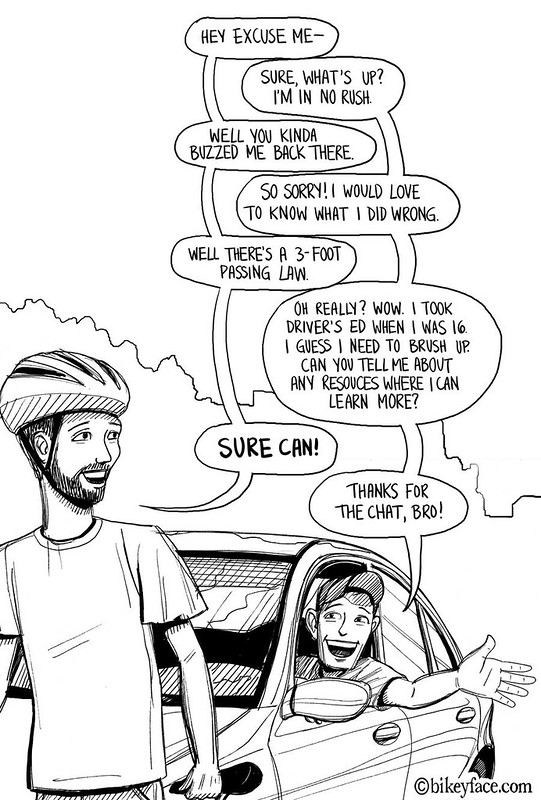
Bikeyface has another great post. Motorist honking… even when they use words they really do not do much better. (You have to see her illustrations!)
https://bikeyface.com/2012/09/20/thick-skin/
But I have to share the last frame as I think it makes a strong point why we need better motorists education:
After all, does this ever happen?
LaHood Incorrectly Blames 80 Percent of Pedestrians for Their Own Deaths
https://dc.streetsblog.org/2012/09/27/lahood-incorrectly-blames-80-percent-of-pedestrians-for-their-own-deaths/
B’ Spokes: I recommend reading the article linked above but I really have to say, If we were talking about motorists making left turns that killed this many, we would get left turn lanes with specialized left turn lights not a "Look before you make a left turn" campaign.
Enough with the trying to shoehorn bikes and peds into car centric infrastructure!
Vulnerable road users
[B’ Spokes: Lots of thoughts went through my head while reading this. If you have an interest in traffic psychology then this is good. I’ll pull out one highlight.]
****************************************************************************************************************
Jon Sutton interviews Ian Walker about how psychology can assist non-car drivers
…
Pedestrians
‘If we think cyclists are ignored by researchers, pedestrians have it even worse. Of the little that is published on pedestrians, almost all of it can be construed as supporting the societal status quo in which pedestrians are firmly held as second-class to people in motor vehicles. Analyses tend to look at why pedestrians are so “reckless” as to “jaywalk” away from their designated crossing areas, rather than to study what I would argue are much more fundamental questions about the social, environmental and health consequences of obliging healthy and harmless walkers to yield priority to inactive and polluting drivers. Ian Roberts and Carolyn Coggan looked at this in a 1994 paper (see tinyurl.com/735bl96) – little has changed.’
…
Continue reading “Vulnerable road users”