
by Angie Schmitt, Streets Blog
Imagine how the sheer amount of space given over to cars in North American cities must look to someone from a place with real multi-modal streets. To Copenhagenize‘s Mikael Colville-Andersen, the word that comes to mind is “arrogance.” It’s arrogant not just for cars to have so much space, but to doggedly assert that cars can’t possibly make do with less.
These assumptions are demonstrably false, he says:
…
https://streetsblog.net/2013/03/21/on-north-american-streets-space-for-bikes-is-right-there-if-you-want-it/
Cyclists draw a line; Demand accountability in car accidents
BY JEFFERSON SIEGEL, The Villager
…
In certain circles, there is even a saying: If you want to kill someone in New York and get away with it, use a car.
…
“The N.Y.P.D. is charged with investigating serious crashes and enforcing traffic laws, including the requirement that motor vehicles be driven with due care. Yet in each of these cases, and in the vast majority of cases in which pedestrians and cyclists are killed by automobile, the N.Y.P.D. declared ‘No criminality suspected’ within hours of the crash,” said traffic analyst Charles Komanoff. He added that accident investigation reports in recent crashes have not been released to the public or to the victims’ families.
The New York City Department of Transportation reports that deaths resulting from traffic accidents increased 23 percent from 2011 to 2012. In 2012 there were almost 300 fatalities; more than 150 of those involved the deaths of bicyclists and pedestrians. “The N.Y.P.D. is whitewashing traffic violence to the public, withholding potentially emotionally healing information from grieving families, and robbing safer-streets activists of the information they need to best advocate for a livable city,” said Keegan Stephan, the Time’s Up! ride organizer.
…
https://www.thevillager.com/2013/03/21/cyclists-draw-a-line-demand-accountability-in-car-accidents/
Recycling champ wins city service award
"Beth A. Strommen, a 22-year veteran of the Planning Department, was commended by Mayor Stephanie Rawlings-Blake for initiating the bike planning program, a maritime master plan for the much-neglected Middle Branch and coordinating operational reforms that have saved the city $2 million."
Read more: https://www.baltimorebrew.com/2013/03/21/recycling-champ-wins-city-service-award/
BikeSpike Kickstarter opportunity
From press release:
If you’ve ever had your bicycle stolen, you probably wished there was a way to get it back…
A Chicago based startup is addressing this with a new gadget called BikeSpike that alerts your smartphone when your bike is tampered with and makes it easy to notify police. Similar to Apple’s “Find My Phone” feature, you get text and email alerts and can track the cycle’s location on the web and through your smartphone.
Not only does it protect your bike, it goes beyond this with BikeSpike’s accelerometer, which can also detect a crash, pinpoint its location and alert people on your contact list to send help. Parents could also be alerted when kids ride outside a set “safe zone.” BikeSpike also enables cyclists to monitor stats like distance, speed and favorite courses, and fans and coaches can oversee groups of bikers or watch a specific person race from the web. Plus, it comes with open API for any software developer to create special smartphone apps.
To get this new gadget, BikeSpike is raising funds through Kickstarter where anyone who pledges $149 can get the device, carbon filter water bottle cage and bundled data plan this October
CDC: Americans Drive Distracted Waaaay More Than Europeans
by Tanya Snyder, Streets Blog
Adults aged 18–64 who said they had talked on their cell phone while driving in the past 30 days, by country. Image: CDC
…
Cell phone use while driving is an enormous safety problem in this country. NHTSA reports that distraction-related crashes kill more than nine people and injure more than 1,060 every day in the U.S. The effects of distraction are severe: According to U.S. DOT’s website on the issue, Distraction.gov, “Sending or reading a text takes your eyes off the road for 4.6 seconds. At 55 mph, that’s like driving the length of an entire football field, blindfolded.”
[Updated link from one of our readers: https://www.sr22insurance.net/distracted-driving/
Thirty-three U.S. states and the District of Columbia have laws restricting cell phone use while driving, at least for teens, but these laws haven’t yet proven effective at getting people to change their behavior.
https://dc.streetsblog.org/2013/03/15/cdc-americans-drive-distracted-three-times-more-than-brits/
O-TUS MINI SPEAKER
[B’ Spokes: While you can use headphones in just one ear this seems like an option that might be worth considering. I will note I have no experience with this product, it just looks cool.]

In many states it is illegal to operate a vehicle (yes that includes bikes and skateboards) with earbuds in your ear.
More states are creating legislation every year. It is dangerous, however, in all 50 states and Canada. O-tus IS the solution!
With O-tus 15 watt near-ear speakers, you can hear background sounds (bikes, cars, emergency vehicles, and your friend’s whining) and have your own personal surround sound stereo. All without long chords to tangle and untangle.
There Is No Poop Fairy
[B’ Spokes: I’m posting this because by my causal observations too many dog walkers treat our trails as having a poop fairy.]
From Sustainable Storm Water
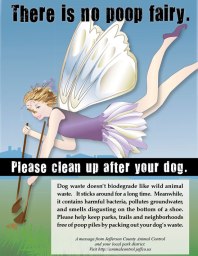
First: Please know that we love our pets. This post is about human behavior, not pets!
Have you heard of the Poop Fairy? The first thing you should know about her is that she doesn’t exist. Many municipalities use the myth of the Poop Fairy in campaigns to remind residents that there is no magical way to make dog poop “go away”.
Just like with littering, some people may not realize the impact their behavior has on waterways, and some may simply not care. Some may even think it’s good to leave it to fertilize the grass.
Besides the immediate issues, like the fact that it looks bad, smells gross, and that unfortunate (and subsequently irate) people step in it, there are plenty of other reasons cities are campaigning to decrease the doo doo:
- Nutrients – Pet waste adds to nutrient pollution, which in turn increases algal blooms which block light for aquatic life and deplete the water of oxygen when it decays.
- Bacteria – E. coli, giardia, and salmonella.
- Parasites – Roundworms, hookworms, and cryptosporidium.
- It lasts – Dog poop doesn’t break down quickly because of the foods we feed them. It sticks around and builds up in parks, or washes down storm drains during rain events.
- It is concentrated – Any open space that has access to pets can become ground zero for these pollutants, especially in urban areas that have limited open space areas. With highly concentrated use, stormwater runoff from these areas is a toxic soup.
In short, research is showing that this is a significant part of urban pollution. The chart below shows the estimated amount of waste being left on the ground by dog owners in the city of Baltimore alone:
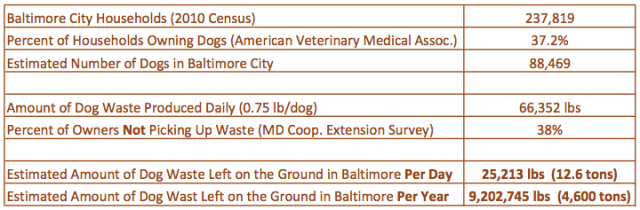
Stormwater in Baltimore washes dog waste (that’s thousands of tons per year) into storm drains, then streams like Herring Run or Jones Falls, and then Baltimore Harbor and the Chesapeake Bay.
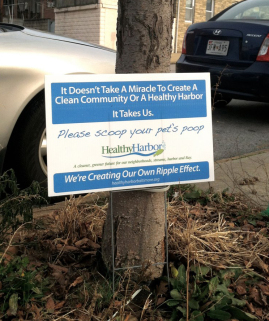 The best methods for dealing with dog waste are to seal it in a bag and dispose of it in the regular trash, which bothers some because it might never break down in a landfill, or you could flush it so it will be treated along with other sewage. Cat waste, however, should not be flushed because a parasite common to felines, Toxoplasma Gondii, is not killed by regular sewage treatment methods.
Check out these sites for more info:
- The Myth of the Poop Fairy
- US EPA: Pet Waste Management
- Chesapeake Bay Program: Nutrients
- Healthy Harbor Neighborhood Green Guide
https://sustainablestormwater.org/2013/03/11/there-is-no-poop-fairy/
Happy March 25 — Opposite Chamber Bill Crossover Date
On this date:
Each Chamber to send to other Chamber those bills it intends to pass favorably
Opposite Chamber bills received after this date subject to referral to Rules
Committees (Senate Rule 32(c), House Courtesy Date)
https://mgaleg.maryland.gov/Pubs-current/current-session-dates.pdf
B’ Spokes: That is to say that the Mandatory Helmet Bill did not transfer over so it is officially dead as all our other bike bills.
Streets, cars, pedestrians, accidents: streets as anti-social spaces
[B’ Spokes: I’ll note at one time Montgomery County was good at doing pedestrian crosswalk stings and now this? What the heck happened?]
*************************************************************************
By Richard Layman, Rebuilding Place in the Urban Space
Montgomery County’s Action Committee on Transit released a brief press release yesterday, because there were 3 accidents involving 5 pedestrians all before 9am yesterday morning:
What Will It Take for the Montgomery County Police To Tell Drivers To Obey the Law?
Five pedestrians were struck by drivers in three Montgomery County incidents yesterday (Tuesday) morning before 9:00 am. All three collisions occurred where the pedestrians had the right of way.
Yet county police responded with a press release entitled "Police Remind Pedestrians To Be Careful." Nowhere did the police tell drivers to obey the law, which requires drivers to yield to pedestrians on sidewalks and in marked and unmarked crosswalks.
The three incidents:
– A mother and her two children were struck on the sidewalk at Gaithersburg Elementary School.
– A pedestrian was struck crossing Wisconsin Avenue in an unmarked crosswalk at Chelsea Lane in Bethesda.
– A Watkins Mill high school student was struck in a marked crosswalk on the way to school.
…
https://urbanplacesandspaces.blogspot.com/2013/03/streets-cars-pedestrians-accidents.html
Driver Safety Laws: An Old Approach That’s Worth Reviving
by Steve Vaccaro, Streets Blog
In the aftermath of a crash, we inevitably ask: How can a dangerous driver be kept off the road? It seems that the entire automobile transportation regime is aimed at keeping the driver behind the wheel. Absent impairment or flight from the scene of the crash, police quickly conclude that “no criminality is suspected.” The name of the responsible driver may be carefully guarded by police, even when the name of the victim or selective details are not. Government compels the insurance market to continue insuring the responsible driver, even if the market would consider the driver too risky to insure. The under-resourced legal system and insurance industry neglect and obstruct crash litigation, pressuring victims to simply accept whatever insurance is available without holding the driver personally responsible.
But it wasn’t always that way.
Before the advent of compulsory auto insurance laws in the 1950s, New York and most other states had “safety responsibility” laws instead. Under these laws, drivers involved in crashes had their licenses suspended until they posted a bond or demonstrated insurance in an amount sufficient to compensate the crash victim. Based on their involvement in a crash, these drivers would also be required to maintain insurance as a condition of keeping their driving privileges.
Under New York’s safety responsibility law (codified as Section 94-b of the Vehicle and Traffic Law), the crash victim had the right to directly petition the commissioner of the Bureau of Motor Vehicles for suspension of license of any driver involved in a crash causing personal injury or $25 of property damage. Absent the requisite showing of financial responsibility, the commissioner was required to suspend the license of a driver within 45 days — even if there had not been any finding of fault. At least for those drivers without insurance and financial means, this approach resulted in prompt suspension of driving privileges for drivers involved in crashes.
Though ensuring compensation of victims was clearly the primary purpose of the safety responsibility law, it also had an undeniable deterrent effect. As one New York court explained in 1942, “the penalty which § 94–b imposes for injury due to careless driving is not for the protection of the [crash victim] merely, but to enforce a public policy that irresponsible drivers shall not, with impunity, be allowed to injure their fellows.”
…
https://www.streetsblog.org/2013/03/19/driver-safety-laws-an-old-approach-thats-worth-reviving/