David Byrne on how biking builds a better a city – and growing up in Arbutus

From Baltimore Brew

Writer, musician and former MICA student and Talking Heads front-man David Byrne had a thoughtful piece on biking yesterday in The New York Times. The peg was New York’s bike-share program which is going to start with 420 stations in Manhattan, Long Island and Brooklyn and ultimately make 10,000 bikes available.

But then he goes on to discuss how bicycles help us with “learning to live with cities instead of in spite of them” and how the failure of urban transportation in Baltimore contributed to white flight and the downward spiral of the urban core. And he anchors the piece with his own recollections of growing up around here:

“I realized that bike travel had practical value a long time ago, when I was a kid, in Baltimore. I lived in Arbutus, which is on the outskirts, near the city line. There was public transportation, a bus line, but it was designed mostly to get people into the central city. It was useful for an occasional urban gawking adventure, but it was useless if I wanted to visit my friends. So I rode a bike to get to the nearby neighborhoods where they lived and where my high school was.

Read more: https://www.baltimorebrew.com/2012/05/28/david-byrne-on-how-biking-builds-a-better-a-city-and-growing-up-in-arbutus/

Finally a decent Baltimore rail system map

From Beyond DC

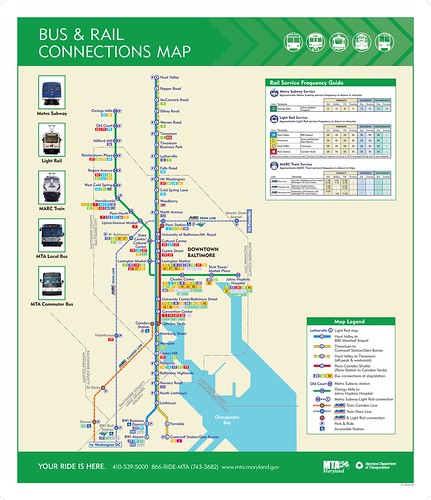
For years Baltimore has lacked a consolidated rail system map. Rather, they had separate maps for the Metro-Subway, light rail, and MARC, even though all are run by the same agency. This made navigating the city’s rail system unnecessarily difficult, since users hoping to transfer between the various rail modes had to consult multiple maps.

Finally, late in 2011, a consolidated rail map for Baltimore was published. It’s not the world’s greatest example of graphic design, actually it’s quite awful from that perspective, but at least it’s functional. It is easily the most fully integrated rail system map I’ve ever seen for the city.

image

The map is one part of an entire series of new transit maps produced by MTA for the Baltimore region. There are several interesting maps in the series, including a diagrammatic bus system map (as opposed to a geographical one), and a WMATA map showing MTA bus connections.

Continue reading “Finally a decent Baltimore rail system map”

Survey Identifies Ways to Better Support Cyclists

From Citizens Planning & Housing Association, Inc. blog

A survey conducted earlier this year by Maryland’s Office of Tourism, Department of Business and Economic Development (in collaboration with Bike Maryland, the Department of Transportation, the Highway Administration, and others) has shown that cyclists in Maryland are a tech-savvy, safety-conscious group that primarily uses their bikes for health benefits or pleasure. The survey, which was open to the public from May to October 2011, received 2,300 submissions and concerned cycling habits, map resource use and preferences, demographic information, and more. The key findings of the survey are as folows:

  • The top motivating factors for cycling are health benefits and for pleasure – 95 percent of respondents recognize these as leading factors – followed by environmental reasons.
  • The top four activities for all respondents were: enjoying outdoors and nature, going to restaurants for food and beverages, shopping, and visiting friends.
  • 75 percent of cyclists sometimes or always use paper maps to plan cycling trips.  Of those who have seen the Maryland Bicycle Map, more than 65 percent reported that the Maryland Bicycle Map was useful.
  • The overwhelming majority of survey respondents also reported using online maps to plan bicycle trips – 85 percent use them currently. A little over half of respondents reported at least sometimes using navigational devices while on their trip. Google Maps is the most popular web service for planning and navigating a trip.
  • Respondents across the board showed the most support for a map in a mobile application format. Additionally, they would be most interested in having a map that shows connections to local bike routes, parks and off-road trails, followed by type of riding surface and bike shops.
  • More than half of respondents reported that the amount of traffic, surface type and smoothness of the road, and speed of traffic were most important to them. Additionally, almost half listed continuous, safe routes and shoulder width as important.
  • For amenities, more than half of respondents reported that scenic views, parks, points of interest, and restrooms were most important to them – followed closely by food services.

The Office of Tourism and its partners in Annapolis have rightly interpreted these findings as a call for the state to engage with online resources that cyclists already use, such as Google Maps, while continuing production of the Department of Transportation’s Maryland Cycle Map. The conclusions section also includes a vow to use survey respondents to test any new products and services offered.

This very interesting and thoughtful survey missed an opportunity to learn about the infrastructure improvements bicyclists see as important for their continued and increasing use of bicycling for purposes beyond health and pleasure.  Since 45% of respondents use a bicycle for their commute to work, respondents would have been able to identify priority funding areas the state could target that might result in increasing the number of bicycle commuters in the years ahead.  In particular, efforts to make densely populate areas more bike-friendly should be a concern for state policymakers interested in reducing congestion and promoting physical fitness.

Read the full survey report here.

Continue reading “Survey Identifies Ways to Better Support Cyclists”

Salisbury Seeks Grant To Improve Bicycle Routes

[B’ Spokes: Just to note we have $38 million available in Transportation Enchantments funds so I put the amount requested in this article in millions as well for easier comparison. Ref: https://www.enhancements.org/profile/MDprofile.php ]
*************************************************************************************************
SALISBURY, Md. (AP) — City officials and local advocates are pursuing a state grant that will kick-start efforts to make Salisbury a bicycle-friendly community.
Teresa Gardner, director of Public Works, submitted an application to the Maryland Bikeways Program earlier this month for $0.014 million in funding for a minor retrofit project, which consists of striping designated bike lanes where road width permits, applying shared lane bike symbols where road width is constrained and installing permanent marker signs on the roadside as well as bike boxes at select traffic signals.

https://baltimore.cbslocal.com/2012/05/25/salisbury-seeks-grant-to-improve-bicycle-routes/`

IS IT POSSIBLE TO WALK AND WORK AT THE SAME TIME?

-> According to a May 7th NPR story, "When it comes to walking, the easy part is understanding the benefits: Regular, brisk walks can strengthen our bones, help control blood sugar, help lower blood pressure and cholesterol, and the list goes on. The hard part is finding the time to fit it in. Engineering physical activity back into Americans’ daily lives is the goal of an educational campaign launched by Kaiser Permanente, an Oakland (CA)-based health plan. There are tons of tips and resources online, with the goal of creating a culture of walking. Kaiser Permanente even seems to be walking the walk with its own employees. ‘We actually do have walking meetings at Kaiser Permanente, believe it or not,’ says executive Ray Baxter. ‘My team is pretty productive, so it must be working.’ Baxter believes walking together — as opposed to sitting down at a table — can change the dynamics of interactions for the better (think consensus building and brainstorming)…"
Source: https://n.pr/JKzzno

Traffic Fatalities: How Manslaughter Became "Accidents"

From Planetizen

Sarah Goodyear chronicles the transition of streets in America from public space to the exclusive domain of autos. Professor Peter Norton, author of “Fighting Traffic: Dawn of the Motor Age” explains the ingenuous strategy of the auto industry.

Before Goodyear wrote about how Amsterdam and Copenhagen became so bicycle-friendly, she provided a short history of how the car, more precisely, the auto industry, did take over American streets. One of the more fascinating episodes took place in 1923 in Cincinnati when residents, outraged at all the children killed by autos, placed a ballot measure that “would have required all vehicles in the city to be fitted with speed governors limiting them to 25 miles per hour.”

Peter Norton, an assistant professor at the University of Virginia and the author of Fighting Traffic: The Dawn of the Motor Age in the American City, has done extensive research into how our view of streets was systematically and deliberately shifted by the automobile industry, as was the law itself.”

Historically, “the principles of common law applied to crashes. In the case of a collision, the larger, heavier vehicle was deemed to be at fault. The responsibility for crashes always lay with the driver. Public opinion was on the side of the pedestrian. “There was a lot of anger in the early years,” says Norton. “A lot of resentment against cars for endangering streets.”

To respond to the Cincinnati referendum, the auto industry went into overdrive, sending letters to motorists, enlisting dealers and local auto clubs, and most of all, organizing the Detroit auto companies themselves. And they didn’t stop after defeating the referendum.

“The industry lobbied to change the law, promoting the adoption of traffic statutes to supplant common law. The statutes were designed to restrict pedestrian use of the street and give primacy to cars. The idea of “jaywalking” – a concept that had not really existed prior to 1920 – was enshrined in law.”

Source:
The Atlantic Cities, April 24, 2012

Continue reading “Traffic Fatalities: How Manslaughter Became "Accidents"”

The Cabot Tour route is coming to MD

On June 13th Cabot Community Tour riders are coming to MD on June 12th. Here are the routes and days they will be riding.

June 12th Washington DC to Annapolis

June 13th Annapolis to Towson

June 14th Towson to Havre de Grace

June 15th Havre de Grace to Newark DE

It would be great to populate the ride with local riders. The riders will need to determine how to get back to their point of origin, etc. There will be two sag vehicles, one will have a mechanic. The rides should all be starting at the hotels that the riders will be staying at. Typically the rides will start at 9:00. Please feel free to post on list serves/send to email lists, etc.

Here is the URL for the tour. https://www.cabotcommunitytour.com/

How to register

Thank you all, and glad to have the route now buttoned down to be able to send to you.

Andrew Hamilton, RLA, ASLA, APBP
Mid-Atlantic Trail Coordinator
East Coast Greenway Alliance

Laps around the Lake

image

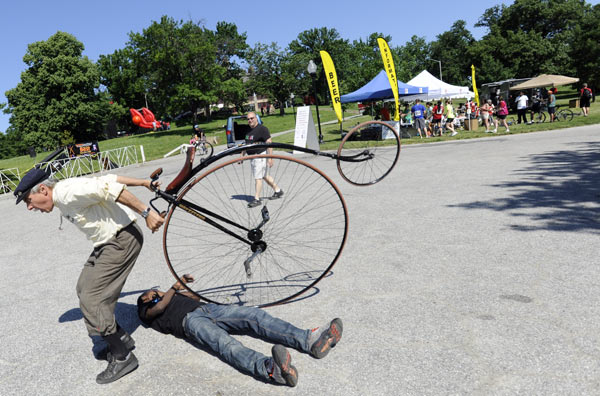
5-8p, at Lake Montebello and held each Tuesday through the end of August. Family-oriented program for leisurely rides or bike lessons for all ages. Adult and children’s bikes and helmets are available. You must have photo ID to borrow equipment. Rides are free, but a $5 donation is suggested.
Continue reading “Laps around the Lake”