Biller’s Bikes Havre de Grace Re-Opens April 1

image

Biller’s Bikes in historic Havre de Grace, MD re-opens April 1st for its fourth bicycling season.

Located at the meeting point of the Susquehanna River and Chesapeake Bay, the recreational bike shop sells SUN cruisers and trail bikes, Bianchi hybrid, sport and touring bikes, offers daily rentals, and sells practically priced parts and accessories. The versatile repair shop attracts customers from MD, PA and DE for its quality service and pricing.

Biller’s Bikes is a trailhead on the East Coast Greenway and offers Greenway members and other touring cyclists legal and safe means of crossing the Susquehanna River. Home of the fully-equipped SUN Stage and Cinema, Biller’s Bikes features a Spring/Summer schedule of music and film events and activities. The classic “mom-and-pop” bike shop is built inside a restored 1920s mens’ department store.

For hours, directions, events and more information, see www.billersbikes.com.

This Spring/Summer season you are eagerly invited to come “Bike Havre de Grace!”

Name that bill!

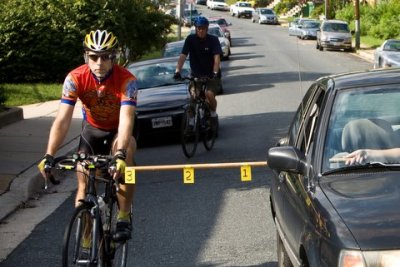
Here Biking Bis summarizes States attempt at passing 3′ safe passing distance laws across the nation and notes that only 1 in 9 passed. And I’ll note that the one bill that passed was named for an 18-year-old senior at Tupelo High School. He struck by a pickup in August 2009 as he trained on his bicycle for upcoming triathlete events.

I really have to ask were is our Jack Yates, Yoram Kaufman, unnamed 14 year old girl killed crossing Route 2 because of the lack of lights and crosswalks, the cyclist that had the right of way and the driver was 100% at fault still lost at recovering damages from the driver, my freind Hugh Macintosh who was mirrored bills? All these stories and more come across my desk and then just fade away, that’s just sad. I realize that these stories and names cover many issues but to me its just sad, that these stories are just a tragedy and nothing more. [Note please feel free to add names or stories I might have missed in the comments.]

Anyway Biking Bis has a nice picture of Maryland’s One Less Car president, Greg Cantori, demonstrating what three feet looks like when passing:
image
Continue reading “Name that bill!”

Environmentalists Say Legislators Are “Giving the Environment the Shaft”

And the pedestrians and cyclists are getting it too. All out bills are stalled in the legislature with the exception of HB 1155 Which will help mainstream bike/ped projects as well as requiring the state to meet specific goals (other then just randomly spending money.) While I am personally concerned that the State will still maintain barriers to funding bike/ped projects such as: it has to be really expensive before financial aid will even be considered along with a unflexible matching requirement, which between the two hinder projects that can do the most good in meeting the established goals as well as preventing projects from being built where they will do the most good.

Despite my concerns over HB 1155 establishing goals is a very important first step, and the fact that it has passed the House (nothing of importance of ours has passed the House in the last 5 years) this is good news. No we have to wait to see what the Senate will do with their version SB 760.
Continue reading “Environmentalists Say Legislators Are “Giving the Environment the Shaft””

Maryland LCV Action Network – Call to Action

University of Maryland Environmental Law Center
Issue
Withdrawing Funding from UMD Environmental Law Center and Adding Strings
Background
Because of the horrible water quality around Perdue’s chicken farms, the University of Maryland Law Clinic is representing clients who are suing to stop these extreme water violations.
Now state lawmakers are threatening to withhold funding from the school.
It is outrageous that legislators are putting Perdue’s interests over the impartiality and prestige that define the University of Maryland. Tell them to stop.
Take action! https://mdlcv.e-actionmax.com/takeaction.asp?aaid=4616

Let Him Ride!

Donate

Contribute to the Reed “ChipSeal” Bates Defense Fund.

Protect your legal right to the road. Every dollar counts! Please contribute as much or as little as you can.

A fellow cyclist in Texas is being repeatedly arrested, simply for riding his bike. This is bigger than just one rider. It affects all of us. Click the donate button to help.


image

Continue reading “Let Him Ride!”

Leading the way to a green lifestyle

By Brittany Kenworthy For the CDT
It is an early morning at Penn State, and Lydia Vandenbergh is riding her red, 15-year-old Trek mountain bike across campus.
A program coordinator for the Campus Sustainability Office at Penn State, Vandenbergh forgoes a commute by car and opts for the 15- minute bike ride, stowing her briefcase in the “functional, yet dorky” basket attached to the back. She’s determined to decrease her carbon footprint, and even this time of year, she opts to pedal rather than drive her car most days of the week.

Described by her colleagues as innovative and resolute, Vandenbergh developed and is implementing a program called “Green Teams” that uses teams of staff and faculty to advocate to their peers to save energy by changing behaviors, such as turning off lights, shutting down computers, opening the blinds to let sunlight in and sharing appliances.
Vandenbergh said the key to conservation is that people “look at their circumstances and look at all of the implications of their actions.” It is important for people to make decisions about how to conserve energy based on their own circumstances, she said.
She admits that an action that is right for one person may not be for another. Her family hangs clothes in the attic to dry instead of using a dryer, but for a student living in small apartment this would not be practical.

Learning to conserve is a two-stage process in the home, on campus and in society. “First an action becomes conscious and then it becomes unconscious because you just do it,” Vandenbergh said.
She believes that if people consider their circumstances and the implications of their actions, they will be able to understand the consequences of their choices. By biking to work she conserves energy and exercises at the same time. It is much faster than walking or taking the bus, and it prolongs the life of her car. She can park outside the building instead of a far parking lot.
Vandenbergh said, “When you observe the personal and societal impacts of conservation, it just makes sense.”
Continue reading “Leading the way to a green lifestyle”

The City of Hagerstown adopts a bike master plan

Congratulations to Hagerstown in their newly adopted Bike Master Plan but I’ll note that they seemed to have fallen into the same trap that other dormant bike plans have fallen into and that is the problem of funding. While we all read about the success stories across the nation and how they have successfully used Federal Aid to implement bicycling infrastructure but seriously what hope do we have in a state that ranks 45 out of 50 in spending of Federal Aid per the 2010 Benchmarking report?

Lets see if pictures can tell the story of Maryland’s funding vs oh lets say Oregon (since they have a reputation for being one of the best states that support cycling.)
image


image


On the pie charts note the Cat 1 (purple area) that’s spending on bike/ped projects and ours is notably smaller while we have a larger and more dense (by 15X) population then Oregon which should be ideal grounds for supporting cycling. On the charts on the right note the brown “Available” area,. we have $25 Million available, that’s a lot over what’s appointed and obligated. I seriously have to ask what’s the hold up on getting this money on the ground? This level of funding can’t do anything for cars but it can make a huge contribution for cycling, roughly by what Portland has done we have a potential here for 200 miles of on-road bike accommodations but the State would rather give the money back to the Feds then spend it on us, this is not right.

Note that per State Law: § 2-602. Public policy. The General Assembly finds that it is in the public interest for the State to include enhanced transportation facilities for pedestrians and bicycle riders as an essential component of the State’s transportation system…

So I have to ask how can MDOT deny funding to something that is essential per state law? We have an adopted State Bike Master plan with the stated goal of making Maryland the best State for cycling yet $25 billion in available funds is essentially denied by outrageous policies that make no sense after decades of neglect and totally inappropriate for cycling as transportation. Basically overall Maryland’s Bicycle Level Of Comfort scores for roads have not changed in 10 years because as the number of roads improve there is a near equal number of roads that become hostile for cycling. This trend of falling to make progress has to stop!

I’ll personally challenge MDOT to get its bike/ped spending up to at least the average spending per capita. Maryland being constantly noted as being in the bottom dregs of things related to cycling and walking has to end!
Continue reading “The City of Hagerstown adopts a bike master plan”

Some look to make Maryland a bicycle tourism destination

By Ron Cassie

Alex Obriecht, the featured speaker at the 13th annual get-together in mid-February, didn’t bother bogging down the event with statistics or studies.
The owner of Race Pace bike stores in Westminster, where he lives, Ellicott City, Columbia and Owings Mills, Obriecht focused on the joyful, wind-in-the-face recreation of traveling by bike. He also touted the immediate opportunity for Maryland to become a bicycle tourism destination, akin to Colorado, Vermont and northern California.
Holding up a copy of a mid-Atlantic bicycling magazine, Obreicht tallied the states with advertisements priming the pump of bicycle tourism. His thesis centered on the natural geography of the Old Line state and the economic benefits of bicycle tourism.
"Vermont, Georgia, Florida, Indiana, Ohio, Pennsylvania, Virginia, New York," Obreicht called out, reading the magazine ads. "What about Maryland? People leave Maryland to go to Central Florida and ride bikes? That’s ridiculous."
The early October Sea Gull Century in Salisbury drew 8,300 bicyclists in 2009, producing $3.25 million in overall economic activity, Obriecht said. There are other annual events, such as the One Less Car-sponsored Tour du Port in Baltimore, but Maryland is barely scratching the surface of its potential as a bicycle tourism destination, Obriecht said.
The bicycle industry, including some 70 to 75 bike shops in the state, generates $38 million to $42 million in gross revenue, Obriecht said. Given Maryland’s location in the southern end of the Northeast corridor, with terrain that extends from the Chesapeake Bay to Baltimore to rolling hills and mountains in the west, the state is ideally suited for bicycling — a reputation usually reserved for states such as Vermont and Colorado, and certain regions such as Napa Valley in California.

Having traveled Europe, Central America and much of the U.S. by bike, some of Obriecht’s favorite roads are right outside his door in Carroll and Frederick counties.
In fact, there are world-class athletes who built their careers training in Frederick.
Former six-time, 24-hour world solo mountain bike champion Chris Eatough, who lives in Howard County, does most of his training in Gambrill State Park, even riding from Ellicott City to Frederick to hit the mountains.
Rebeccah and Laurel Wassner, Gaithersburg natives and twins, are both professional triathletes who have spent considerable time training in northern Frederick County. Rebeccah is a Mount St. Mary’s alumna.
Creating a functioning, statewide bicycle network that’s attractive to tourists goes beyond painting new bike paths on road shoulders or extending existing trails into population centers, Obreicht said. Public buses must be outfitted with bike racks and trains need to be outfitted with dedicated bike cars.
"Every train in Europe has a bike car, period," Obriecht said. "I get on a train with my bike in Genoa, Italy, and get off in Germany, and it’s no problem. Going anywhere on Amtrak with a bike, it’s a struggle."
Obriecht compared Baltimore with Portland, Ore., a similar size city with one of the largest percentages of bicycle commuters and recreational cyclists in the country. He pointed to the challenge the Charm City faces, as well as the potential.

Reversing decades-long transportation planning that ignored bicycling is difficult. Twenty years ago, said Bill and Vicki Smith, members of the Frederick Pedalers, bicycling in Frederick was actually easier. They noted the dramatic changes and increased traffic along the Rosemont Avenue/Yellow Springs corridor, for example, that has pushed out bicyclists.
"We need to make bicycling a real part of transportation planning," Obriecht urged symposium attendees. "This is crucial for both the recreational and the commuter bicyclist. That’s why were here today as far as I’m concerned."
In many European cities, bicycling and walking account for as much as 30 percent of all transportation, he said, creating both a healthier transportation model and a healthier population.
"Every road, within reason, should have bicycle access," Obriect said. "That’s the only way things will change."
Continue reading “Some look to make Maryland a bicycle tourism destination”