No accountability for driver who hit bicyclist

On behalf of my colleagues, I send best wishes for a speedy recovery to 20-year-old Nathan Krasnopoler, the bicyclist who is recovering from a coma after being hit by a motorist on February 26th. Mr. Krasnopoler was safely riding his bike in a marked bike lane on University Parkway in Baltimore when he was hit by a motorist who failed to yield.

Mr. Krasnopoler’s injury is disturbing, but it is made even more disturbing because there will be no reckoning. That is to say, the driver who hit Mr. Krasnopoler will face no criminal charges despite the apparent violation of the law. Just last year, the legislature passed and the governor signed the "three foot rule" with the specific intent of preventing this type of accident. The "three foot rule" requires motorists to yield the right-of-way to the cyclist lawfully riding in the designated bike lane or on the right-most side of the road and to give a 3-foot buffer when attempting to pass. Therefore, the motorist’s action, while possibly accidental, was nonetheless illegal. We cannot hope to deter this type of horrible accident unless the police enforce the three foot rule and other laws which both protect the lawful cyclists and cite bicyclists when they violate the rules of the road.

Legislation such as the "three foot rule" is not intended to punish drivers but to preserve the right of cyclists to ride safely. More and more people are using their bikes for commuting, recreation and other reasons. As cyclists merely want to ride from place to place safely, drivers need to be made aware of the increasing number of cyclists and their right to arrive without injury.

Del. Jon S. Cardin, Annapolis

The writer, a Democrat, represents District 11 in Baltimore County.

Continue reading “No accountability for driver who hit bicyclist”
PG County wants to remove bike/ped planners from road review process

from TheWashCycle by washcycle

WABA reports that PG County Executive Rushern Baker’s transition team wants to remove M-NCPPC from the review process of roads in an effort to make the process more efficient. DPW&T would do all of the reviews on their own.

To minimize the ability of [M-NCPPC]’s qualified bike and pedestrian planners to provide input on the need for road improvements and the nature of those improvements is to undermine the very improvements in bicycle and pedestrian connectivity and livable, sustainable development that County Executive Baker has extolled.

DPW&T remains, by and large, a traditional, automobiles-first transportation agency, and has been reluctant to take the steps necessary to improve roadways for the benefit of cyclists–even going so far as to recommend that a cyclist not travel a certain roadway in the county with his child due to its unsafe conditions, while refusing to make improvements.

Hopefully Baker will not follow this recommendation (and will add a bike/ped coordinator position at DPW&T).

Continue reading “PG County wants to remove bike/ped planners from road review process”

We Need to Make Alternatives Attractive

By Patrick J. Natale, P.E.
P.E., Executive Director, American Society of Civil Engineers

The price of gas is irrelevant. Fluctuating gasoline prices are not the problem, but they do serve to intensify the challenges we face after decades of under-investing in surface transportation. If the price of gas goes up, drivers start using other modes that cannot handle the volume. If it goes down, we still have a massive congestion problem and current revenues from gas taxes are not sufficient.

The cynical person might interpret that trend as a clear sign that Americans prefer driving over other modes of transportation. That may well be, but it could also be an indication that we have not done a good enough job making the alternatives attractive.

Continue reading “We Need to Make Alternatives Attractive”

Announcing a new Meetup!

Why:
The Rando Ramble is a monthly series of unsupported century rides (100+ miles) leaving from Baltimore. We spend the day in the saddle riding various well-cued routes exploring the surrounding counties and states and we make it back in time for dinner
When:
Sunday, March 20, 2011 8:00 AM
Where:
The Maryland Zoo in Baltimore
Druid Hill Park
Baltimore, MD 21217
exact start here: https://tinyurl.com/5trp6ox
more details about the next ride here: https://randoramble.posterous.com/

Missing at least three points about sustainable transportation

from Rebuilding Place in the Urban Space by Richard Layman

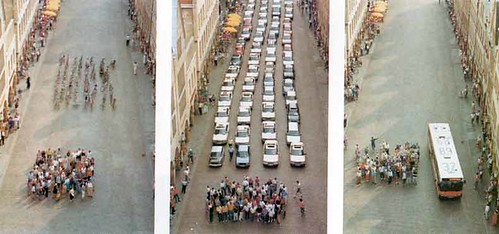
1. The primary reason that I don’t talk about “how great it is” “to expand people’s choices” when it comes to bicycle, pedestrian, and transit infrastructure is because it’s not about choice, it’s about efficiency and optimality.

The issue isn’t giving people more choices, it’s about using scarce resources more effectively.
Muenster bike vs. car vs. bus vs. walking poster
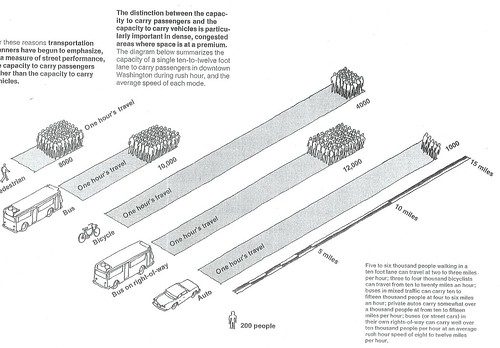
First image: Muenster, Germany bike vs. car vs. bus vs. walking poster. Second image: Mobility efficiency, Central Washington (DC) Transportation and Civic Design Study, 1977. John Passonneau, lead investigator.
Mobility efficiency -- Passonneau

It’s much more optimal–given the right spatial form–to walk or bike or use transit than it is to use a car–at least for a community, if not for an individual.

It’s why we talk about “mass” transit.

2. The desire to maintain the primacy of the automobile in transportation planning on the part of drivers especially is the source of the animus with regard to prioritizing (or rebalancing) transportation infrastructure development towards biking, walking, and transit.

This is what’s behind the fight against bike lanes everywhere, not just in NYC. See “Battle of the Bike Lanes” from the New Yorker and “Suit Over Brooklyn Bike Lane Challenges City Initiative” from the New York Times.

While various people have written counter-pieces to the New Yorker article, the reality is that it comes down to the question of optimality and yes, externalities and properly pricing them (see “Tragedies of the commons: The world is his parking spot” from the Economist blog).

3. The third point is something deserving of a blog entry of its own, but it’s not like I haven’t written about it ad infinitum already.

The issue is that reframing and rebuilding the transportation mode split where walking, biking, and transit are significantly used to conduct a majority of trips _is a process_ that will take a long time.

John Cassidy writes in the New Yorker:

But from an economic perspective I also question whether the blanketing of the city with bike lanes—more than two hundred miles in the past three years—meets an objective cost-benefit criterion. Beyond a certain point, given the limited number of bicyclists in the city, the benefits of extra bike lanes must run into diminishing returns, and the costs to motorists (and pedestrians) of implementing the policies must increase. Have we reached that point? I would say so.

He is missing the point entirely. You don’t build infrastructure for today’s use only, but to provide the means to achieve your mode split goals.

In Copenhagen, close to 40% of all daily trips–not just trips to work–are conducted by bike.

Continue reading “Missing at least three points about sustainable transportation”

Prince George’s community groups plead for safer, more walkable streets

B’ Spokes: In brackets is the comparative stat for Baltimore County.
"As we’ve noted here before, Prince George’s has had the pathetic distinction of topping [#2] the regional fatalities list every year going back to 2001. Last year 24 [21] pedestrians and cyclists were killed on county roads, 10 [7] more than in the District and more than [very close to] twice as many than in Montgomery County. Last week we had a nice reminder of how inhospitable a place it can be for pedestrians when a jury found the state of Maryland liable for $3 million in a case in which a woman was killed on Pennsylvania Avenue in 2008. She’d been walking on a stretch of highway that had no sidewalk or guard rails whatsoever."
Continue reading “Prince George’s community groups plead for safer, more walkable streets”