from Rebuilding Place in the Urban Space by Richard Layman
1. The primary reason that I don’t talk about “how great it is” “to expand people’s choices” when it comes to bicycle, pedestrian, and transit infrastructure is because it’s not about choice, it’s about efficiency and optimality.
The issue isn’t giving people more choices, it’s about using scarce resources more effectively.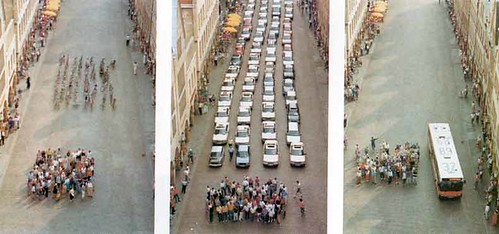
First image: Muenster, Germany bike vs. car vs. bus vs. walking poster. Second image: Mobility efficiency, Central Washington (DC) Transportation and Civic Design Study, 1977. John Passonneau, lead investigator.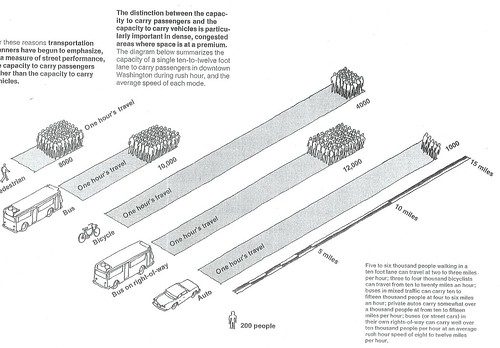
It’s much more optimal–given the right spatial form–to walk or bike or use transit than it is to use a car–at least for a community, if not for an individual.
It’s why we talk about “mass” transit.
2. The desire to maintain the primacy of the automobile in transportation planning on the part of drivers especially is the source of the animus with regard to prioritizing (or rebalancing) transportation infrastructure development towards biking, walking, and transit.
This is what’s behind the fight against bike lanes everywhere, not just in NYC. See “Battle of the Bike Lanes” from the New Yorker and “Suit Over Brooklyn Bike Lane Challenges City Initiative” from the New York Times.
While various people have written counter-pieces to the New Yorker article, the reality is that it comes down to the question of optimality and yes, externalities and properly pricing them (see “Tragedies of the commons: The world is his parking spot” from the Economist blog).
3. The third point is something deserving of a blog entry of its own, but it’s not like I haven’t written about it ad infinitum already.
The issue is that reframing and rebuilding the transportation mode split where walking, biking, and transit are significantly used to conduct a majority of trips _is a process_ that will take a long time.
John Cassidy writes in the New Yorker:
But from an economic perspective I also question whether the blanketing of the city with bike lanes—more than two hundred miles in the past three years—meets an objective cost-benefit criterion. Beyond a certain point, given the limited number of bicyclists in the city, the benefits of extra bike lanes must run into diminishing returns, and the costs to motorists (and pedestrians) of implementing the policies must increase. Have we reached that point? I would say so.
He is missing the point entirely. You don’t build infrastructure for today’s use only, but to provide the means to achieve your mode split goals.
In Copenhagen, close to 40% of all daily trips–not just trips to work–are conducted by bike.
…
https://urbanplacesandspaces.blogspot.com/2011/03/missing-at-least-three-points-about.htmloldId.20110316120356787