
from Cycle Jerk
…
Most of the time coworkers take the path of least resistance and go for the simple "So! How was the ride?", followed by "You’re crazy man!" after my response. Don’t get me wrong, it’s a nice gesture and I do appreciate the thought. This person wants to hear how cool my commute was, and that’s cool. However, the question is asked of me so often I started giving it right back to the source.
"My ride was awesome! How was your drive in?"
This is met with a wide spectrum of responses;
…
This led me to ponder the trend… it seems to be a common assumption that being a bike commuter, my daily ride in is always great and that any commute by car is always shitty. If that assumption is both true and common why aren’t people more open minded about bike commuting?
The same person who complains about the traffic every day gets to work with two assumptions, that my ride in was awesome and that I’m crazy for doing it.
My assumption is that a good percentage of these people live an easily rideable distance from the office.
I apologize, that was way too many assumptions for one post.
…
PSA Bike to Work Day in the DC Area: https://www.waba.org/events/btwd/
In the Baltimore Area: https://www.baltometro.org/commuter-options/bike-to-work-day
Continue reading “Small Talk Paradox: "How Was Your Commute?"”
Why do people j-walk?
This animation comes from Commute Orlando. It amazes me how many road “engineers” can’t figure out why this is a bad design.
Missing at least three points about sustainable transportation
from Rebuilding Place in the Urban Space by Richard Layman
1. The primary reason that I don’t talk about “how great it is” “to expand people’s choices” when it comes to bicycle, pedestrian, and transit infrastructure is because it’s not about choice, it’s about efficiency and optimality.
The issue isn’t giving people more choices, it’s about using scarce resources more effectively.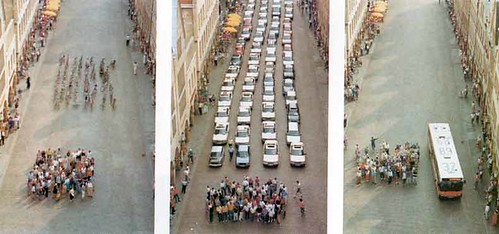
First image: Muenster, Germany bike vs. car vs. bus vs. walking poster. Second image: Mobility efficiency, Central Washington (DC) Transportation and Civic Design Study, 1977. John Passonneau, lead investigator.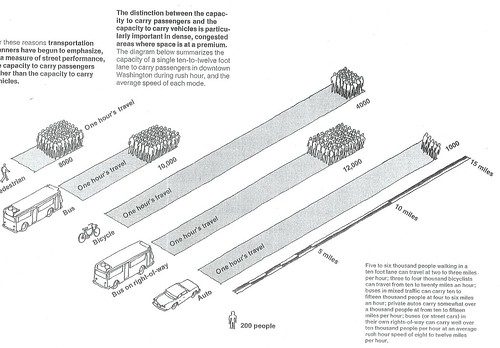
It’s much more optimal–given the right spatial form–to walk or bike or use transit than it is to use a car–at least for a community, if not for an individual.
It’s why we talk about “mass” transit.
2. The desire to maintain the primacy of the automobile in transportation planning on the part of drivers especially is the source of the animus with regard to prioritizing (or rebalancing) transportation infrastructure development towards biking, walking, and transit.
This is what’s behind the fight against bike lanes everywhere, not just in NYC. See “Battle of the Bike Lanes” from the New Yorker and “Suit Over Brooklyn Bike Lane Challenges City Initiative” from the New York Times.
While various people have written counter-pieces to the New Yorker article, the reality is that it comes down to the question of optimality and yes, externalities and properly pricing them (see “Tragedies of the commons: The world is his parking spot” from the Economist blog).
3. The third point is something deserving of a blog entry of its own, but it’s not like I haven’t written about it ad infinitum already.
The issue is that reframing and rebuilding the transportation mode split where walking, biking, and transit are significantly used to conduct a majority of trips _is a process_ that will take a long time.
John Cassidy writes in the New Yorker:
But from an economic perspective I also question whether the blanketing of the city with bike lanes—more than two hundred miles in the past three years—meets an objective cost-benefit criterion. Beyond a certain point, given the limited number of bicyclists in the city, the benefits of extra bike lanes must run into diminishing returns, and the costs to motorists (and pedestrians) of implementing the policies must increase. Have we reached that point? I would say so.
He is missing the point entirely. You don’t build infrastructure for today’s use only, but to provide the means to achieve your mode split goals.
In Copenhagen, close to 40% of all daily trips–not just trips to work–are conducted by bike.
…
Continue reading “Missing at least three points about sustainable transportation”
Reiterating the third point about bicycling as part of sustainable mobility and infrastructure

Of that 67%, 1% are willing to ride in any condition, and 6% are willing to ride in most any condition.
Frankly, that 7% of the population is about what we are getting thus far in terms of “large scale” bicycle use.
Continue reading “Reiterating the third point about bicycling as part of sustainable mobility and infrastructure”
2nd Annual Adventure Cycling Photo Contest Winners

Stairs are dangerous – wear a helmet
from A view from the cycle path – David Hembrow
In 2008, 716 cyclists died on the roads of the United States. It’s quite a death toll – it would of course be better if there were fewer. However, by comparison, 12000 people die each year on stairs in the same country. It’s much the same pattern in any country. Stairs are much more dangerous than bicycles. Nearly 17x as dangerous. This article provides a list of helpful tips to prevent injuries
Continue reading “Stairs are dangerous – wear a helmet”
Fuel Prices Expected to Jump
Japan will have to import more oil, fuel and natural gas for electricity generation to make up for the shortfall caused by the shutdown of nuclear power plants after the earthquake.
Continue reading “Fuel Prices Expected to Jump”
Van hits and kills 5-year-old boy riding bycicle
This is in Florida but still …
"At this point, I don’t see anything that would lead us to charge anybody but it’s still pretty early in the investigation,” Captain Rocco said.
Is this standard police training across the US? It’s like saying: Don’t worry it’s just another necessary death to accommodate motor vehicle travel. WTF?
Continue reading “Van hits and kills 5-year-old boy riding bycicle”
Congressional Bike Ride (for Rep. Gabrielle Giffords) [video]
DZR Clip-In Sneaker Review
from Commute by Bike by David Herbold

https://www.commutebybike.com/2011/03/11/dzr-clip-in-sneaker-review/