
From MDOT!!!

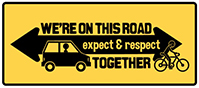
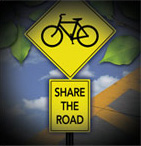
We’re on this road together, expect and respect is the theme of SHA’s new bicycle safety education effort geared to both drivers and bicyclists. In an expansion of past “Share the Road” efforts, the new campaign issues a plea to both drivers and bicyclists to follow the rules and laws of the road and anticipate the needs of each other. Bicycle safety is a two-way street – the safety of bicyclists not only depends upon the bicyclist, but the drivers with whom bicyclists share the road. Bicycles are less visible, quieter, and don’t have a protective barrier around them.
 As the popularity of bicycling grows as a healthy and environmentally friendly way to commute, as well as exercise, SHA is committed to providing “Complete Streets” in Maryland. With each roadway resurfacing project, SHA evaluates the road for bicycle markings and amenities.
  Tips for drivers:
 -
Expect bicyclists on the road.
-
Always keep a safe following distance.
-
In certain conditions, bicycles may position in the center of the lane.
-
Allow at least 3 feet when passing.
-
When turning, yield the right-of-way to bicycles as you would other vehicles.
-
Merge into bike lanes before turning right.
-
Look for bicyclists before opening a car door.
-
Be vigilant when pulling out of driveways or side streets.
-
Watch for children.
-
Stay alert and keep your eyes on the road. It’s illegal to text and use hand held devices while driving.
-
Use turn signals and obey the speed limit.
-
 Bikes are vehicles; obey the rules of the road. Stop at all red lights and stop signs.
 -
Ride defensively – expect the unexpected.
-
Ride with traffic, never against it.
-
Use hand signals when turning or stopping.
-
Stop for pedestrians.
-
Pass on the left when overtaking a vehicle.
-
Use marked bike lanes when present.
-
Never ride more than two abreast.
-
Maryland law restricts bicycles on sidewalks, except where allowed by local ordinance.
-
Make yourself visible day and night with lights, reflectors and gear.
-
Wear a helmet correctly – not tilting back.
Maryland Laws

By Maryland law, bicycles are vehicles, and bicyclists have rights and responsibilities just as do drivers of motor vehicles – but bicycles are less visible, quieter, and don’t have a protective barrier around them.
Motorists should drive carefully around a bicyclist; even a slight mistake can result in serious injury or death. Bicyclists fare best when they act like and are treated as drivers of vehicles.
Traffic Laws for Motorists
|
 |
Traffic Laws for Bicyclists
Maryland law provides for the right-of-way of bicyclists, just as it does for the operators of motor vehicles. Bicyclists also have the duty to obey all traffic signals, signs and pavement markings, just as do drivers.
Riding in Traffic Lanes and on Shoulders
- A bicyclist riding slower than the speed of traffic is confined to the right hand through lane (much the same way as a slow moving vehicle is) and as close to the right side of the road as is safe. A bicyclist can move further left to:
- Make or attempt to make a vehicular style left turn;
- Pass a stopped or slower moving vehicle; or
- Avoid pedestrians or road hazards.
- This ride-to-the-right provision does not apply when operating in a lane that is too narrow for a bicycle to travel safely side-by-side with another vehicle within the lane. The provision also does not apply where the right-hand lane is a turn lane, or the bicyclist is operating on a one-way street. (TR § 21-1205(a))
- A bicyclist riding at the speed of traffic can operate in any lane, just as any other vehicle can..Where there is not a bike lane, a bicyclist may also use the shoulder of the roadway. (TR § 21-1205.1(b))
- Bicycles may not be ridden in the travel lanes of any roadway where the posted maximum speed limit is more than 50 miles an hour; however, bicycles may be operated on the shoulder of these roadways.
- Bicycles may not be operated on expressways (access-controlled freeways and interstate highways), except on an adjacent path or facility approved by the State Highway Administration. (TR § 21-1205.1(a)(2))
Riding in Bike Lanes
|
Where there are marked bicycle lanes paved to a smooth surface, a person operating a bicycle must use the bike lane and may not ride on the roadway, except in the following situations: |
|
 |
|
Equipment Required
|
 |
Campaigns

The Maryland highway safety program includes a comprehensive pedestrian and bicycle safety program that promotes safe pedestrian and bicycle practices, educates drivers to share the road safely with other road users, and encourages safe facilities for pedestrians and bicyclists through a combination of education and engineering strategies. In the Washington DC metro area, the Street Smart Campaign continues to address pedestrian safety issues through coordinated education and enforcement activities.
In 2009 the Street Smart program was expanded to include the Baltimore metropolitan region. Managed through a grant with the Baltimore Metropolitan Council, the Baltimore Street Smart campaign has successfully administered media and public outreach efforts during the month of July, typically the month with the most amount of bicycle and pedestrian crashes, and targeting specific corridors were identified in Baltimore City and Baltimore County.
Components of the Baltimore Street Smart campaign included:
-
Media campaign with Public Service Announcements (utilizing elected officials in Baltimore City and Baltimore County)
-
Email Safety Tips to over 25,000 residents
-
Editorials in numerous newspapers describing the pedestrian and bicycle crash problems
-
Street Teams in High Crash Corridors (Essex and downtown Baltimore City)
-
Literature distribution utilizing geographic-specific information
-
Banner waving to passing motorists
-
Law Enforcement details at identified corridors and neighborhoods
-
-
Campaign Evaluation utilizing web panel surveys
Statewide Bicycle and Pedestrian Safety:
This campaign operates with the Washington Area Bicyclists Association (WABA), and continues to promote the Maryland Pedestrian and Bicycle Safety Education Program in collaboration with the Maryland Safe Routes to School program. Bicycle and pedestrian safety training trailers are used to educate children on basic pedestrian safety issues and bicycle operation skills.
Maryland Highway Safety Office and its Community Traffic Safety Programs
(CTSP) partners distributed more than 200,000 pieces of educational material in 2010, including Street Smart branded materials, school system electronic pedestrian safety alerts, pedestrian safety law cards, booklets for school aged children, copies of the Bicycling in Maryland booklet and the DVD Competence and Confidence: an Adults Guide to Safe Cycling, and other materials.
NEW PROJECTS
Bicycle Safety Law Enforcement Video Training
The Maryland Department of Transportation, under a grant from SHA, is developing a training video for law enforcement agencies and officers on traffic law enforcement for bicyclist safety. For more information on this project, click here.
Bicycle Safety Ambassadors Project
BikeMaryland, under a grant from SHA, is developing a bicycle safety outreach program for the Baltimore City area, targeting high risk areas and populations. For more information on this project, click here.
ADDITIONAL TIPS
For Bicyclists:
|
 |
For Motorists:
|
 |
Resources
Maryland Bicycle Maps
Bicycle Safety Activity Kit for Kids
Resource Guide on Laws relating to Bicycle or Pedestrian Safety
NHTSA’s Bicycle Safety Info Page—Access material for kids, videos, brochures, and more
Maryland Bicycle Safety
Bicycle Safety—It’s a Two Way Street—Advice to Motorists & Bicyclists
Bike to Work Day 2013 (PDF, 175kb)
Source: https://www.roads.maryland.gov/Index.aspx?PageId=357oldId.20131016084715219