
[B’ Spokes: This has relevance to Baltimore and it’s resistance to Road Diets.
by Carol H. Tan, FHWA
Lane
reduction can increase safety for pedestrians, bicyclists, and motorists while
improving the quality of life in downtowns across the country.
 |
| (Before) A road diet conversion helped turn this five-lane Main Street in Pottstown, PA, into a more livable downtown with facilities for motorists and other users. |
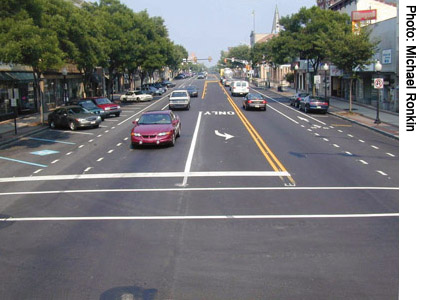 |
| (After) Pottstown’s Main Street after repaving and implementation of a road diet now has travel and bicycle lanes, a center left-turn lane, and parallel parking on one side changed to back-in diagonal parking. Increasing parking can help local businesses attract shoppers. |
…
Benefits
In theory, road diets have potential drawbacks, but in fact,
case studies in a number of States suggest that problems usually do not occur.
Instead, this approach offers a number of benefits in terms of traffic
operations, safety, and livability when applied in the appropriate situations.
…
Lagerwey says, “In general, when you complete a road diet, you can expect close to a 30 percent overall crash reduction factor. There are at least 50 to 60 standard traffic operation tools that we have to reduce crashes. Getting close to a 30 percent crash reduction factor is a really high number in terms of the effectiveness of a particular treatment.”
…
Public Acceptance
Gaining public acceptance is important but can be challenging.
Without the support of the residents and business owners, the road diet may not
happen or, if it is installed, residents may criticize the transportation
department’s efforts. Common concerns include impact on traffic flow,
congestion, cost, increased traffic on neighborhood streets, and access to and
from driveways and side streets.
A transportation agency can address concerns about traffic flow and congestion by providing the results of success stories where road diets improved mobility for all road users. When road diets are applied appropriately, traffic will remain relatively unchanged. Lagerwey offers a word of caution, however: “Pay attention to the signalization to avoid potential backups. See if you need to put in a left-turn arrow so your road diet doesn’t backfire. The public reaction will be that there is a problem — not with the signal, but with the road diet — and they will want to get rid of it.”
…
https://www.fhwa.dot.gov/publications/publicroads/11septoct/05.cfm