
By: Steve Magas
“Share The Road” to me, actually STINKS as a marketing & legal concept… in fact, it’s not “legal” at all…
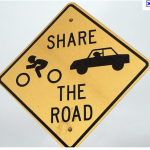
Usually diamond-shaped and yellow, these “warning signs” caution drivers that the road is slippery when wet; there is an intersection ahead, the lanes narrow, or there may be bicyclists, farm animals, or wildlife on or near the roadway. Somehow cyclists are supposed to be comforted by the notion that Big Brother is “protecting” us by putting out a “warning” that we are nearby – as though we are a hazard to motorists...
The whole point of the “SHARED lane” marking is to indicate to motorists that they ought to “share the lane” with cyclists. This entire line of thought has always baffled me, frankly, because it implies that motorists OWN the lane and must be told, or just asked, to “share” a bit of it with cyclists.
“Sharing” is not a concept mandated by law, but a concept that relies upon the goodwill of the Share-or to give up a little bit of that which he owns to the Share-ee. No law says that the motorist owns the road and the cyclist may borrow it sometimes, IF the motorist feels like sharing.
Rather, the law is that a PERSON wishing to use the public roads has the right to CHOOSE the vehicle. A bicycle and a car are equally valid, legitimate and lawful choices as vehicles. A person who chooses to ride a bike on the roadway has exactly and precisely the same quantity or bundle of rights as one who chooses to operate a car.
RIGHT TO TRAVEL – RIGHT TO USE THE ROADS
Remember this –> The rights belong to the person, not the vehicle. The RIGHT is the RIGHT TO TRAVEL. The Right is not bigger if you choose a bigger vehicle…
The “right to travel” has been recognized by the U.S. Supreme Court in U.S. vs. Guest which held citizens hold “… the constitutional right to travel freely from State to State and to use highways and other instrumentalities for that purpose…”
In Packard v. Banton, the Supreme Court said, “The streets belong to the public and are primarily for the use of the public in the ordinary way.”
In Kent v. Dulles, the Court said, “…The Right to travel is part of the Liberty of which the citizen cannot be deprived without due process of law ...”
The Virginia court said, in Thompson v. Smith: “The right of the Citizen to travel upon the public highways …. includes the right, in so doing, to use the ordinary and usual conveyances of the day, and under the existing modes of travel….” While ”ordinary and usual conveyances of the day” is certainly open for discussion bicycles, having been around longer than cars, certainly fit the bill!
With regard to the right to travel and move about the country, a Mississippi court held in Teche Lines Inc. v. Danforth, held as follows:
“…The right of a citizen to travel on public highway is a common right which he has under his right to enjoy “life, liberty, and pursuit of happiness,” and the right to “travel,” which means the right to go from one place to another, includes the right to start, to go forward on the way, and to stop when the traveler’s destination has been reached, and also the right to stop on the way, temporarily, for a legitimate or necessary purpose when that purpose is an immediate incident to travel…”
RIGHT OF WAY LAW
So the PERSON, the “citizen,” not the vehicle, possesses this “right to travel” about the country. But, once you’ve walked into your garage, looked at your car, your truck, your motorcycle and your bike and you chosen to use the public way on ylur BIKE, what “rights” do you have on your bicycle? Most states say you have the SAME bundle of rights as the operator of other vehicles, and the same responsibilities. You don’t get bigger rights because you choose a bigger vehicle!
The person driving in the front of the pack of traffic typically has the “right of way” and the rights of the operator of the vehicle operated behind, or passing, are subservient to the one with the right of way. The “right of way” is a very powerful collection of rights.
In Ohio, for example, the “right of way” is defined in O.R.C. 4511.01:
UU) “Right-of-way” means * * * :
(1) The right of a vehicle, streetcar, trackless trolley, or pedestrian to proceed uninterruptedly in a lawful manner in the direction in which it or the individual is moving in preference to another vehicle, streetcar, trackless trolley, or pedestrian approaching from a different direction into its or the individual’s path;
Note – the word “share” is not in the law. There is no crying in baseball, and there is no “sharing” in the right of way law. So, really, the concept of “sharing” has absolutely no business being in the transportation lexicon. Advising a motorist who is coming up on a bicyclist from behind to “Share The Road” with the cyclist ahead is fundamentally and legally WRONG.
The cyclist owns the right of way and does not have to share… in fact the cyclist shouldn’t “share.” Once the cyclist gets into a “sharing” mentality, the cyclist has lost the battle. You HAVE rights – the right of way. Maybe the motorist doesn’t know this but you have to ASSERT that right. The fact that you have a right means nothing if you don’t USE it.
Remember, the cyclist ahead of the motorist has the right of way – which is really a powerful collection of rights. The right to proceed ahead in an uninterrupted manner. The operator with the right of way has rights, as the preferred vehicle, that are GREATER than other vehicles. A “Share The Road” sign may give the motorist behind the cyclist the wrong message that the motorist can choose to share, or not, since the implication is that the bigger car has bigger rights that supercedes the right of the cyclist.
The motorist is encouraged to view the cyclist as one who has actually SNATCHED HIS RIGHT TO DRIVE HIS CAR away, which ticks off the motorist, who may not WANT to “share” his roadway…
The Right of Way is valuable – it’s important – and it’s something cyclists should not SHARE.
https://ohiobikelawyer.com/uncategorized/2010/09/share-the-road-stinks/oldId.20100926233223340
From GC:
Also to bolster your good points about ‘sharing’:
Universal Declaration of Human
Rights (1948) and the International
Covenant on Civil and Political Rights (1966). Article 13 of the Universal
Declaration of Human Rights, adopted by the U.N. General Assembly, reads,
(1) Everyone has the right to
freedom of movement and residence within the borders of each State.
(2) Everyone has the right to leave
any country, including his own, and to return to his country.
Article
12 of the International Covenant on Civil and Political Rights incorporates
this right into treaty law:
(1) Everyone lawfully within the
territory of a State shall, within that territory, have the right to liberty of
movement and freedom to choose his residence.
(2) Everyone shall be free to leave
any country, including his own.
(3) The above-mentioned rights
shall not be subject to any restrictions except those provided by law, are
necessary to protect national security, public order (ordre public), public
health or morals or the rights and freedoms of others, and are consistent with
the other rights recognized in the present Covenant.
(4) No one shall be arbitrarily
deprived of the right to enter his own country.
The
ICCPR entered into force for the initial ratifying states on 23 March 1976, and
for additional states following their ratification. In 1999, the U.N. Human
Rights Committee, which is charged with interpreting the treaty, issued its
guidelines for Article 12 of the ICCPR in its “General Comment No. 27:
Freedom of Movement”.