

Baltimore’s “It’s the pedestrians fault” ad campaign. I don’t know about you but I feel safer crossing the streets now. :-/
By John Bennett
This sequence of events is becoming awfully easy to predict:
- Pedestrian is killed or injured on a local street that’s dangerous by design.
- News media coverage of the incident uncritically repeats law enforcement warnings that pedestrians should use crosswalks.
- Readers and viewers of news media coverage jump at the chance to share stories about “stupid” pedestrians who represent “a nuisance to motorists” because they don’t use crosswalks.
One interesting thing about WTOC-TV’s coverage was the only cursory mention of a vehicle that hit the pedestrian and left the scene. Instead of exploring that important detail, the report instead spent time blaming the pedestrian for failing to use a crosswalk that does not exist. From the transcript of the broadcast:
“Police say especially when it’s dark the real danger is not using a crosswalk. ‘He was wearing dark clothing the area here is not well lit and it’s not a crosswalk area. Our closest crosswalk is 400 to 500 yards down the road. You know without street lights and dark clothing that’s likely the driver did not see him,’ said [Garden City Police Sgt. Benji] Selph.”
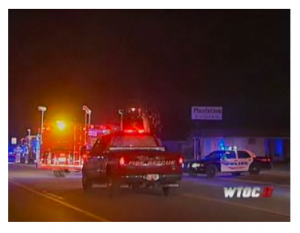 Did you get that? I’ll repeat it again: “Police say especially when it’s dark the real danger is not using a crosswalk.” Sorry, that’s just not true. The real danger is the design of the street itself, which Selph helpfully describes. The crosswalks are hundreds of yards apart and the lighting is poor. And that’s not even mentioning the five lanes of high speed motor vehicle traffic dissecting an urban area in which many residents depend on their feet or bicycles for daily transportation. Crosswalks or not, as long as these factors remain unchanged, people will continue to die on Ogeechee Road. I have no doubt Selph’s advice to use crosswalks was issued with the best intentions. The design of the street, the true culprit in many pedestrian deaths, is beyond his jurisdiction. All he can do is respond to the carnage.
Still, when Selph and his colleagues instinctively repeat the “use crosswalks” mantra, it automatically becomes part of almost every single local news story on pedestrian deaths. Thus, the pedestrian shoulders the blame, even when the closest crosswalk is five football fields away. Do we really expect normal people to walk this far out of the way to cross the street? Really? In a community where able-bodied people feel entitled to park on sidewalks (and usually do so without attracting any attention from law enforcement agencies) in order to save a couple steps?
It appears that we do expect people who walk to endure all sorts of inconveniences we’d never tolerate. And every news story that blames pedestrians for dying on streets that are dangerous by design fuels the unreasonable anger toward people who walk. It reinforces the idea that pedestrians are the problem even when they are not. And it endorses an unfortunate way of thinking about the design of our streets and the behavior of the people who use them, as described in this piece called The Taming of The Motorcar, which was forwarded to me today by a kind Sustainable Savannah reader:
“It is felt that by training the members of the human population, buy teaching them certain tricks, like walking at ‘green’ and stopping at ‘red,’ by putting them behind fences or chains along curbs, their spirit of individuality and independence can be broken so that they will be willing to submit to the regime of the automotive beings.”
Thankfully, that kind of thinking — while still popular among many motorists here in Savannah — was directly contradicted today by a new United States Department of Transportation Policy Statement. U.S. Secretary of Transportation Ray LaHood described this as the end of favoring motorized transportation at the expense of non-motorized. The key recommendations for state departments of transportation and communities include:
• Treat walking and bicycling as equals with other transportation modes.
• Ensure convenient access for people of all ages and abilities.
• Go beyond minimum design standards.
• Collect data on walking and biking trips.
• Set a mode share target for walking and bicycling.
• Protect sidewalks and shared-use paths the same way roadways are protected
• Improve nonmotorized facilities during maintenance projects.
Following these recommendations will not only reduce pedestrian deaths and injuries, they will create healthy and vibrant communities. And that’s something no amount of warning people to use crosswalks will accomplish.
oldId.20100317131241749