
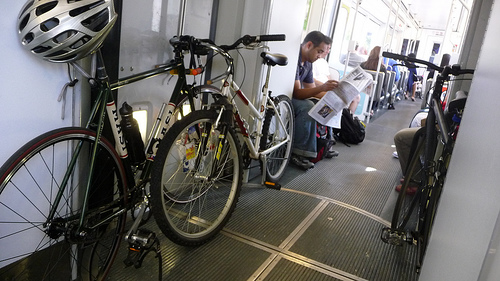
Bikes on Los Angeles County Metro’s Gold Line. Photo by Nate Baird.
…
Kevin Krizek and Eric Stonebraker’s paper Bicycling and Transit: A Marriage Unrealized summarizes the latest trends on the issue, and reports that several studies suggest that recent growth in transit and bicycling modes may be in small part a result of synergy between the two modes. That marriage, still very much in its infancy, can work via at least five broad possibilities:
1. transporting a transit customer’s bicycle aboard (inside or outside) a transit vehicle (see photo above!);
2. using and parking a transit customer’s bicycle at a transit access (or origin) location;
3. sharing a bicycle (publicly or privately provided), primarily based at the transit access point;
4. using a transit customer’s bicycle at the egress (or destination) location;
5. sharing a bicycle (again), but primarily based, this time, at the transit egress point.
The authors focus on four factors that affect the mode share percentage of cycling-transit users (CTUs): 1) transport mode, 2) location in the urban fabric, 3) egress catchment area, and 4) trip purpose.
Their review suggests that transit services that quickly transport users relatively long distances—30 miles plus—with relatively few stops (i.e. commuter rail or express buses) tend to draw larger shares of CTUs than slower and shorter-distance routes. Catchment areas (the area that a transit stop serves) tend to shrink or expand depending on the speed of the transit mode, with bicyclists willing to ride farther for a faster service. Finally, research confirms the obvious observation that most trips are work- and education-related. As such, CTUs often bypass inefficient feeder systems, to save time, while also preferring fastest, most efficient transit services.
…
https://thecityfix.com/bikes-on-board-the-latest-research-on-bicycletransit-integration/oldId.20100209132410127