
WASHINGTON, DC, June 15,
2009 (ENS) – For the first time, the U.S. EPA is opening a competitive grant
program for local and tribal governments that want to establish and implement
climate change initiatives to reduce greenhouse gas emissions in their
communities.
A total of $10 million
will be distributed next January in Climate Showcase Communities grants.
“Ending climate
change and moving to a sustainable, clean energy future begins on the ground in
our communities,” said EPA Administrator Lisa Jackson, announcing the new
grants program today.
“We’re offering a
helping hand to local areas that are leading the way in confronting climate
change, and a call to action for anyone concerned about making a difference
where they live,” she said.
The EPA is requesting
proposals from local governments, federally-recognized Indian tribal
governments, and inter-tribal consortia to create replicable models of
sustainable community action, generate cost-effective greenhouse gas
reductions, and improve the environmental, economic, public health, and social
conditions in a community.
The agency expects to
award about 30 cooperative agreements, each one ranging from $100,000 to
$500,000.
Approximately five
percent of the funds, or about $500,000, is being set aside for tribal
governments.
A 50 percent cost-share
is required for recipients, with the exception of tribal governments and
intertribal consortia, which are exempt from matching requirements under this
grant.
“We can cut energy
costs and reduce harmful emissions at the local level, and build a model for
fighting climate change in every community,”
Jackson said.
The Climate Showcase
Communities grant program aims to create models of sustainable community action
that generate cost-effective and persistent greenhouse gas reductions while
improving the environmental, economic, public health, or social conditions in a
community.
|
|
Knoxville ,
|
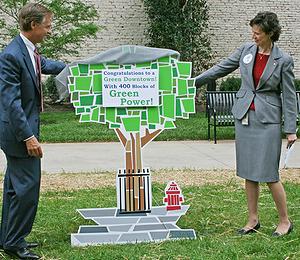
During the grant
program, EPA will offer training and technical support to grant recipients, and
share best practices and lessons learned with communities across the country.
The idea for that
Climate Showcase Communities grants originated with a national coalition of
cities and counties known as Climate Communities. The coalition is managed by
The Ferguson Group, a Washington, DC, government affairs firm focused on
educating federal policymakers about the essential role of local governments in
addressing climate change and promoting a strong local-federal partnership to
reduce greenhouse gas emissions.
Climate Communities
worked with Congressman Norm Dicks, a Washington Democrat who chairs the House
Interior and Environment Appropriations Subcommittee, to create the Climate
Showcase Communities initiative through the Fiscal Year 2009 Appropriations
Bill.
That legislation
authorized EPA to administer the $10 million competitive grant program to help
local and tribal governments accomplish their climate change goals.
Climate Communities
takes the position that local governments are uniquely suited to implement job
creating programs and projects that will reduce energy consumption in
commercial and residential buildings and in the transportation sector by
improving transit and reducing vehicle miles traveled.
Another advocate for
local government action to protect the climate is ICLEI, Local Governments for
Sustainability, which has started a Climate Resilient Communities program that
grant applicants can look to for inspiration.
The city of
Santa Cruz , California ,
for instance, is studying ways to buffer the river levee, counter coastal
erosion and remap flood zones to deal with climate-related sea level rise.
Florida‘s
Miami-Dade
County has formed a Climate Change
Advisory Task Force task force that is developing new standards for buildings,
roads, ports, airports and bridges to deal with sea level rise, sal*censored*er intrusion
and severe weather.
In an effort to prepare
for rising sea levels, temperatures and air pollution associated with climate
change, the San Francisco Bay Conservation and Development Commission now
factors in climate change impacts when considering developments in the region.
New York City is
planning to create an inventory of tunnels, airports, subways and other at-risk
infrastructure.
The state of
Alaska is investigating
how to protect or relocate villages at risk from erosion caused by melting permafrost,
wave surges or flooding associated with climate change. Newtok, Shismaref,
Kivalina, and Shaktoolik are a few of the Native Alaskan villages at risk.
And at least five
states – Alaska , California ,
Maryland , Oregon
and Washington
– are working on statewide climate preparedness plans.
The Climate Showcase
Communities grant program is administered by EPA’s Local Climate and Energy
Program. Click here for additional grant information and an application
form. Climate Showcase Communities grant proposals are due by July 22, 2009, at
4:00 pm EDT. Grants are expected to be awarded in January 2010.
Copyright Environment News
Service (ENS) 2009. All rights reserved.
oldId.20090618182702545