New traffic light aims to improve pedestrian safety in College Park

By Mike Murillo, WTOP

COLLEGE PARK, Md. — Three college students were killed and several others injured this year while attempting to cross a dangerous section of U.S. Route 1 near the University of Maryland-College Park.

The pedestrian fatalities spurred calls for change from students, lawmakers and families of the victims.

On Thursday, the Maryland State Highway Administration (SHA) officially completed a number of safety improvements with the launching of a pedestrian signal at Hartwick Road. The new light stops traffic in all directions when a pedestrian crosses the busy highway.

"SHA fast-tracked these projects because we wanted to ensure we can deliver them in the fall semester," said State Highway Administrator Melinda Peters.

In addition to the new signal, the speed limit has been lowered to 25 mph, speed cameras became active 24/7 and a median fence was erected to encourage pedestrians to use the crosswalks.

https://www.wtop.com/?nid=893&sid=3718988

@@@@@@@@@@@@@@@@@@@@@@

[B’ Spokes: This is much better than my last report on this area. Are they finally starting to get that you address all users of a road?
Let’s force pedestrians to cross where they are getting killed for safety – Route 1 in College Park
https://www.baltimorespokes.org/article.php?story=2014071720391011 ]

U.S. Transportation Secretary Foxx Announces New Initiative to Enhance Pedestrian and Bicycle Safety

image

DOT 81-14
Wednesday, September 10, 2014
Contact:  DOT Press OfficeT
el.: (202) 366-4570 

U.S. Transportation Secretary Foxx Announces New Initiative to Enhance Pedestrian and Bicycle Safety
DOT to launch nationwide safety assessment of key bike/ped routes 

PITTSBURGH – U.S. Transportation Secretary Anthony Foxx today announced a new initiative to reduce the growing number of pedestrian and bicyclist injuries and fatalities through a comprehensive approach that addresses infrastructure safety, education, vehicle safety and data collection.  The 18-month campaign will begin with road safety assessments conducted by U.S. Department of Transportation field offices in every state, and will produce multiple resources to help communities build streets that are safer for people walking, bicycling, and taking public transportation. Secretary Foxx made the announcement at the Pro Walk, Pro Bike, Pro Place conference, the largest gathering of, transportation engineers, city planners and professional bicycle-pedestrian safety advocates and practitioners in the country. 

“Safety is our highest priority and that commitment is the same regardless of which form of transportation people choose, including walking and biking,” Secretary Foxx said.  “This initiative is aimed at reversing the recent rise in deaths and injuries among the growing number of Americans who bicycle or walk to work, to reach public transportation and to other important destinations.”  

Injuries and fatalities of pedestrian and people bicycling have steadily increased since 2009, at a rate higher than motor vehicle fatalities.  From 2011 to 2012, pedestrian deaths rose 6 percent and bicyclist fatalities went up almost 7 percent. 

The new pedestrian and bicycle safety initiative will promote design improvements to ensure safe and efficient routes for pedestrians and bicycles, promote behavioral safety, and provide education to help individuals make safer travel choices. The initiative will also encourage vehicle safety by drawing on current crash avoidance technologies to alert motorists to the presence of bicyclists and pedestrians. 

The initiative will begin when the Department’s Federal Highway Administration (FHWA), Federal Transit Administration (FTA) and National Highway Traffic Safety Administration (NHTSA) field offices survey routes for pedestrians and cyclists with local transportation officials and stakeholders to understand where and why gaps exist in the non-motorized transportation network and strategize on ways to close them.  Gaps are areas where the risk of a crash increases due to the lack of sidewalks or other safe infrastructure. The Department’s Federal Motor Carrier Safety Administration (FMCSA) and Federal Railroad Administration (FRA) will participate in assessments to gain understanding of non-motorized crashes involving truck and trains.  

Among the many resources the Department will provide will be a guide to creating “road diets,” in which roadways with lower traffic volumes are redesigned to add space for bicycle riders and pedestrians.  Studies show that road diets reduce all traffic crashes by an average of 29 percent, and when used on rural highways that pass through small towns, they can reduce crashes by almost half – 47 percent.  Additional resources will help practitioners incorporate small safety improvements into many road projects, address “last mile” safety for people taking buses and trains, and make it easier for jurisdictions to count and plan for people traveling by foot and bicycle. 

The Department will work with local officials, advocacy groups, and safety organizations to help champion the use of the new resources by practitioners, law enforcement, and safety organizations.  It also will convene meetings with practitioners and researchers about practices and policies that have been barriers to creating safer streets for non-motorized users. 

The initiative will also focus on improving pedestrian and bicycle routes that provide access to bus stops and train stations.  Research has shown that lower income communities have disproportionately higher rates of pedestrian deaths, as well as less safe pedestrian infrastructure, despite higher reliance on non-motorized modes and public transportation. 

Click here for additional information on the pedestrian and bicycle safety initiative. 

 

https://content.govdelivery.com/accounts/USDOT/bulletins/ceb80a

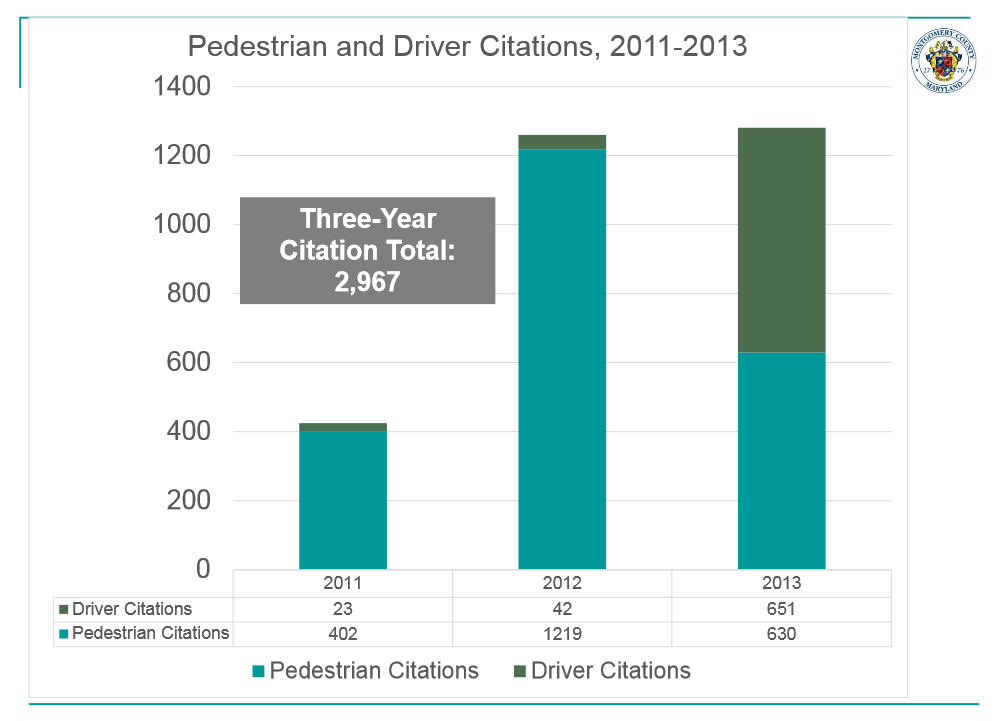
Statistics Show Shift in Citations of Drivers, Pedestrians for Crosswalk Violations

By ANDREW METCALF, Bethesda Magazine


“The police department made a very conscious shift,” Councilmember Hans Riemer said. “It’s deliberate and represents an evolution in their enforcement strategy.”

image

He said police are conducting about two to three crosswalk stings per week, but have plans to increase that number to five or six per week. McCullough said the department could increase the number of stings if it could pay more overtime to officers for traffic enforcement.

https://www.bethesdamagazine.com/Bethesda-Beat/2014/Statistics-Show-Shift-in-Citations-of-Drivers-Pedestrians-for-Crosswalk-Violations/

Residents aim to improve Annapolis bike trail access, safety

By Tim Prudente, Capital Gazette

Jon Korin would solve city problems with bicycles.

Less traffic, parking challenges and Chesapeake Bay pollution if more people pedaled.

"If none of those benefits work for you, then do it because it drives the economy," said the Severna Park bicyclist. "Cycling tourism is huge."

Bicycling will be celebrated Wednesday when city officials proclaim it "East Coast Greenway Day" in Annapolis.

"Once you get over the Naval Academy Bridge, then you’ve got to ride with cars along Route 450, turn left on King George Street and over the Spa Creek bridge," he said. "My dream is to see designated bike lanes that give cyclists a safer place to ride."

City spokeswoman Rhonda Wardlaw said officials recognize the gap, but downtown streets aren’t wide enough to accommodate parking and bike lanes. There’s no plan at this time, she said, to enhance the route downtown.

"The city currently has numerous terrific, but disconnected trails," she said. "(We) would like to see our various departments work with (BikeAAA) to see how we could participate in the greenway project."

She said the proclamation of "East Coast Greenway Day" will promote safe bicycling and healthy living.

https://touch.capitalgazette.com/#section/-1/article/p2p-81600821/

Why 12-Foot Traffic Lanes Are Disastrous for Safety and Must Be Replaced Now

By JEFF SPECK, City Lab
States and counties believe that wider lanes are safer. And in this belief, they are dead wrong.

When lanes are built too wide, pedestrians are forced to walk further across streets on which cars are moving too fast and bikes don’t fit.

"Yeah, you’ve got your studies that say that 10-foot lanes are safer than 12-foot lanes. But I’ve got a pile of studies this high," he insisted, waving at his hip, "that say the opposite."
"Wonderful," I said. "May I see them?"
"No. They’re from the early days. I threw them out."

https://www.citylab.com/design/2014/10/why-12-foot-traffic-lanes-are-disastrous-for-safety-and-must-be-replaced-now/381117/

Many drivers ignoring crosswalk law: study

By Jon Hilkevitch, CHICAGO TRIBUNE
Most drivers tracked in a new Chicago-area survey failed to comply with a state law requiring them to stop for pedestrians, a finding that the research’s backers attribute to inadequate police enforcement and education on traffic-safety laws.
But the results suggest that driver compliance with the must-stop law may be significantly improved if more visual warning cues are placed at crosswalks.
The survey, conducted by the automobile-alternative advocacy group Active Transportation Alliance, concluded that motorists in the area disregard a state crosswalk protection law more often than they comply with it in many circumstances.
In the observational survey conducted at 52 locations in Chicago and nearby suburbs, 61 percent of motorists did stop for pedestrians at painted crosswalks that also had other safety features, including in-road "stop for pedestrians” signs, brick or stone crosswalks, raised crosswalks or flashing beacons, according to the alliance, which carried out 208 individual trials, four at each of the locations.
But compliance with a four-year-old statewide law requiring drivers to stop whenever a pedestrian has entered a crosswalk was only about 18 percent on average when the pedestrians attempted to cross a street in a traditional painted crosswalk, the survey found.
And the compliance rate plummeted to almost 5 percent at unmarked crosswalks. Under the law, a crosswalk is present whenever a sidewalk leads into the street, regardless of any markings present.

https://www.chicagotribune.com/news/hilkevitch/ct-crosswalk-survey-getting-around-met-0908-20140907-column.html

Crossing A Double Yellow Line

by Eli Damon, Co-author: Steven Goodridge, I am Traffic


How did we get here?

In response to motorist errors, traffic engineers began marking no-passing zones in areas where the sight distance was inadequate to safely pass a vehicle traveling just below the maximum posted speed limit.

Over time, solid centerlines proliferated over a larger percentage of roadway miles. Engineers marked them extending out several hundred feet from intersections, in areas with driveways, and anywhere else that the engineers considered unsafe for passing, particularly at high speed. The formulas and tables used to determine where to place solid centerlines assumed that the vehicle being passed was traveling near the maximum posted speed limit1, so that dashed center lines, indicating permission to pass, became quite rare. On many two-lane roads, solid centerlines continue for miles at a time, with no dashed sections at all.

The markings that traffic engineers placed on most miles of two-lane roads did not communicate a reasonably convenient process for passing low-speed vehicles.

What’s the problem?

In most of the United States, a motorist is not clearly permitted to cross a solid centerline to pass a cyclist when it is safe to do so. Yet practically all drivers do so rather than continue to follow the cyclist at reduced speed. Drivers recognize that current striping policies for no-passing zones are overly restrictive in the context of low-speed vehicles. Mathematical analysis bears this out. For instance, safely passing a motorist traveling at 35 mph on a 45 mph road requires a sight distance 600 feet longer than passing a 15 mph bicyclist on the same road.

The legal ambiguity around crossing a solid centerline line is a source of conflict for cyclists, motorists, police officers, and driving instructors. Motorists can be unnecessarily inconvenienced because they believe that they are not allowed to pass a cyclist. Their frustration can lead to resentment and hostility toward cyclists. It can even lead to riskier behavior and crashes. A motorist might honk or yell at cyclists or might buzz them to avoid crossing a solid centerline. In the worst cases, motorists have attempted to squeeze past cyclists within the same lane and fatally struck the cyclists.

Can we fix this thing?

Model No-Passing-Zone Exception

When passing a pedestrian, bicycle, tractor, or other slow moving vehicle, the operator of a vehicle may drive on the left side of the center of a roadway in a no-passing zone when such movement can be made in safety and without interfering with or endangering other traffic on the highway.

We ask that legislators modernize their passing laws to reflect safe and practical passing practices, and that cycling advocates make a priority of lobbying them to do so.

https://iamtraffic.org/engineering/crossing-double-yellow-line/

Good cities need more streets that “fail”

BY DAVE CIESLEWICZ, Wisconsin Bike Fed
How do we measure a successful street?
Well, traditionally we’ve allowed traffic engineers, focused on moving cars, to create that measure. They’ve developed a grading system for streets called “Level of Service” or LOS.
But here’s the problem. If you look at a LOS map of many of the downtowns and neighborhoods that we love the best you’ll see almost nothing but level of service “D” and “F”. In other words, by the measure of moving cars our streets are failing or nearly failing. And if you ranked streets by friendliness to bicyclists and pedestrians the maps would look very different.
At the Pro Walk/Pro Bike conference in Pittsburgh last week I heard a compelling argument to forget about LOS in most urban environments altogether. After all, a city is not a place for cars to move efficiently. And if you make it that you’ve almost certainly lost all the things that make your city a good place to be. You’ve destroyed your city in order to save it.
We need to start thinking of cities as something more than impediments to the smooth movement of traffic. MIT engineer Jeff Rosenblum presented a study of one street in Cambridge, which was treated with a road diet – fewer lanes, broader sidewalks, bump-outs at pedestrian crossings, wider terraces. That street moved 20,000 cars a day before this treatment. And afterwards? It still moves 20,000 vehicles a day. By restricting turns and timing stop and go lights the street was made more efficient for cars just as it was made more welcoming for biking, walking, hanging out and just living.

https://wisconsinbikefed.org/2014/09/19/good-cities-need-more-streets-that-fail/