Fire truck issues with street designs

B’ Spokes: Once and a while someone will say that we can’t build bike/ped friendly infrastructure on our streets because it will delay fire truck response time. Usually this is because of the width and turning radius of fire trucks. If only there was a better fire truck…

Alert: Fix severed bike route NOW!

Update: Meeting planned for mid to late november thanks to Rikki Spector’s help.


[B’ Spokes: I go away for a few years and look what they did to my bike route. 🙁
I personally find it repulsive that in this day and age when they “upgrade” an intersection not only did they not include any consideration for pedestrians they made it even more dangerous for pedestrians to cross. And basically once you accommodate pedestrians, bicyclists can easily be accommodated as well. To state the obvious, if you accommodate motorist to turn left then cyclists can turn left as well.]

Google mapGoogle maps

no left turn allowedNote the double right turn only and no crosswalks. (Looking north.)

LAW: TR § 2-602.(3) As to any new transportation project or improvement to an existing transportation facility, the Department shall work to ensure that transportation options for pedestrians and bicycle riders will be enhanced and that pedestrian and bicycle access to transportation facilities will not be NEGATIVELY impacted by the project or improvement;

COUNCIL BILL 09-0176R
5. Cyclists have the right to routine accommodations in all roadway projects and improvements.
6. Cyclists have the right to urban and roadway planning, development, and design that enable and support safe cycling.
7. Cyclists have the right to traffic signals, signage, and maintenance standards that enable and support safe cycling.


Need

We need more accommodations for cyclists and pedestrians in Baltimore not less!


If there was an award for the most inappropriate transportation “improvement” this has to be a contender for first place, as it symbolizes all that is wrong with old school transportation planning. We need to end transportation planning that has the ideals that the mode that travels the fastest and furthest with ease needs to travel even faster (typically measured in seconds) and needs the most direct routes. While the modes that are slower and have limited distance range would not mind going out of their way and going much slower (typically measured by half hour increases.)
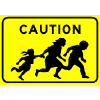
image
W54-Special (California) – Freeway Pedestrian –

gif (yellow)
via https://www.trafficsign.us/

Maybe we should install some of these signs, not for the motorists but for the pedestrians to show how they need to cross 6 lanes of traffic. Of course I am being facetious but my point is just because a mode is not accommodated does not mean they go away. You can see by Google satellite imagery there is a “goat path” along the northern side of Northern Parkway, that is till the guard rail gets in the way just before the intersection. I’m so flabbergasted that rather than improving the situation here for pedestrians they actually made it worse by removing the stop phase for westbound Northern Parkway traffic on a blind curve no less. Seriously, no thought for even a crosswalk here and you call that an improvement? We had engineers looking at this intersection and this is the best they could come up with?

The case for cyclists is easier, the route was master planned and usable for years and now it’s not legal or safe and it was made that way in violation of law. But for even more support this connects the northern portion of the Jones Falls trail to my neighborhood and no it’s not cool just to wait for when the trail is finally built even further east to cross Northern Parkway. 1) there is the time waiting and 2) it will not be near this intersection (see my first point about increasing distance for slower modes.) Pedestrians need to be accommodated here and if pedestrians are accommodated then cyclists can be easily added as well.


Action

  • If you are tired of too many intersection dialed up to only accommodate motorists with no thought of cyclists and pedestrians.
  • If you are tired of the city erasing bike lanes within a week of installation for unstated safety reasons but when our safety and right to travel has been curtailed the city drags its feet.
  • Making slow and steady progress in accommodating cyclists is dependent on not losing any ground, yet metrics like the Bicycle Level of Service has remained unchanged over the years because we are losing ground as fast as we are gaining.
  • Service request 13-00749905 has been entered and a due date of 3/23/2014 is unacceptable.

While efforts to improve conditions for bicycling in the
region have been robust in the time since the 1999 analysis,
the 2004 [the most recent data] value distribution is statistically identical.
https://www.baltometro.org/reports/BikePedLOS.pdf

Write:
mayor@baltimorecity.gov
transportation@baltimorecity.gov
Your city council rep (look up)
Your state senator and delegates (Look up) as they should know when local goverments activly engaged in making the streets unsafe for pedestrains and cyclists.
(Be sure to include your full name, address and phone number.)
Continue reading “Alert: Fix severed bike route NOW!”

BICYCLE SAFETY

From MDOT!!!

Respect Banner - We're on this road together.

We’re on this road together, expect and respect
is the theme of SHA’s new bicycle safety education effort geared to both drivers and bicyclists.  In an expansion of past “Share the Road” efforts, the new campaign issues a plea to both drivers and bicyclists to follow the rules and laws of the road and anticipate the needs of each other.  Bicycle safety is a two-way street – the safety of bicyclists not only depends upon the bicyclist, but the drivers with whom bicyclists share the road. Bicycles are less visible, quieter, and don’t have a protective barrier around them.
 
We're on this road expect and respect together.As the popularity of bicycling grows as a healthy and environmentally friendly way to commute, as well as exercise, SHA is committed to providing “Complete Streets” in Maryland.  With each roadway resurfacing project, SHA evaluates the road for bicycle markings and amenities. 

 
Most drivers tend to look for other drivers, and may unintentionally overlook our friends on two-wheels. Even the slightest mistake on the part of the driver can result in tragic consequences for the bicyclist. 
 
Bicyclists fare best when they act like and are treated as drivers of vehicles.  By Maryland law, bicycles are vehicles, and bicyclists have the same rights and responsibilities as drivers of motor vehicles.  Staying visible to drivers is key, so bicyclists need to ride in a predictable manner and take important steps to wear the proper gear and equip bicycles appropriately.
 
Drive Smart!Tips for drivers:     
  • Expect bicyclists on the road.
  • Always keep a safe following distance.
  • In certain conditions, bicycles may position in the center of the lane.
  • Allow at least 3 feet when passing.
  • When turning, yield the right-of-way to bicycles as you would other vehicles.
  • Merge into bike lanes before turning right.
  • Look for bicyclists before opening a car door.
  • Be vigilant when pulling out of driveways or side streets.
  • Watch for children.
  • Stay alert and keep your eyes on the road.  It’s illegal to text and use hand held devices while driving.
  • Use turn signals and obey the speed limit.
Tips for bicyclists:
  • Bike Smart!Bikes are vehicles; obey the rules of the road.  Stop at all red lights and stop signs.
  • Ride defensively – expect the unexpected.
  • Ride with traffic, never against it.
  • Use hand signals when turning or stopping.
  • Stop for pedestrians.
  • Pass on the left when overtaking a vehicle.
  • Use marked bike lanes when present.
  • Never ride more than two abreast.
  • Maryland law restricts bicycles on sidewalks, except where allowed by local ordinance.
  • Make yourself visible day and night with lights, reflectors and gear.
  • Wear a helmet correctly – not tilting back. 

Continue reading “BICYCLE SAFETY”

Amtrak tests bicycle roll-on service on Capitol Limited route between Pittsburgh and D.C.

By Jon Schmitz / Pittsburgh Post-Gazette
Linda McKenna Boxx said she has been trying for more than a decade to get Amtrak to improve accommodations for bicycles on its Pittsburgh-to-Washington, D.C., trains, which closely follow the trails that connect the two cities.
On Tuesday, that goal moved a step closer to reality, when Amtrak allowed 20 bicyclists to take their two-wheelers onto the Capitol Limited train in Pittsburgh in a one-day trial of roll-on service.

https://www.post-gazette.com/stories/local/region/amtrak-tests-bicycle-roll-on-service-on-capitol-limited-route-between-pittsburgh-and-dc-707669/

8-9-13 MBPAC Meeting Minutes Comments

Jim Swift noticed that there were a couple of outdated laws in the current version of the fine or penalty deposit schedule for violations of vehicle laws as published by the District Court of Maryland. The outdated laws were the requirement that bicyclists must use shoulders and have bells on their bicycles. Peace officers rely on this fine schedule when writing traffic citations. He proposed that MBPAC send a letter to the District Court requesting that the fine schedule be revised to show the current laws.

[B’ Spokes: I thought that was interesting.]

(The above will be posted soon on this page: https://www.mdot.maryland.gov/Office_of_Planning_and_Capital_Programming/Bicycle/MBPAC.html)


And this from the Government and Legislative Affairs Subcommittee:
image

[B’ Spokes: I find it rather ironic that WMATA is not a Maryland state agency while MTA is a state agency (which MBPAC can advise) and has no such pointed understanding of bicycle and pedestrian issues that is given to Baltimore Metro bus drivers. Not that there is anything wrong with pointing out something nice happening within the state but still I for one would like to see more support of at least getting Baltimore Metro area bus drivers up to the same level of bicycle friendliness I see in DC and Montgomery County.]

Bikeability-trained kids cycle more, finds study

by Carlton Reid, Bike Biz
School kids who have undertaken Bikeability training use their bicycles more frequently than untrained children of the same age.

Bikeability training leads to an uplift of 12.6 percent in the amount of children who cycle to school. Training also leads to an 11 percent increase in the amount of cycling children do with their families away from school.

“Most children want to ride their bikes but often their parents are understandably reluctant to let them, even though they know that cycling is good for health. Bikeability is designed to give children the skills and confidence to ride well and to give their parents reassurance.”
In England Bikeability is funded by the Department for Transport and Transport for London and is offered free to about 50 percent of primary school children, mostly in urban and suburban settings. Most training occurs during school time in years 5 and 6.
https://www.bikebiz.com/news/read/bikeability-trained-kids-cycle-more-finds-study
***************************************************************************************
[B’ Spokes: I will note that from my informal polls parents are the ones that teach kids to ride against traffic and to ride on the sidewalk. We need something to address this wrong kind of thinking.

Get moving: Creating a research strategy for active cities

By Ben Welle, The City Fix

Many cities around the globe are home to dangerous roads, social stigmas that bicycling is “for the poor,” and urban designs that neglect walking and bicycling. Photo by Slightly-less-random.

Cities around the globe are seeing a creeping problem of growing physical inactivity, due in part to the lack of pleasurable every-day walking and bicycling. While in some cities there are ample facilities for a refreshing commute on bicycle, a leisurely stroll to the neighborhood market or park, or the ability to walk to high-quality public transport, many of the world’s metropolises are home to dangerous roads, social stigmas that bicycling is “for the poor,” and urban designs that neglect walking and bicycling.

The Problem

Physical inactivity currently causes 3.2 million deaths worldwide every year, and a growing number of the world’s inactive population comes from low- and middle-income countries.

https://thecityfix.com/blog/get-moving-creating-research-strategy-for-active-cities-active-transport-ben-welle/