Health Economic Assessment Tool (HEAT)

by World Health Organization (WHO), via walkinginfo.org

This tool is designed to help you conduct an economic assessment of the health benefits of walking or cycling by estimating the value of reduced mortality that results from specified amounts of walking or cycling.

The tool can be used in a number of different situations, for example:

  • when planning a new piece of cycling or walking infrastructure.HEAT attaches a value to the estimated level of cycling or walking when the new infrastructure is in place. This can be compared to the costs of implementing different interventions to produce a benefit-cost ratio (and help to make the case for investment)
  • to value the reduced mortality from past and/or current levels of cycling or walking, such as to a specific workplace, across a city or in a country. It can also be used to illustrate economic consequences from a potential future change in levels of cycling or walking.
  • to provide input into more comprehensive economic appraisal exercises, or prospective health impact assessments. For example, to estimate the mortality benefits from achieving targets to increase cycling or walking, or from the results of an intervention project.

Continue reading “Health Economic Assessment Tool (HEAT)”

Spotlight on Pedestrian Safety

[B’ Spokes: Have you noticed how few places in Maryland have high-visibility crosswalks? There is a reason why we have the forth highest pedestrian fatality rate. Those that were worse are making improvements mentioned in this article.]


by Tamara Redmon, Dan Gelinne, Leah Walton, and Jeff Miller, FHWA

FHWA’s aggressive approach to reducing the fatality rate in
13 States and 5 municipalities is showing promising results.

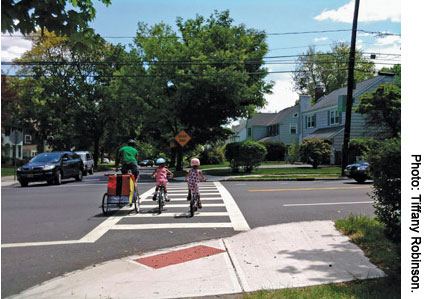
Focus cities have installed high-visibility crosswalks, such as this one in Montclair, NJ, in a number of locations to improve pedestrian safety.
Focus cities have installed high-visibility crosswalks, such as this one in Montclair, NJ, in a number of locations to improve
pedestrian safety.

For the past 7.5 years, the Federal Highway Administration
(FHWA) has been trying to aggressively reduce pedestrian deaths by focusing
extra resources on the States and cities with the highest numbers or rates of
pedestrian fatalities. In recent years, 13 States experienced pedestrian
fatalities above 150 per year and above the national rate of 2.5 per 100,000
population. In 2003 those States were Arizona, California, Florida, Georgia,
Hawaii, Illinois, Michigan, New Jersey, New Mexico, New York, North Carolina,
Pennsylvania, and Texas. An increase in Nevada’s rate later added it to the
list, while Michigan dropped off in 2007. In addition, five cities had the
highest number of fatalities per year: Chicago, IL; Detroit, MI; Los Angeles,
CA; New York, NY; and Phoenix, AZ. Washington, DC, later went on the list, and
Detroit dropped off (only to rejoin in 2011).

To address this challenge,
FHWA’s Focused Approach to Pedestrian Safety project began with a memorandum
dated May 2004 outlining the goal of reducing pedestrian fatalities by 10
percent by the year 2008 (goal later changed to 2011).


Continue reading “Spotlight on Pedestrian Safety”

Bishop Bikes

By Nick Legan, velonews


Baltimore, Maryland isn’t known as a hotbed for hand-built bicycles. But Chris Bishop is putting it firmly on the map with his chess piece logo and award-winning framesets. His 1970’s California framebuilder style track bike won Best Steel Construction this year. New for 2012, frames entered in this category had to be unpainted.

Bishop drilled the rear fork ends, custom machined the fork crown and bottom bracket shell, fillet brazed the lugs to sculpt them and then joined tubes using silver brazing. The bike was built to Bishop’s personal dimensions, but added that, “my wife’s pregnant, so everything’s for sale.”

As word gets around about the quality of Bishop’s frames, supporting his new family should get easier and easier.
Continue reading “Bishop Bikes”

Going on a Road Diet

[B’ Spokes: This has relevance to Baltimore and it’s resistance to Road Diets.


by Carol H. Tan, FHWA

Lane
reduction can increase safety for pedestrians, bicyclists, and motorists while
improving the quality of life in downtowns across the country.

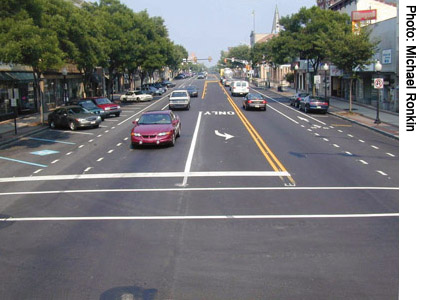
(Before) A road diet conversion helped turn this five-lane Main Street in Pottstown, PA, into a more livable downtown with facilities for motorists and other users.
(After) Pottstown’s Main Street after repaving and implementation of a road diet now has travel and bicycle lanes, a center left-turn lane, and parallel parking on one side changed to back-in diagonal parking. Increasing parking can help local businesses attract shoppers.

Benefits

In theory, road diets have potential drawbacks, but in fact,
case studies in a number of States suggest that problems usually do not occur.
Instead, this approach offers a number of benefits in terms of traffic
operations, safety, and livability when applied in the appropriate situations.

Lagerwey says, “In general, when you complete a road diet, you can expect close to a 30 percent overall crash reduction factor. There are at least 50 to 60 standard traffic operation tools that we have to reduce crashes. Getting close to a 30 percent crash reduction factor is a really high number in terms of the effectiveness of a particular treatment.”

Public Acceptance

Gaining public acceptance is important but can be challenging.
Without the support of the residents and business owners, the road diet may not
happen or, if it is installed, residents may criticize the transportation
department’s efforts. Common concerns include impact on traffic flow,
congestion, cost, increased traffic on neighborhood streets, and access to and
from driveways and side streets.

A transportation agency can address concerns about traffic flow and congestion by providing the results of success stories where road diets improved mobility for all road users. When road diets are applied appropriately, traffic will remain relatively unchanged. Lagerwey offers a word of caution, however: “Pay attention to the signalization to avoid potential backups. See if you need to put in a left-turn arrow so your road diet doesn’t backfire. The public reaction will be that there is a problem — not with the signal, but with the road diet — and they will want to get rid of it.”

https://www.fhwa.dot.gov/publications/publicroads/11septoct/05.cfm

Hagerstown road projects list

By C.J. LOVELACE , Herald Mail

Fourth on the priorities list is a proposed Civil War Railroad Trail, which is a 24-mile scenic pedestrian and bicycle trail connecting Hagerstown to Weverton that would promote tourism, recreation and healthy living.
The final priority is the city’s retrofit sidewalk program and the Safe Routes to School Program, which has been used in the past.
Recent legislation requires local jurisdictions to submit their priorities by April, although Department of Transportation officials won’t tour the state until late 2012.

Continue reading “Hagerstown road projects list”

Cardin Annapolis Reports: Week 10 — Moving Forward

From newsletter

 
Jon Cardin 11th District State Delegate
Cardin Annapolis Reports: Moving Forward

by Jon Cardin
March 16, 2012

It’s been a very busy week for my staff and me, including three bill hearings in two different committees on top of marathon hearings in my Ways and Means Committee.  Don’t forget that our crucial primary election is fast approaching, April 3.  See the last paragraph for more information!
On Tuesday, I advocated for two of my three bills pertaining to bicycle safety and infrastructure.  First, HB1178 is a legislative response to last year’s tragic death of 20 year-old Johns Hopkins student Nathan Krasnopoler.  While riding in the designated bicycle lane, wearing all appropriate safety gear and adhering to all applicable rules of the road, Nathan was struck by an 83 year-old driver and left trapped beneath the weight of the vehicle for nearly 20 minutes.  The driver neither called for help nor notified onlookers.  My bill, developed with the Krasnopoler family, would increase the points assessed to drivers convicted of failure to either provide or call for aid after an accident resulting in death or bodily injury.  Second, HB1278 would
require each public institution of higher education to develop a “facility master plan” to address bicycle and pedestrian circulation on and near campus, including measures to incorporate existing infrastructure and to promote biking and walking on the campus.  My third bicycle safety-related bill will be heard in committee this Tuesday.  HB1397 would strengthen last year’s “3-Foot Rule” to allow drivers to pass cyclists and other non-cars on the roadways at a safe distance in an otherwise non-passing zone, under certain safe conditions.

The Road to Complete Streets in Baltimore and Beyond

by Stu Sirota, Envision Baltimore

If you haven’t heard by now, a remarkable thing has just happened in Baltimore. If it stands, it will long be remembered as a turning point in local transportation history: Baltimore City transportation officials have selected a “Complete Streets” configuration for Boston Street in conjunction with the planned Red Line light rail line.

What this means is that the current configuration of Boston Street – which became a fast moving 4-lane, suburban-style arterial roadway about twenty years ago – will eventually be transformed into a 2-lane urban waterfront street with exclusive space for the light rail, bike lanes, and enhanced pedestrian facilities and landscaping. The new configuration will calm traffic along Boston Street by discouraging speeding, while encouraging more walking, biking, outdoor lingering, café dining, and transit use along the corridor.

A New Day

Selecting the Boston Street Completes Street option is a testament to the courage and leadership of the Baltimore Department of Transportation (BDOT), which, in recent years, has been willing to take some chances on progressive initiatives aimed at making the city more livable and less traffic-dominated.

Emerging Advocacy amid Stumbling Blocks

A key factor that has fostered BDOT’s ability to take a more progressive approach is the increasing support among the general public for complete streets and sustainable transportation infrastructure, particularly for things like bike lanes and attractive surface transit that become an integral and visible part of the public realm. New advocacy groups like RedLine Now, The Downtown Baltimore Family Alliance, and a newly formed Baltimore cycling advocacy organization, are all prime examples of the growing interest in urban living that relies less on driving and creates more hospitable environments for walking, cycling, and transit.

Despite its good efforts and intentions, BDOT can’t implement these innovative projects without broad public support. This was starkly illustrated last year when BDOT installed a bike lane on Monroe Street in West Baltimore by removing one of the travel lanes. Despite the street having a relatively low volume of car traffic, the bike lane was met with vocal community opposition and the lane was subsequently removed.

Continue reading “The Road to Complete Streets in Baltimore and Beyond”

Spoke Bicycle Insurance

[B’ Spokes: No relation and not an endorsement, just something I think is a cool idea.]
*****************************************************************************************************

"Its like auto insurance for your bicycle."

SPOKE BICYCLE INSURANCE is the first of its kind; a comprehensive stand-alone bicycle insurance program available to individual riders in the USA.

Our bike insurance programs were developed with professional input from legal experts in the cycling field, bicycling industry consultants and representatives of national and regional cycling clubs and organizations.

We’re bicycle people just like you. At Spoke Bicycle Insurance, we understand the risks facing the cycling public and our mission is to provide much needed insurance coverage to this under-represented community.

The Spoke Bicycle Insurance program wants its clients to have the same level of protection afforded to other users of the road. We back up our bicycle insurance program with an "AM Best A-rated carrier". Insurance brokers RE Chaix and associates administrate Spoke Bicycle Insurance programs and Sports Insurance Solutions is the retail agency responsible for providing coverage to Spoke Bicycle Insurance customers. Our knowledgeable team is very excited about our unique bicycle coverage. We are dedicated to promoting safe cycling and helping our clients secure the coverage that is right for them.

https://www.spokeinsurance.com/html/index.php