
Hell on two wheels
By The Baltimore Guide
Lance Armstrong might have some competition.
OK, maybe not. But Baltimore Ravens’ linebacker Ray Lewis admitted he’s fallen in love with cycling, a sport he’s incorporated into his offseason training program. While away from football during the lengthy labor dispute, Lewis rode his bike to better his endurance.
On the Ravens’ first day of training camp Thursday, Lewis looked conditioned and didn’t miss a beat.
“I think cycling is one of the greatest sports in the world,” Lewis said. “The respect of what kind of cardio shape that gets you in, with low impact. That’s the key to it, to really train as hard as you can, to get your heart rate as high as you can get it and then come back and do it the next day, without that pounding. I credit a lot of my training to my cycling.”
…
Continue reading “Hell on two wheels”
Trees before Grand Prix!
UPDATE: City: Grand Prix to plant many more trees than it cuts

OVERVIEW
Everyone agrees on the benefits of trees – including the Baltimore Grand Prix race organizers (link). However, they seek to remove 136 or more healthy, mature trees and replace them with 139 “new” trees, a significant percentage of which will be in planters (for transportability for future races.)
Race organizers say that the trees need to come down in order to “improve sight lines” for race specators – presumably allowing greater attendance, and higher ticket prices.
“New” trees (which may have a 2″ caliper diameter) do not provide anywhere near the benefits that a mature tree can. Furthermore, the aesthetic quality of trees in planters is significantly lower than a mature established tree.
We believe that sacrificing established trees to increase profits for race organizers is unfair and should have been more open to public discussion and, if executed at all, done in compliance with the law.
When the subject of trees first came up last fall, race organizers used mild-mannered words like “uproot and replant,” to describe their plans, but it seems that the plan all along was to clearcut. We seek to halt any new cutting, determine a new plan, and hold the Mayor and race organizers accountable to protecting our city’s trees, a valuable and fundamentally irreplaceable public asset.
We assert that the removal of multiple trees on August 1 (several of which were over 40 years old and 3 feet in circumference at the base) was in violation of Article 7 of the Code of the City of Baltimore, which lists explicit protections for trees, and we will seek an immediate injunction to halt the further removal of trees until such time as a new plan can be vetted before the public, experts in the field, and the broader business community.
For more information, read this coverage from the Baltimore Sun, August 1.
PETITION LETTER
Halt the clear-cutting of trees in Baltimore City for the Grand Prix race
Greetings,
I just signed the following petition addressed to: Mayor Stephanie Rawlings-Blake.
—————-
Halt the clear-cutting of trees in Baltimore City for the Grand Prix race
Everyone agrees on the benefits of trees – including the Baltimore Grand Prix race organizers. However, they seek to remove 136 or more healthy, mature trees and replace them with 139 “new” trees, some percentage of which will be in planters.
“New” trees (which may have a 2″ caliper diameter” do not provide anywhere near the benefits that a mature tree can. Furthermore, the aesthetic quality of trees in planters is significantly lower than a mature established tree.
The race organizers originally used words like “uproot and replant,” but it seems now the plan is to clearcut. We seek an injunction to determine a new plan and hold the race organizers accountable to protecting our city’s trees, a valuable and fundamentally irreplaceable public asset.
—————-
Sincerely,
[Your name]
Transportation Trust Fund Closeout Fiscal 2010
[B’ Spokes: Just to point out that 5.3% of that sales tax on your new bike and other stuff you buy goes to pay for state roads (your property tax goes to pay for local roads.) And if SHA says they can’t afford to accommodate bike/peds maybe they need a reminder they have $234 million that they could have spent on bike/peds but didn’t last year.]
| Starting Fund Balance | $245 |
| Revenues | |
| Titling Taxes | $543 |
| Motor Fuel Taxes | 721 |
| Sales Tax | 218 |
|---|---|
| Corporate Income, Registrations, and Misc.MVA | |
| Fees | 690 |
| Other Receipts and Adjustments | 501 |
| Bond Proceeds and Premiums | 140 |
| Total Revenues | $2,813 |
| Uses of Funds | |
| MDOT Operating Expenditures | $1,583 |
| MDOT Capital Expenditures | 575 |
| MDOT Debt Service | 151 |
| HUR | 146 |
| General Fund Transfer | 304 |
| Other Expenditures | 47 |
| Total Expenditures | $2,806 |
| Projected Ending Fund Balance | $252 |
| Less HUR Adjustment | -18 |
| Final Ending Fund Balance | $234 |
Continue reading “Transportation Trust Fund Closeout Fiscal 2010”
Update on Rumble Strips
From Alliance for Biking and Walking
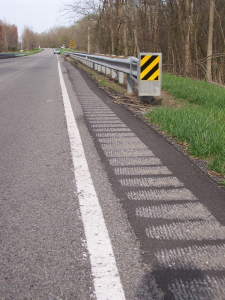
Since early 2010, the Alliance, League of American Bicyclists and Adventure Cycling Association have been working with the Federal Highway Administration regarding concerns about rumble strip applications.
In May 2011, the FHWA quietly distributed a new Technical Advisory (guidance) to district offices and state departments of transportation (DOT’s) on the installation of rumble strips. Unfortunately this guidance doesn’t meet the standards needed to ensure the safety of cyclists, and we did not get a chance to review it before its release as we had asked.
The new FHWA guidance on the installation of both shoulder and centerline rumble strips is significantly worse for bicyclists than the 2001 guidance. Not surprisingly, they did not notify us of the new guidance before sending it out to their district offices, even though we’d continually asked them to do so. When we learned about the new guidance in mid-June, we immediately contacted FHWA and set up a meeting.
Last month, the Alliance, League and Adventure Cycling returned to FHWA, where we met with a dozen FHWA and USDOT staff to express our concerns with the process and the lack of accommodation for bicycling in the new guidance. As a result of our meeting with FHWA, we are submitting written detail of the specific points the bicycling community wants to see addressed in the new guidance.
We made it clear that we are holding back on raising the alarm with bicyclists across the country, but we are asking for a complete revision of the Technical Advisory and will track this process very closely in the coming weeks. If we don’t succeed, we will let you all know and mobilize as needed. For now, please wait to take any action.
Why Should States Care About Bicycling and Walking?
from Bikeleague.org Blog by Darren
…
Since 1991, states have spent just over 1% of their transportation funds on bicycling and walking – even though these two modes now account for 12% of all trips and 14% of all fatalities in traffic crashes. These critical transportation modes connect people to jobs, friends and family, goods and services; they provide healthy, clean, efficient, and sustainable ways for kids to get to and from school; and they are increasingly popular and economically vital forms of recreation. Recent studies show that in addition to providing these benefits, investing in bicycling and walking infrastructure is very cost-effective and creates more jobs than traditional highway-only projects.
As our population continues to grow in rural and urban areas alike, providing real transportation choices – especially for short trips – is essential to reducing congestion, improving air quality, achieving energy independence, increasing physical activity levels, and improving traffic safety: critical goals that are squarely in the national interest, and goals that cannot be left to the whim of state Departments of Transportation who have proven unwilling to make these choices unaided.

Darren Flusche
League Policy Analyst
Continue reading “Why Should States Care About Bicycling and Walking?”
Being direct in advertising: pedestrian safety
[B’ Spokes: I’m sharing this because:
1) Too many who have power and control over pedestrian safety have failed to acknowledge “One of the biggest pedestrian safety problems is the failure of motor vehicles to stop at crosswalks.”
2) Why the heck are not these campaigns put out for public comment? Rather then paying someone a heck of a lot of money to “I only drive a car and don’t walk or bike so this is what I think….”
3) To note the first ad criticized is DC/Baltimore’s “safety” campaign. (and yes there is a reason why safety is in quotes.)]
from Rebuilding Place in the Urban Space by Richard Layman
I don’t think this ad is very good. It’s too stylized to really communicate much about safety at crosswalks.

One of the biggest pedestrian safety problems is the failure of motor vehicles to stop at crosswalks. Perhaps, the biggest problem is on multi-lane roads, when a car, seeing a pedestrian, stops at the crosswalk, drivers in other lanes think the driver is doing something stupid rather than recognizing they are stopped for a pedestrian, and proceed, endangering people.
Maybe all this ad needs is a much better tagline about stopping for pedestrians at crosswalks, but the ad in and of itself, is insufficient.
— “Cities try to improve crosswalk safety,” USA Today
Corinna sent me a chain email with a bunch of creative wrap ads on transit buses. I like these ones about pedestrian safety and buses. I have no clue where the ads are from.
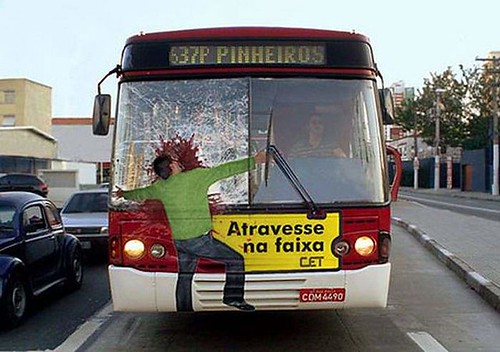
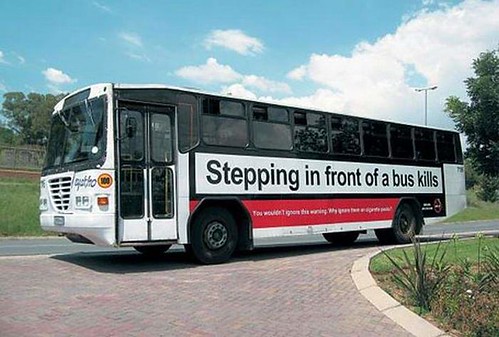
Well, maybe this ad isn’t all that creative, but it is direct.
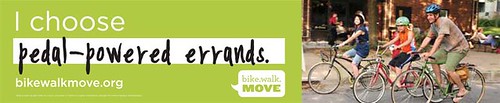
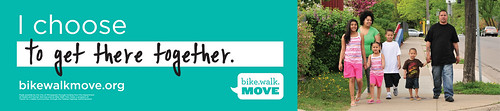
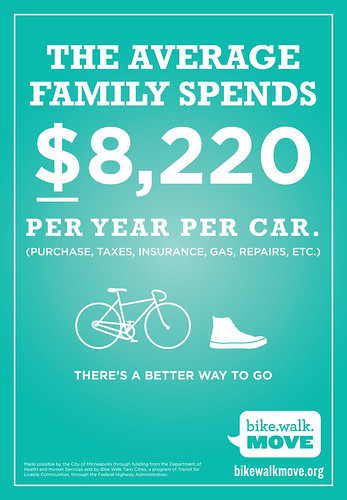
Speaking of some great sustainable mobility promoting ads, the Bike Walk Move program in Greater Minneapolis (funded in large part through a massive demonstration grant from the US DOT back when James Oberstar was in Congress) has some good ones for bus shelters. See ““Bike Walk Move” campaign aims to get more people moving.”
Continue reading “Being direct in advertising: pedestrian safety”
How to Handle Bike-Car Accidents, Part 3
An excellent read if you have been in an accident by By Bob Mionske
https://bicycling.com/blogs/roadrights/2011/07/17/how-to-handle-bike-car-accidents-part-3/
Cars parked illegally in bike lane? No problem if you have a tank.
136 Trees falling for Baltimore Grand Prix
Just one of the many reasons why the Grand Prix and cars in general are "good" for Baltimore. :/
https://articles.baltimoresun.com/2011-08-01/features/bs-md-grand-prix-trees-20110801_1_plant-trees-baltimore-grand-prix-baltimore-racing-development