Alert: State drivers test is still a joke as far as rights and responsibilities toward bicyclists

It really yanks my chain when a “professional” producing material for adult competency to drive a one ton killing machine, write them if they were a high school juveniles. Can we please treat this with some dignity and professionalism?

You can take the on-line sample test here.

Seriously, what are the top pedestrian issues? I would put drivers not stopping for pedestrians in crosswalks near the top.

But MVA seems to think drivers buzzing a blind person is a major contributing factor in our 4th highest pedestrian fatality ratting Here is MVA’s question:
image
If you are the car in this picture, and you see a blind pedestrian walking with a guide dog ahead on your side of the road, what should you do?

  • Speed up and see how close you can get.
  • Stop and tell them that they should be walking on the other side.
  • Exercise extreme care and be prepared to stop.

I would think showing the pedestrian (blind or other wise) trying to cross and saying the driver HAS to stop, would be a lot better. But What is this question even in the test for? Comic relief? Is this even remotely professional given that bike/ped issues only get one question out of the test? We comprise over 20% of the traffic fatalities so we should be getting four questions not just one.


How about bicycling top issues? How about how to safely share the road with bicyclists? And oh look MVA has one of the signs used in part to indicate share the road up on their test, are they going to get close on this one? (Note two tries of the test to get both questions, they are NOT on the same test.) MVA’s question:

image

THIS ROAD SIGN MEANS:

  • Bicycle crossing/bike path
  • Stop only if other cars are approaching
  • Soft shoulders for motorcycles
  • Yield right-of-way

If you were hoping that there is some mention on the drivers test that bicyclists have the right-of-way, well there isn’t, as that’s not what this sign means as it needs another bit that says “share the road” to mean “share the road “. So we MUST emphasize that ween you see this sign it does not mean bicyclists have a right-of-way.

What’s even more bizarre is Maryland does not use the sign (W1-11) solo it uses W1-15 (a bike and ped together) and this sign is in violation of standard guidance for W1-11:

Standard:
Bicycle Warning signs, when used at the location of the crossing,
shall be supplemented with a diagonal downward pointing arrow (W16-7p)
plaque (see Figure 9B-3) to show the location of the crossing.

Oh great, we are testing drivers to know what a sign that does not follow MUTCD guidance means and when we do use this “bit” with a “share-the-road” sign we are teaching drivers that it means cyclists DO NOT have the right-of-way because we have NO “share the road” sign example in the handbook. A recent Washington Post letter the writer thinks “Share The Road” means “Cyclists Must Get Out Of The Way” and no wounder our Drivers’ Handbook incorrectly states “A bicycle should be operated as close to the right side of the road as
practical and safe.” So legal errors in the Drivers’ Hand book and standard guidance errors in the Drivers’ Test (not to mention ONE of these questions is the ONLY question a driver will see on this topic.

What’s worse our voice in MDOT, the Director of Bicycle and Pedestrian Access is defending this junk!


Write the Governor and ask for some semblance of professional questions on Maryland’s drivers’ test that deal with major bicycle and pedestrian issues for example take something from Bicycle Safety: It’s a Two Way Street. They recently redid the on-line practice test and it is still a major joke on bicycle and pedestrian issues.

governor@gov.state.md.us
cc: bswaim-staley@mdot.state.md.us

Continue reading “Alert: State drivers test is still a joke as far as rights and responsibilities toward bicyclists”

Another stupid "share the road means get out of my way" letter – Response

Perhaps I should appreciate James Rush’s grudging willingness to wait behind road cyclists until it’s safe to pass ("A Clash of Motorists and Bicyclists", May 16). But when he says bicyclists who don’t get out of his way aren’t "sharing the road", he is misconstruing the meaning of that phrase seen on signs around the region. The "share the road" message is simply meant to instruct drivers to allow cyclists to operate in the same space based on the rules of the road. Signs with this message are in no way asking cyclists or anyone else to leave the road, speed up, move over (except where legally required) or behave in some fashion beyond just riding legally. If there’s no opportunity for a driver to pass a slower cyclist, sharing means following behind the cyclist. If there’s ample width, sharing may mean driving next to the cyclist, with certain exceptions.
Perhaps jurisdictions should replace "share the road" signs on narrow roads with the message "bicyclists may use full lane". Under Maryland law, a cyclist in a right-hand lane that isn’t wide enough to share side by side with a car may ride in any position within the lane. This law was passed so cyclists could ride in the safest position in a narrow lane, which is most often – counter-intuitively – in the middle of the lane. Riders who hug the right edge of a narrow lane encourage drivers to try to squeeze by when there isn’t room, putting the cyclist at great risk. Mr. Rush complains that cyclists at the roadway edge don’t ride in a straight line, but that’s often impossible to do without risk of falling on crumbling pavement or debris that collects there – another reason why riding in the middle is advisable. Getting sandwhiched between cars and bad pavement isn’t courteous; it’s dangerous.
If Mr. Rush wants to know how to drive safely on rural roads with limited sight distance, it’s to slow down around curves in anticipation of slower vehicles or road hazards ahead. That’s how I was taught to drive.
Jack Cochrane
Continue reading “Another stupid "share the road means get out of my way" letter – Response”

Co-opting Complete Streets

from New Urban Network – The Source for Urban Planning, Walkable Communities & Smart Growth by Charles Marohn

The Complete Streets concept is one that is long overdue. We’ve spent two generations transforming a public realm once comprised of walkable, mixed-use neighborhoods into auto-only zones. These are places where the kids used to play ball in the street. Today a kid can’t even play safely in their own front yard.
At Strong Towns, we’ve worked to illuminate the fact that this transformation has been done at tremendous financial cost. This is not only because the construction of wider, flatter and straighter streets has been expensive, but because the auto-centric nature of the transformed public realm drives private-sector investment out of traditional neighborhoods, dislocating it to places that provide more buffering to the car.

I’ve now seen two projects where engineers promoted the use of "complete streets." In each I see the engineering profession co-opting the Complete Streets moniker without any thought to a Complete Neighborhood. For the engineers on these projects, the approach remains the same. I’ll quote from our piece, Confessions of a Recovering Engineer:
An engineer designing a street or road prioritizes the world in this way, no matter how they are instructed:
1. Traffic speed
2. Traffic volume
3. Safety
4. Cost
The rest of the world generally would prioritize things differently, as follows:
1. Safety
2. Cost
3. Traffic volume
4. Traffic speed
In other words, the engineer first assumes that all traffic must travel at speed. Given that speed, all roads and streets are then designed to handle a projected volume. Once those parameters are set, only then does an engineer look at mitigating for safety and, finally, how to reduce the overall cost (which at that point is nearly always ridiculously expensive).
Continue reading “Co-opting Complete Streets”

Yard Thefts Continue With Warmer Temperatures

By Ron Cassie – Dundalk Patch

Property crimes increased 3.3 percent overall in 2010, with thefts up 6.7 percent.

However, as much as 26 percent of all property theft in Precinct 12 is related to people not locking bicycles, storage sheds, car doors and homes, according to Capt. Woodland M. Wilson, III, commander of the North Point Station.

The Baltimore County Police Department suggests all bike owners engrave their bikes. If necessary, owners can go to the local precinct and borrow an engraving tool, Baltimore County police said in a recent press release.

Police say using the ID numbers from a driver’s license or Maryland ID card is the best way to mark your bike. Never use a social security number as an ID number, they caution.

Police also suggest when storing a bike in a shed or garage, lock and attach it to a lawn mower or other heavy, bulky equipment. Thieves break into sheds and garages, but attaching a bike to a piece of heavy equipment makes it more difficult to just walk or ride away from the area.

Continue reading “Yard Thefts Continue With Warmer Temperatures”

A clash of motorists and bicyclists

[B’ Spokes another case for improved education for drivers?]
******************************************************************
Via Washington Post
Can I get some input from the bicycling community? On any sunny weekend, the roads in upper Montgomery County are filled with dozens of cyclists, many of whom appear to be part of organized clubs. The roads on which these cyclists travel are narrow, hilly and winding. There are blind corners and restricted sight lines. The speed limits vary from 30 to 50 mph, and most of the roads have double yellow lines. The bikers travel between 5 and 25 mph.
When I am driving on one of these roads at the speed limit and encounter cyclists, what am I to do? First, I have to hope I don’t come upon one around a corner or hill and have to brake suddenly to avoid a collision. I could then remain behind the bike while waiting to reach a safe and legal area to pass. But if I do, I risk the possibility of another motorist traveling at the posted speed hitting me from behind.
I could try to squeeze by while staying in my lane, but then I risk sideswiping the bike. Since many cyclists ride side by side or seem unable to hug the edge of the road without swerving, this is not a safe option. I can take a chance and cross a double yellow line to pass, which is illegal and poses the possibility of a head-on collision with a vehicle in the oncoming lane.
Many cyclists loudly insist that motor vehicles alter their behavior and “share the road.” But these upcounty cyclists are not sharing; they are placing themselves and others in danger. Is it worth your life or the lives of others to exercise your perceived right?
James Rush, Gaithersburg
Continue reading “A clash of motorists and bicyclists”

Don’t Drive Like An Asshole.

From this web site.

Inspired by NYC DOT’s Don’t Be A Jerk campaign and the hope for equal safety and enforcement of traffic laws for all New Yorkers.

Take the pledge:

I, as a driver, want to help keep New York’s streets safe for everyone. I pledge to:

  1. Yield to pedestrians
  2. Stop at red lights and stop signs
  3. Obey the 30MPH speed limit
  4. Keep bike lanes, crosswalks and intersections clear
  5. Give cyclists adequate space when passing
  6. Never make an illegal U-turn

To the fella commuting by bike on Reisterstown Rd in the reisterstown/owings mills area…

Via Reddit

You are my hero. Every time I see you I get jealous that I am not on my bike, pedaling away. You are also smart about it! You wear bright and reflective clothing (plus proper cold weather gear) and when I’ve seen you at night you’ve had proper lighting, too! If only more cyclists were like you.
I wish I was not too much of a coward to brave Reisterstown Road!

Maybe, just maybe he’ll see this, and he’ll know that at least someone out there isn’t raging in their car because he is riding his bike on a busy street.
Continue reading “To the fella commuting by bike on Reisterstown Rd in the reisterstown/owings mills area…”

Aftermarket Device Helps Distracted Drivers

WASHINGTON, DC (WUSA) — Many new luxury cars include high-tech devices that warn drivers heading for a collision. Now that technology can be installed in any vehicle aftermarket.
In the Metro Washington area last year, 83 people died and another 2,700 were injured in pedestrian or bike accidents involving vehicles, according to AAA.
The CEO of Mobileye, Skip Kinford, said the device costs $930.

Continue reading “Aftermarket Device Helps Distracted Drivers”

Transverse markings for crosswalks – not the best engineering practice

[B’ Spokes have you ever noticed that SHA uses a lot of skimpy crosswalk markings on high speed roads and wounder if they are effective?]


excepts from: Evaluation of Pedestrian and Bicycle
Engineering Countermeasures:
Rectangular Rapid-Flashing Beacons,
HAWKs, Sharrows, Crosswalk Markings,
and the Development of an Evaluation
Methods Report – FHWA

image

image

image

CONCLUSIONS

The conclusions from this study were as follows:

• The detection distances to continental and bar pairs are statistically similar and are
statistically longer than those for transverse markings.

• For the existing midblock locations, continental markings were detected at about twice
the distance upstream as transverse markings during daytime conditions. This increase in
distance reflects 8 s of increased awareness of the crossing for a 30-mi/h operating speed.

• The results of the appearance ratings of the markings on a scale of A to F mirrored the
findings from the detection distance evaluation. Participants preferred the continental and
bar pair markings over the transverse markings.

• Participants gave the continental and bar pair markings similar ratings during both the
daytime and nighttime. However, the transverse marking ratings differed based on the
light level. The participants gave slightly better ratings (although still worse than
continental or bar pair markings) for transverse markings during the nighttime as
compared to the daytime. The lower ratings during daylight conditions might be
due to sun glare or shadow issues mentioned by the participants.
Continue reading “Transverse markings for crosswalks – not the best engineering practice”

With Skulls and Bones, Signs That Say ‘Speed Kills’

imageimage
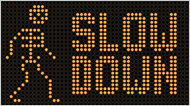
To promote pedestrian safety, New York City plans to introduce LED warning signs that feature a skeletal figure and warn drivers of the speed limit and how fast they are going.

“The idea is to get people to realize that what they’re doing can kill them or kill somebody else,” the mayor said at a news conference on Thursday. “Unless you make it graphic, people don’t get the message.”

Skeletons are already a trope of the Transportation Department’s “That’s Why It’s 30” publicity campaign, which reminds drivers through bus shelter posters and television announcements that cars traveling at 40 m.p.h. are far more dangerous to pedestrians than vehicles that follow the speed limit.

[B’ Spokes: Has any one else notice that our “speed” cameras allow for near 40mph in school zones? (25+12=37mph)]
Continue reading “With Skulls and Bones, Signs That Say ‘Speed Kills’”