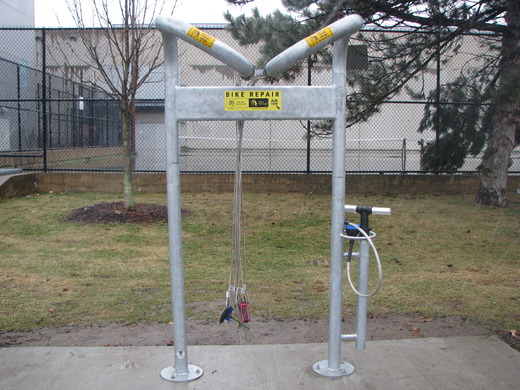
Cambridge Installs Self Help Tool Stations

from Boston Biker

This is awesome…

Cambridge Transportation Program Manager Cara Seiderman said the city has installed the bicycle repair stations in Harvard Square and outside the main library in the past two weeks. Another center was installed at Fresh Pond late last year.

“It’s a way of supporting and making it easier for people to bike,” Seiderman said.

The stands provide tire gauges and pumps, Allen wrenches and a few other tools that enable cyclists to make minor repairs, such as adjusting seats or handlebars.

Each station cost the city about $1,000 and Seiderman said the city got the idea from MIT which has already installed repair stations around its campus.

The installation of the repair stations comes as the city has seen a growing number of people riding bikes through Cambridge. A study conducted by the city estimates that the number of people bicycling in Cambridge more than doubled between 2002 and 2008, based on a study of the number of cyclists counted traveling through 17 different intersections. Seiderman said the number has continued to rise since 2008.(via)

For almost free (as far as these sort of things go) you can now stop by two locations in Cambridge and pump up your tires, fix a flat, and several other easy repairs. Thanks Cambridge, Boston you paying attention?

I think this is a great idea, and hope to see a couple of these near some popular bike parking spots all over town.

Continue reading “Cambridge Installs Self Help Tool Stations”

Bill to create new crime of negligent homicide by vehicle clears major hurdle in Maryland House Committee

In the Maryland General Assembly, House Bill 363 (Manslaughter by Vehicle or Vessel, criminal negligence) unanimously passed the House Judiciary Committee, with amendments. The bill would create a new crime of negligent homicide by vehicle or vessel, with a maximum term of three years.

The existing crime of manslaughter by vehicle requires proof that the defendant consciously disregarded a substantial risk of killing someone. Except for drivers who were either drunk or at least 30 mph faster than the speed of traffic, no one has been convicted unless a witness at trial testified as to the driver’s state of mind, which makes it impossible to convict most solo drivers.

For further details, please see WABA’s testimony.

Maryland is one of only a handful of states where a conviction for vehicular homicide is so difficult. Under House Bill 363, it will be possible to convict a defendant who should have known there was a risk of killing someone, without proving that the defendant actually knew about the risk.

Passing the House Judiciary Committee is a major milestone. The bill has been introduced each of the last seven years, but never brought to a vote, due to the opposition of Judiciary Committee Chairman Joseph F. Vallario (D-Prince Georges).

If you live in Maryland, please call your delegates and ask them to support the bill.  Even if you only get their staff, calls make a much greater impression than emails. But emails are certainly worthwhile if you can only find the time after business hours.

Please act as soon as you can, because bills move fast this time of year. The amended bill has not yet been posted. In the next few days, we will provide an update on the amendments and what we need to do next.

(The author, Jim Titus, is a Member of the WABA Board of Directors and resident of Prince George’s County, MD.)

Continue reading “Bill to create new crime of negligent homicide by vehicle clears major hurdle in Maryland House Committee”

Bicylists can be road ragers too, it seems

Michael Dresser posted an “interesting” complaint letter from a motorist against a cyclist and Michael’s comments were very balanced in response to that letter (his article follows.) I think bicyclists in the Baltimore Metro Area should be appreciative of Michael’s understanding of these issues and being able to address these issues in a more mainstream fashion. Michael calls on both motorists and bicyclists for more civility and does a good job of giving the motorist a new framework on how to rethink the issue but fails in my opinion to give cyclists a new framework. So here is my attempt:

The root of the problem: I am right and you are wrong

This goes for both bicyclists and motorists, let me begin with a true story: In a parking lot there were two motorists one pulling out and one pulling into parking spaces. Both proceeded till blocked by the other persons actions, they honked, they cursed and then finally got out of their cars to discuss the issue “rationally.” One insisted that the person pulling into a parking space has to yield to the one pulling out. The other person insisted that you can’t backup till the area is free of cars so the person pulling in has the right-of-way. And there they sat for 15 minutes with neither one budging and insisting that they are right and the other one is wrong.

This can be easily fixed be replacing “I am right and you are wrong” with LOOK FOR OPPORTUNITIES TO DO A RANDOM ACT OF KINDNESS. And this goes both for motorists as well as bicyclists.

The two levels of “I am right and you are wrong”

It is important to note that there are two levels to this kind of thinking. The most problematic is where the person’s who THINKS they are right reacts to the other persons actions in a negative way, honking or a one finger salute are common reactions and both are wrong. And there is more aggressive behavior of cars swerving across the cyclists path “to teach them a lesson” and such as the cyclist In Michael’s post. But there is a subtle lower level that is equally hazardous for bicyclists.

To explain; picture a j-walker standing on the center line and how much care, courtesy, passing space you give them when driving by in your car. Now picture a person lawfully crossing in a crosswalk and.how much care, courtesy, passing space you give them when driving by in your car. If you are like most people you will give more care to the lawful crossing pedestrian then to the unlawful one. And generally no one finds fault in this kind of behavior UNLESS there is a mismatch of “rules” like in my first story.

This mismatch of “rules” is a very real problem bicyclist face as they are given less courtesy by motorists if the motorist “thinks” the cyclist is in the wrong. If we were to poll people in Maryland we would find that people think bicyclists must: ride on the sidewalk, ride against traffic, ride with traffic, ride in the middle of the traffic lane or ride to the far right of the roadway as possible.

I imagine right now people are going “I know which one is right.” Stop it! No seriously, stop it. Look for opportunities to be kind and considerate, even to crazy bicyclists or motorists. If you want bicycle advocates to wag their finger at this cyclist we need everyone to focus on their safe and lawful behavior on the roadway and not other people’s, enforcement is the job of the police and you can get into a lot of trouble if you try to enforce the laws on your own.

There is little doubt that cyclists feel frustrated and possibly a bit helpless in the onslaught of everyone trying to force what they “think” is right on them and it’s all different. My typical response to an aggressive motorist is “If you think I am doing something wrong call the police. If you try to enforce the law on your own, I call the police and you can go to jail.”

No arguing what is or is not the accepted rule just a plain statement that you can put another person’s life in danger when you act out with your car and there can be serious consequences. This is step one to help a bicyclist feel less helpless and approach conflicts more constructively then a one figure salute. Step two, is the bicycling advocates are working with the State and Baltimore City to improve education and enforcement on ALL sides.

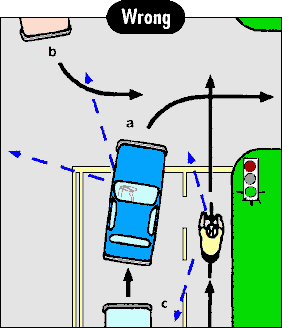
The lack of education and the right turn problem at intersections

image
Most cyclists know this is a dangerous position to be in, after all who wants to be in a crash like Nathan Krasnopoler? But how do we deal with this problem? Where is the guidance for bicyclists besides just riding far right? So most bicyclists just try to get out of that uncomfortable situation as fast as possible… by running the light. While that is not a good resolution of the problem it is compounded by unlawfully and impatient drivers who refuse to wait behind the bicyclist before making their right turn. Where is the motorists guidance not to do this? No one is fully innocent with this problem.

When the rules are not clear for all road users and how they are supposed to interact, chaos results.

Bicyclists please see: Must read for bike safety
Motorists please see: Turning across bike lane graphics and Bicycle Safety: It’s a Two-Way Street

And please everyone, lets look for opportunities to do a random act of kindness. Being on the road has enough junk for everyone to deal with but if we all did something nice for someone else, who knows we could make being in traffic a pleasant thing. – B’ Spokes
Continue reading “Bicylists can be road ragers too, it seems”

Comatose bicyclist’s family sues 83-year-old driver for $10 million

Complaint alleges driver who hit Hopkins student violated multiple laws

By Michael Dresser, The Baltimore Sun

The family of a comatose college student who was struck by a car while riding his bicycle near the Johns Hopkins University is suing the 83-year-old driver for $10 million, claiming she made an abrupt right turn into his path.

In a suit filed Monday, lawyers for Nathan Krasnopoler charged that Jeanette Marie Walke violated multiple traffic laws on Feb. 26 when she collided with the 20-year-old bicyclist as she turned into her apartment building on University Parkway.

According to his lawyers, Krasnopoler has remained unconscious at Johns Hopkins Hospital since the crash, which has stoked outrage among bicycling advocates over the Baltimore Police Department’s handling of the case.

Walke has not been charged in the case, though an investigation is continuing. A police spokesman initially said the driver would not be charged, but the department has since backed off that position, saying that decision would be made in consultation with the city state’s attorney’s office.

Anthony J. Guglielmi, director of the police public affairs office, said members of the department’s crash team have been meeting periodically with the state’s attorney’s office to discuss the case.

According to the lawsuit, filed by Baltimore lawyer Andrew G. Slutkin, Krasnopoler was riding in a marked bike lane at the intersection of University and W. 39th Street when Walke made a right turn across the bike lane and into the Johns Hopkins University student’s path.

The suit says that Krasnopoler was unable to stop the bicycle and struck the passenger side of Walke’s car, which then ran over him and pinned him on his back. According to the suit, Krasnopoler suffered severe burns because the driver left the engine running while the vehicle was on top of the victim.

Krasnopoler suffered two collapsed lungs, broken ribs and collarbone, facial fractures, eye damage and a traumatic brain injury, according to the complaint in Baltimore Circuit Court. The suit said Krasnopoler went into cardiac arrest when he was being transported to the hospital in an ambulance, and has remained in a coma since the crash.

Slutkin said that since the crash Krasnopoler has undergone extensive facial surgery. He said physicians will not know the true extent of Krasnopoler’s injuries until he comes out of the coma.

The lawsuit alleges that Walke violated a state law adopted last year requiring drivers to keep a 3-foot distance between their vehicles and bicycles when passing them. It also accuses her of negligent and reckless driving and other traffic violations.

Slutkin, of the firm Silverman Thompson Slutkin & White, was the lead attorney in a similar suit filed by the family of cyclist John "Jack" Yates, who was struck and killed by a truck driver in 2009. The plaintiffs and defendant reached a settlement in that case last year despite an initial police finding that the bicyclist was at fault.

In that case, Slutkin said, the plaintiffs were able to overturn the police investigation through video analysis, crash reconstruction and deposition of witnesses.

In the Krasnopoler case, Slutkin said, the family decided after the initial police statement that they wanted an independent investigation. The lawyer said his firm interviewed witnesses and has learned that police have since spoken with some of the same people.

Slutkin said his firm is hoping additional witnesses will come forward. [See: https://www.baltimorespokes.org/article.php?story=20110309130612695 ]

The attorney noted that the crash, like the Yates case before it, has received a great deal of attention from bicycling advocates. "The bicycling community feels the police are not sensitive to the laws that exist in Maryland to protect bicyclists," he said.

Carol Silldorff, executive director of Bike Maryland, said Baltimore police either rule a bicyclist at fault or decline to make a report in a disproportionate number of bicycle-vehicle collisions. "I think there’s a perception that too many times accidents go unreported and it’s a struggle to get a report written up that the motorist is at fault," she said. [Ref: https://www.baltimorespokes.org/article.php?story=2011030523251899 ]

After hearing protests from Councilwoman Mary Pat Clarke and others early this month, the Police Department apologized for the statement issued by its public affairs office.

"At this point in time, no charged have been filed and it is premature to speculate on potential next steps as this case is still very much open," the department said.

Guglielmi said a spokesman in his office has been "misinformed" when making the original statement that the driver would not be charged.

Walke could not be reached to comment.

Baltimore Sun reporter Tricia Bishop contributed to this article.

Continue reading “Comatose bicyclist’s family sues 83-year-old driver for $10 million”

"Dangerous" NYC intersections for peds are tame by Maryland standards

As many of you know I am in NYC right now and I was surprised to see Bike Snob highlight an intersection that is near my new apartment as "unsafe." While by New York City standards this is a messed up intersection but it’s far safer then most Maryland intersections I’ve walked as a pedestrian in Maryland.
Why is that? The number one reason is there is no right-on-red here. There are (usually) no cars blocking the crosswalk and 99.9% of the cars stop for you when you start to cross. No Maryland style honking or "I’ll run your foot over if you don’t let me hurry past you." or other aggressive driver moves.
Yet traditionally Maryland does not eliminate right-on-red to improve safety for pedestrians. And further there is no benefit for the motorized transportation network as a whole in allowing right-on-red (unless there are a lot of people travelling in clockwise circles) as any benefit at one light gets canceled when you wait at the next light and then there is the other people downstream from the right-on-red trying to pull out/in to driveways that now have to wait for traffic traveling at lower density then queued traffic (they have to wait longer for fewer cars.)
All right-on-red does is exasperate impatience and encourage more jackrabbit starts. Yet Maryland says we "need" to keep right-on-red while our pedestrian fatality rate is refusing to go down while our other crash stats are.
Continue reading “"Dangerous" NYC intersections for peds are tame by Maryland standards”

Spread of the "Don’t be dead right" cancer

I think this is just shameful and happening in Portland, OR no less. In reaction to several pedestrian deaths where the bus violated the pedestrians right-of-way the bus service decides to install a pedestrian warning device and as it is currently functioning it should be saying something along the lines of “If you can hear this you are being run over by a bus.” at a price tag of over $4,000 per bus.

It’s not clear what is more outrageous, the price tag or trying to put responsibility on the pedestrians to get out of the way of a bus. There is no doubt that trying to shot the gap while making a left turn with a bus is challenging but as in all traffic maneuvers the rule should be “don’t do it till it is safe.” The reaction should be for buses to wait for a yellow clear the intersection phase and take the time to do a left turn safely then this idiotic voice reprimanding law abiding citizens.


Continue reading “Spread of the "Don’t be dead right" cancer”