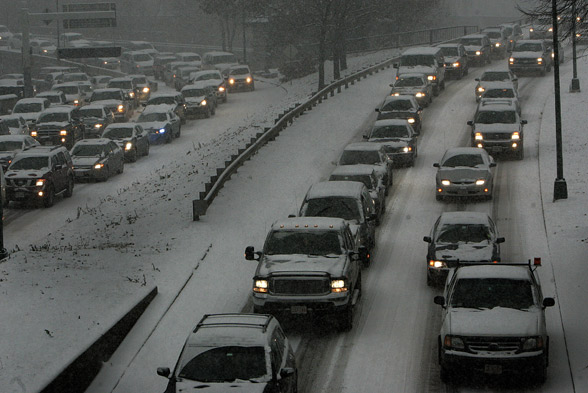
Police need to be first to obey traffic laws

Michael Dresser makes some good points which I’ll highlight:


2. Perceptions that traffic enforcement is a low-prestige assignment that impedes career progress. Would it be presumptuous to suggest that all officer should pull at least an occasional traffic enforcement shift and that command of a traffic patrol would be one of the expected career steps for any officer who aspires to top command. For citizens, it is a priority right up there with violent crime. Most of us face a greater risk to life and health from bad driving than from handguns.

3. A reinforcement of the message that it is every officer’s job to be a model for other drivers both on-duty and off-duty. Officers should be proud of enforcing traffic laws well and should be professionally recognized for doing so.

4. A determined effort to overcome any "front-seat" bias under which officers see issues from the point of drivers at the expense of bicyclists and pedestrians.

Continue reading “Police need to be first to obey traffic laws”

Strongest Cities 2011

You probably don’t exercise much mental energy wondering just how much strength is bundled up in your city. That’s our job. Based on a wide range of criteria, we pitted the top 25 most populous U.S. cities against each other in an ultimate strength smackdown. Those with the most USA powerlifters, strongman competitors, personal trainers and fitness instructors got the highest points. Then we compared statewide physical activity and obesity rates. Extra points were awarded for the quality of the city itself based on the amount of park space, the number of bicycle commuters or the most baseball diamonds, basketball courts and other game spaces per capita. The results may surprise you.

1) Seattle

2) Boston

3) Denver

4) Baltimore

5) San Diego

6) New York

7) Philadelphia

8) Los Angeles

9) San Francisco

10) Chicago

11) Austin, Texas

WINNER: SEATTLE

If all of the powerlifters, personal trainers and aerobics instructors in Seattle got together and invaded the south, the obesity epidemic would be practically vanquished. Only Austin, Texas, and San Antonio can claim more USAPL members than Seattle. This wet northwest burg also hosts the most bicycle commuters (massive quads are the norm), has high overall physical-activity rates, and fewer smokers than Boston and Denver.

Continue reading “Strongest Cities 2011”

Lets Make One Thing Clear, I Am Not Slowing You Down

by Boston Biker

Lets make one thing crystal clear. Cyclists are not slowing you down. You read that correctly, cyclists are not the reason you are not going as fast as you want to go.

“But what about when they ride in the street!!!!!11!!!”

No, stop it. Listen.

C Y C L I S T S A R E N O T T H E O N E S S L O W I N G Y O U D O W N.
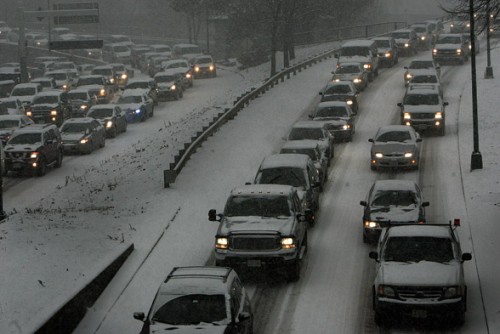
See any cyclists here?

This is not a matter of opinion, this is a simple math problem. I can prove this with a piece of paper and a pencil. I can tell by the look on your face that you don’t believe me. You think I am just another smug cyclists using your road and slowing you down.

Ok lets do a little thought experiment. Every day while you sit in traffic and wonder why traffic isn’t moving, I want you to take a good look at what is in front of you, and take another good look at what is behind you. Keep a little note book, write down what you see. After a month or two, add up your results. I am going to guess that “cyclists” = 0 and “other people in cars” = a whole fucking bunch. Cyclists are not the ones slowing you down.

Need more proof, how about we use some more math. A person on a bicycle takes up 8-10 sq foot of road, a car takes up 100+ square feet of road. Road space is limited…do the math. Cyclists are not the ones slowing you down.

“But one time this guy on a bike got right in front of me and I had to go around, slowing me down!!!!”

You know one time I found a ten dollar bill on the ground, you know what happened the other 99.99% of the time, I didn’t. Cyclists are not the ones slowing you down.

You want to know what is slowing you down? You are. You are the problem. Every day you get in your car all by your self and you drive to work. You take up all sorts of space on the street just so you can move yourself (and no one else) a couple miles down the street. You are getting in everyone way. You are taking up space on the street that another car driver could use. You speed up too fast, and then have to slam on your brakes because you don’t pay attention to the timing of red lights. You are taking up parking spots, you are blocking that driveway, you are are keeping the bus from making that turn. You didn’t let that guy merge in so he is blocking both lanes. You stopped half way into the intersection. You are slowing you down.

Ever wonder why car commercials always show empty streets with only one car speeding around? It’s because they don’t want everyone else to see you! You getting in their way. You causing traffic. You slowing everyone down.

Just because they lied to you, and you swallowed it hook line and sinker doesn’t mean that you have the right to be a dangerous jerk bag on the streets to the only vehicles without metal armor (cyclists). If you really want to get mad at someone for all that traffic, tilt your review mirror down till you can see your own reflection and scream till you feel better.

Continue reading “Lets Make One Thing Clear, I Am Not Slowing You Down”

The New Miracle Treatment for Women in Midlife and Beyond: a True Magic Bullet for Staying Healthy and Feeling Good

By Dr. Janet Horn and Dr. Robin Miller
When you first saw the title of this article, you immediately thought it was hogwash, right?
You were a bit disappointed, too, because doctors are supposed to be honest, and discuss only the treatments that have been scientifically proven to work; and everyone knows that there is no such thing as a miracle treatment that keeps you healthy as you age. But, here’s the thing: we are telling you the truth.
First, let us tell you what this miracle treatment can do. It can help you to retain your memory, and possibly even prevent dementia, or at least postpone it for years. It can prevent you from falling, the most common cause of injuries to those of us who no longer even count the number of candles on our birthday cakes. It can, in some cases, keep you from getting arthritis in your knees, and if you already have it, keep you up and moving. It can keep your heart healthy, and if you already have heart disease, it can get you back to feeling great. It can prevent some cancers. If you have diabetes, or high blood pressure, or high cholesterol, it can, in some cases, make them go away, and at the very least, it may allow you to lower your dose of medication for each of these three. It can help you to breathe easy. It can keep you buff and help your sex life. It can help you sleep better, suppress your appetite, and even increase your metabolism. And it can improve your sense of wellbeing, keep your mood positive, and increase how long you live.
We know you’re still doubtful because if such a thing really existed, it would be on TV constantly and all over the internet, and you would’ve probably bought a huge amount of stock in it. But in fact, it not only exists, but all of the effects mentioned above of our miracle treatment have been scientifically proven!
Human beings were meant to move. Every aspect of our bodies’ functioning is geared toward that. On the flip side, movement and mobility are very important to the quality of life. What does this have to do with the miracle treatment? Easy — the miraculous new treatment for all our ills, particularly those accompanying the aging process, is movement. Because of all the negative connotations, we won’t call it exercise or any of those other clinical-sounding names, like “workout” or “physical activity.”
Continue reading “The New Miracle Treatment for Women in Midlife and Beyond: a True Magic Bullet for Staying Healthy and Feeling Good”

Driver gets 13 years in prison in fatal hit-and-run of Hopkins student, 20

By Tricia Bishop, The Baltimore Sun

Serial drunken driver Thomas Lee Meighan Jr. was sentenced Wednesday to 13 years in prison for the fatal hit-and-run in 2009 of a Johns Hopkins University student described in court by friends and family as a promising young scientist who might have changed the world.

Meighan, 40, was given an additional nine-year-suspended sentence in connection with a similar hit-and-run that occurred several months previously, in July 2009. Five people were injured in Northwest Baltimore after he drunkenly slammed into their compact car before fleeing on foot. If he violates probation after his release from prison, he could be forced to serve the suspended term.

The combined sentence, which came after a guilty plea, is the first significant amount of prison time Meighan has received despite nine prior drinking-and-driving convictions going back to 1994. But it, too, was a compromise.

Continue reading “Driver gets 13 years in prison in fatal hit-and-run of Hopkins student, 20”

New report quantifies just how much a car commute crushes your soul

This Grist article raises some good questions, do we need more roads, smart growth or new metrics? An excerpt from the Article:
The solution is less sprawl, not more roads: The keenest criticism of the report is that it unjustly penalizes densely-packed cities, which are better than sprawly ones in basically all other ways. Greater Greater Washington explains:
The TTI report narrowly looks at only one factor: how fast traffic moves. Consider two hypothetical cities. In Denseopolis, people live within 2 miles of work on average, but the roads are fairly clogged and drivers can only go about 20 miles per hour. However, it only takes an average of 6 minutes to get to work, which isn’t bad.
On the other hand, in Sprawlville, people live about 30 miles from work on average, but there are lots and lots of fast-moving freeways, so people can drive 60 mph. That means it takes 30 minutes to get to work.
Which city is more congested? By TTI’s methods, it’s Denseopolis. But it’s the people of Sprawlville who spend more time commuting, and thus have less time to be with their families and for recreation.
Continue reading “New report quantifies just how much a car commute crushes your soul”

Enforcement, not big fines, key to traffic safety

From Baltimore Sun

A study released Tuesday by the Insurance Institute for Highway Safety demonstrates that Baltimore and 13 other cities made a smart move. An estimated 159 lives were saved over a five-year period by the enhanced enforcement effort. Baltimore alone saw a 14 percent reduction in deaths attributed to red-light running; some cities saw reductions several times as great.

Nevertheless, not all traffic-related fines are so effective. Last week, Gov. Martin O’Malley submitted a budget proposal that included a new surcharge of $300 to $1,500 on traffic fines for more serious offenses, such as drunken driving and excessive speeding.

Continue reading “Enforcement, not big fines, key to traffic safety”

Smart way to improve water quality!

From Sustainable Stormwater Management

Blue Water Baltimore is the new name for the merger of the Jones Falls Watershed Association, Herring Run Watershed Association, Gwynns Falls Watershed Association, Baltimore Harbor Watershed Association and Baltimore Harbor WATERKEEPER. 

One way Blue Water Baltimore is trying to accomplish this is through theIndoor and Outdoor Water Audit Program.  Staff members will assess your property’s “water footprint” to try to reduce polluted runoff from homes, schools, churches and other buildings.  The program is the result of a 3 year grant funded by the Fish and Wildlife Foundation to reduce direct and indirect runoff into the stormwater system of Baltimore.

As part of the audit, several types of opportunities exist.  One opportunity is the downspout disconnection program
Often, downspouts on buildings are connected directly into storm drains.  In other cases, flow from rooftops is directed it to the street with little flow through vegetation.  Believe it or not, rooftops are sources of pollutants that originate from airborne sources.  As flow from downspouts travel along gutters the water picks up pollutants such as trash and chemicals before flowing into inlets.  These storm drains outfall into streams and river which ultimately flow into the Chesapeake Bay.

By redirecting downspouts to discharge into pervious locations such as lawn, landscaping areas or raingardens, or into a rain barrel, the pollutants and garbage into our streams can be reduced!

Downspout directed into rain barrel.

As an added benefit, you will use less resources for keeping your lawn and landscaping watered, reduce the frequency of watering and reduce your water bill!

Homeowners in the Jones Falls and Herring Run Watersheds can contact Blue Water Baltimore for a consultation.  As part of the grant they are able to offer simple downspout disconnections to pervious land at no cost to the homeowner.  They also offer $25 off rain barrels with free installation, and a $500 match for the design and installation of raingardens.  Blue Water Baltimore is also able to offer services such as impervious area removal and tree planting!

This is one way that individuals taking small steps can help make a big difference in the water quality of our waterways and the Chesapeake Bay.

Continue reading “Smart way to improve water quality!”

At work session, council debates bill to limit cap on speed cameras

[B’ Spokes: If you live in Baltimore County you may want to contact your council person https://www.baltimorecountymd.gov/countycouncil/index.html
Baltimore County (5) pedestrian crash stats here: https://www.baltimorespokes.org/article.php?story=20110126113548321 https://www.baltimorespokes.org/article.php?story=20101101220408408 ]
*******************************************************************
By Jay R. Thompson

The Baltimore County Council will vote next week on a bill that would eliminate a current limit on the number of school zones where speed cameras are allowed.

County code currently allows speed cameras in no more than 15 school zones, but 1st District Councilman Tom Quirk, who represents Catonsville and Arbutus, has introduced a bill to lift that restriction.

“The biggest difference with this bill is we’re just removing the limit,” Quirk told his fellow council members at the council’s Feb. 1 work session.

Seventh District Councilman and Chairman John Olszewski said the bill was “something I’m very supportive of.”

A few members of the public offered input on the subject, but some continued the debate about whether or not the county should have speed cameras at all.

Continue reading “At work session, council debates bill to limit cap on speed cameras”