Alert: MSP: Conclusionary, biased and flat out wrong statements about law during an ongoing investigation again (and again … )

B’ Spokes: If you think people have a right to be treated better then just road kill please write:
Maryland State Police
Barrack L – Forestville
3500 Forestville Road
Forestville, Maryland 20747
301-568-8101 (phone) 301-735-1693 (fax)
forestville@mdsp.org

– and –

Col. Terrence B. Sheridan, Secretary of State Police (410) 486-3101
media@mdsp.org

And call:
Office of The State’s Attorney for Prince George’s County
Glenn Ivey
State’s Attorney
Courthouse
14735 Main Street
Upper Marlboro, MD 20772-3050
Contact: Receptionist
(301) 952-3500
Fax: (301) 952-3775


In this video: https://www.nbcwashington.com/news/local-beat/A-Law-Student-and-Senate-Candidate-Was-Struck-by-an-SUV-Sunday-103385829.html

Starting at 0:40 (State?) police says “She [the driver] complied with the laws.”
Really now?

§ 20-102. Driver to remain at scene – Accidents resulting in bodily injury or death.

§ 20-104. Duty to give information and render aid.

As
far as I am concerned all the driver did was give information
(eventually) and failed in the other two requirements. 

I am outraged by the implication that cyclists are essentially in the same category as dead animal removal… just call the appropriate agency at your earliest convenience and that is the beginning and end of your duty. I will strongly assert a reasonable person would have (or should have) in short order inspected such damage to their car and realized they hit a person (flat tire and dragging a bike for three miles is acceptable defense???) Assuming that it is valid to assert that one could not see a cyclist right in front of car headlights (which is not the same thing as asserting not being able to avoid hitting said cyclist.)

So we have a supposedly an ongoing investigation but 

  • The police are already coming out in defense of the motorist
  • Publicly misrepresenting the laws

And this is not the first time, there is the MBPAC October 2009 resolution about St. Mary’s fatality.

Yoram Kaufman’s fatality (also in PG County.)

And there is the Jack Yates fatality. I assumed once the video showed up showing that in fact the truck did not signal its turn that would go in favor of the cyclists, then we got this response from the police:


I am the commander of the Traffic Section within the Baltimore Police
Department. I supervise the Crash Team and therefore the e-mail you
authored to Mayor Sheila Dixon was forwarded to me for a response.


I was at the scene of this tragic crash and I know that this incident
was investigated thoroughly from the very beginning as a very serious
issue, as all fatal crashes are. We have obtained a video of this
incident that shows the entire event.


There are only some aspects of this case that are public record. I will
tell you that the video clearly shows the cyclist to be at fault.
There is no “right to the road” as a cyclist. You have the same rights
as a motor vehicle and also the same obligations.
The cyclist was not
operating within those parameters. The tanker truck that the cyclist
struck was a large one. The cyclist struck it in the rear. There is no
evidence to support that the driver was ever aware there was an impact.
Do not believe what the media reports as entirely true regarding this
or any event.


The investigators within the unit are very educated and experienced in
all types of crashes and have attended several schools specific to the
physics of a pedestrian crash and a cyclist fatal crash. With regard to
the question of it being investigated as a hit and run accident, not
only was it investigated as such but the truck was located by
investigators within a few days of the incident.


Please feel free to contact my office if you have any further questions.


Lt. Leslie Bank


Traffic Commander


Baltimore Police Department


In investigating the statement in bold the police asserted that Yates did not obey a traffic control device… a sign that says parking is permitted during off-peek hours. Seriously? It’s illegal to ride in a parking lane? No way would such a ticket hold up if there was no accident, ah but if there was an accident so now the behavior is illegal, so the rule is where ever a cyclists was when a crash occurred if we can make up something that says he could have been somewhere else then the cyclists is at fault. This is plain and simple wrong reasoning and highly biased against cyclists. 

 I am not filled with confidence that the police are always fair when investigating cyclist’s crashes and I hope this will be corrected.

Ah reminiscing about how Baltimore police treat cyclists, has anything changed?

"If anyone should be sympathetic to the bicyclists’ perspective, it’s me. In my teens, I used a bike as my main transportation and covered considerable distances in the Baltimore area. At one point, I was hit by a car that came out of a side street without stopping and was thrown into the middle of York Road, which is the main commercial artery into the city, roughly similar to Broad Street. The driver didn’t stop, but I got the tag number. I had to walk the bike home while holding the front wheel off the ground because the forks were destroyed. When I went to the police station with the tag number, they told me to get lost."

Continue reading “Ah reminiscing about how Baltimore police treat cyclists, has anything changed?”

Bicyclist, 16, struck by car, seriously injured in Anne Arundel County

By Eileen Ambrose, The Baltimore Sun

A 16-year-old boy was seriously injured when he was struck by a car while riding a bicycle Saturday night in Anne Arundel County, according to fire officials.

The boy was riding in the 1100 block of Sunrise Beach Road, in the Crownsville area, when he was hit about 8:13 p.m., said Division Chief Michael Cox of Anne Arundel County Fire Department. The identities of the boy and driver were not available.

The boy suffered "serious but non-life-threatening" injuries, Cox said. He was taken by ambulance to Maryland Shock Trauma Center in Baltimore.
Continue reading “Bicyclist, 16, struck by car, seriously injured in Anne Arundel County”

Cyclist visibility at night: Perceived visibility may not match reality

Abstract
Visibility limitations make cycling at night particularly dangerous. We previously reported cyclists’ perceptions of their own visibility at night and identified clothing configurations that made them feel visible. In this study we sought to determine whether these self-perceptions reflect actual visibility when wearing these clothing configurations. In a closed-road driving environment, cyclists wore black clothing, a fluorescent vest, a reflective vest, or a reflective vest plus ankle and knee reflectors. Drivers recognised more cyclists wearing the reflective vest plus reflectors (90%) than the reflective vest alone (50%), fluorescent vest (15%) or black clothing (2%). Older drivers recognized the cyclists less often than younger drivers (51% vs 27%). The findings suggest that reflective ankle and knee markings are particularly valuable at night, while fluorescent clothing is not. Cyclists wearing fluorescent clothing may be at particular risk if they incorrectly believe themselves to be conspicuous to drivers at night.
Continue reading “Cyclist visibility at night: Perceived visibility may not match reality”

AAA more cycle-friendly, except where money is concerned

Greater Greater Washington has some great coverage and detail about what our AAA has been up to and I will highlight the concluding paragraph:
"Rails to Trails can only ask its members nationwide to push national AAA on this issue. But we live in the AAA Mid-Atlantic region. If you’re still a AAA member, switch to the Better World Club. And tell AAA you might consider being a member again only if they focus on their real mission, providing services to drivers, and stop trying to lobby against transit, pedestrian and bicycle programs."
Continue reading “AAA more cycle-friendly, except where money is concerned”

MADD marks 30 years of effective road safety advocacy

[B’ Spokes: It’s been on the cycling advocates wish list to be effective as MADD so this might have some relevance in that people can make a huge difference.]


from Welcome to the Fast Lane: The Official Blog of the U.S. Secretary of Transportation by Ray LaHood

Yesterday, I was honored to join hundreds of victims and advocates on the West Lawn of the US Capitol to mark the 30th anniversary of Mothers Against Drunk Driving.

Madd_logo

It was an event of mixed emotions. On the one hand, we could celebrate the more than 300,000 lives saved by MADD since 1980. But, on the other, we were there to remember the thousands of victims killed by drunk drivers on America’s roads every year.

We have come a long way. Since 1980, drunk-driving related fatalities have dropped by more than 40%. Between 2006 and 2009 alone, they declined by 20%. And we owe much of the progress we have made to the effective advocacy MADD has demonstrated–at the local, state, and federal levels–for 30 tireless years.

Drunk-driving

But we have a long distance yet to travel. Impaired drivers are involved in nearly one-third of all roadway deaths. That means almost 11,000 people were killed in 2009 when drunk drivers ignored the law, ignored common sense, and ignored the personal responsibility that is part and parcel of our driving privileges.

Clearly, our work is not done. And any progress we continue to make will almost certainly be in partnership with those who gathered yesterday on the Capitol lawn in support of MADD.

We need those advocates to keep holding our feet to the fire, to keep demanding sound laws, to keep pushing for stronger enforcement, and to keep reminding Americans that it is not okay to drink and drive.

Congratulations to MADD C.E.O. Kimberly Earle, MADD President Laura Dean-Mooney, and all the members of MADD–past and present. You have made America’s roads significantly safer for all of us.

Continue reading “MADD marks 30 years of effective road safety advocacy”

“Forgiving” Distracted Driving Won’t Keep Our Streets Safe

from Streetsblog.net by Angie Schmitt

On Monday, the U.S. DOT released a report concluding that the number of deaths caused by distracted drivers dropped 6 percent in 2009 — from 5,838 the previous year to 5,474. The report was a prelude to the agency’s second national summit on distracted driving, where the message from Transportation Secretary Ray LaHood was very clear: Distracted driving is preventable and enforcement works. LaHood pointed to a pilot enforcement program in Syracuse that has cut texting and cell phone use behind the wheel by about 40 percent.

Over at the National Journal’s transportation experts blog, Greg Cohen, president of the American Highway Users Alliance, wasn’t convinced that enforcement and driver responsibility are the answer. Writing that “we should admit that we all get distracted sometimes” and “enforced legislation and education can only go so far,” Cohen argued that engineering cars and roads to be more “forgiving” of driver inattention and carelessness is the way to go.

Should cars and streets be designed to send the message that these activities are okay? Photo: Seattle Weekly

Cohen’s post prompted this response from Andy Clarke, president of the League of American Bicyclists:

I’m not interested in trying to walk or ride along the street as part of some giant fairground bumper car game where drivers feel like they can crash with relative impunity. I want drivers (and cyclists) to pay attention, drive carefully, and NOT crash. The focus for me has to be on improving driver behavior, attention and responsibility.

We have come a long way in improving the safety of vehicle occupants. Indeed, you could be forgiven for wondering why we aren’t doing dramatically better already after the introduction of seat belts, air bags, anti-lock brakes, crumple zones, roll-over protection and the like. After 50 years of highway design that has widened, and straightened roads; removed all manner of roadside obstacles (like killer trees); installed collapsible poles and safer guardrailing; limited access and crossings; rumbled, signed and marked roads with ever-increasing levels of visibility and reflectivity. After quite incredible improvements in medical treatment and EMS services in the event of crashes. Really, where have all the benefits to all these great developments disappeared? Why have we still been killing 40,000-plus people a year for decade after decade?

One possible answer could be that we are a nation of generally lousy, distracted, careless drivers who really don’t take the responsibility of driving seriously and are not held to account for that behavior individually or collectively. That needs to change, and focusing on distracted driving is a welcome opportunity to do just that.

Elsewhere on the Network today: Following the recent death of Green Party Senate Candidate Natasha Pettigrew in a hit-and-run collision with a motorist, Baltimore Spokes reports that Maryland has some of the country’s most lenient vehicular manslaughter laws in the country. A Commute Orlando blogger analyzes the road conditions on a local thoroughfare after witnessing a motorist hit a cyclist. And the Seattle Transit Blog reports that tax revenue declines as a result of the recession will delay Seattle’s 15-year voter-approved transportation plan.

Continue reading ““Forgiving” Distracted Driving Won’t Keep Our Streets Safe”

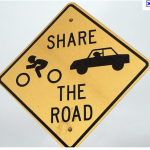
“Share The Road” STINKS…

By: Steve Magas

“Share The Road” to me, actually STINKS as a marketing & legal concept… in fact, it’s not “legal” at all…

Usually diamond-shaped and yellow, these “warning signs” caution drivers that the road is slippery when wet; there is an intersection ahead, the lanes narrow, or there may be bicyclists, farm animals, or wildlife on or near the roadway. Somehow cyclists are supposed to be comforted by the notion that Big Brother is “protecting” us by putting out a “warning” that we are nearby – as though we are a hazard to motorists...

The whole point of the “SHARED lane” marking is to indicate to motorists that they ought to “share the lane” with cyclists. This entire line of thought has always baffled me, frankly, because it implies that motorists OWN the lane and must be told, or just asked, to “share” a bit of it with cyclists.

“Sharing” is not a concept mandated by law, but a concept that relies upon the goodwill of the Share-or to give up a little bit of that which he owns to the Share-ee.  No law says that the motorist owns the road and the cyclist may borrow it sometimes, IF the motorist feels like sharing.

Rather, the law is that a PERSON wishing to use the public roads has the right to CHOOSE the vehicle. A bicycle and a car are equally valid, legitimate and lawful choices as vehicles. A person who chooses to ride a bike on the roadway has exactly and precisely the same quantity or bundle of rights as one who chooses to operate a car.

RIGHT TO TRAVEL – RIGHT TO USE THE ROADS

Remember this –> The rights belong to the person, not the vehicle. The RIGHT is the RIGHT TO TRAVEL.  The Right is not bigger if you choose a bigger vehicle…

The “right to travel” has been recognized by the U.S. Supreme Court in U.S. vs. Guest which held citizens hold “… the constitutional right to travel freely from State to State and to use highways and other instrumentalities for that purpose…”

In Packard v. Banton, the Supreme Court said, “The streets belong to the public and are primarily for the use of the public in the ordinary way.”

In Kent v. Dulles, the Court said, “…The Right to travel is part of the Liberty of which the citizen cannot be deprived without due process of law ...”

The Virginia court said, in Thompson v. Smith: “The right of the Citizen to travel upon the public highways …. includes the right, in so doing, to use the ordinary and usual conveyances of the day, and under the existing modes of travel….” While ”ordinary and usual conveyances of the day” is certainly open for discussion bicycles, having been around longer than cars, certainly fit the bill!

With regard to the right to travel and move about the country, a Mississippi court held in Teche Lines Inc. v. Danforth, held as follows:

“…The right of a citizen to travel on public highway is a common right which he has under his right to enjoy “life, liberty, and pursuit of happiness,” and the right to “travel,” which means the right to go from one place to another, includes the right to start, to go forward on the way, and to stop when the traveler’s destination has been reached, and also the right to stop on the way, temporarily, for a legitimate or necessary purpose when that purpose is an immediate incident to travel…”

RIGHT OF WAY LAW

So the PERSON, the “citizen,” not the vehicle, possesses this “right to travel” about the country.  But, once you’ve walked into your garage, looked at your car, your truck, your motorcycle and your bike and you chosen to use the public way on ylur BIKE, what “rights” do you have on your bicycle?  Most states say you have the SAME bundle of rights as the operator of other vehicles, and the same responsibilities.  You don’t get bigger rights because you choose a bigger vehicle!

The person driving in the front of the pack of traffic typically has the “right of way” and the rights of the operator of the vehicle operated behind, or passing, are subservient to the one with the right of way.  The “right of way” is a very powerful collection of rights.

In Ohio, for example, the “right of way” is defined in O.R.C. 4511.01:

UU) “Right-of-way” means * * * :

(1) The right of a vehicle, streetcar, trackless trolley, or pedestrian to proceed uninterruptedly in a lawful manner in the direction in which it or the individual is moving in preference to another vehicle, streetcar, trackless trolley, or pedestrian approaching from a different direction into its or the individual’s path;

Note – the word “share” is not in the law.  There is no crying in baseball, and there is no “sharing” in the right of way law.  So, really, the concept of “sharing” has absolutely no business being in the transportation lexicon.  Advising a motorist who is coming up on a bicyclist from behind to “Share The Road” with the cyclist ahead is fundamentally and legally WRONG.

The cyclist owns the right of way and does not have to share… in fact the cyclist shouldn’t “share.”  Once the cyclist gets into a “sharing” mentality, the cyclist has lost the battle.  You HAVE rights – the right of way.  Maybe the motorist doesn’t know this but you have to ASSERT that right.  The fact that you have a right means nothing if you don’t USE it.

Remember, the cyclist ahead of the motorist has the right of way –  which is really a powerful collection of rights.  The right to proceed ahead in an uninterrupted manner.  The operator with the right of way has rights, as the preferred vehicle, that are GREATER than other vehicles.   A “Share The Road” sign may give the motorist behind the cyclist the wrong message that the motorist can choose to share, or not, since the implication is that the bigger car has bigger rights that supercedes the right of the cyclist.

The motorist is encouraged to view the cyclist as one who has actually SNATCHED HIS RIGHT TO DRIVE HIS CAR away, which ticks off the motorist, who may not WANT to “share” his roadway…

The Right of Way is valuable – it’s important – and it’s something cyclists should not SHARE.

Continue reading ““Share The Road” STINKS…”