

Why sensible people resort to jaywalking Prince George’s County’s dangerous highways
By Dave Jamieson (Twitter @tbdonfoot)

A woman crossing the street on the stretch of University Blvd. where Cubias Rivera was killed. (TBD)
As reported here earlier, 40-year-old Jose Daniel Cubias-Rivera was killed in a hit and run on University Boulevard in Adelphi last month. Apparently there were two drivers involved in the crash — a Crown Vic taxicab that hit Cubias Rivera and threw him into the next lane over, where he was hit by another car, perhaps a dark-colored Toyota Camry. Both drivers took off.
Hit-and-run crashes aren’t easy to solve, and Prince George’s County police say they haven’t had any breaks in the case. Considering the time that’s passed, it’s looking increasingly likely that these two drivers won’t be held accountable for leaving a homeless man to die in the road.
When a pedestrian is maimed or killed by a car, you’ll often read that the victim was “not in a designated crosswalk” at the time of the crash. There’s a strong undercurrent of culpability in such a statement. I don’t know exactly where Cubias-Rivera was walking when he was hit. But judging from where the on-scene investigation was held the night of the crash, he probably wasn’t in the crosswalk.
That is an important detail — but only because of what it tells us about how this part of Prince George’s County was designed.
The stretch of University Boulevard where the crash occurred was built for automobiles rather than people. But these days there are plenty of people living in that area who unfortunately don’t own cars. Many of them are immigrants who rely on public transportation to get around. They travel down long sidewalks overgrown with grass and weeds; they cross six-lane highways to get to the grocery store; and they do battle with cars as they simply try to get to the bus stop.
Many residents cross the road here where they’re not supposed to, as they do throughout highway-heavy Prince George’s and Montgomery counties. Frankly, I would do the same. There’s a crosswalk at University Blvd. and 23rd Avenue, not far from where Cubias-Rivera was struck and killed. The next crosswalk up the hill is nearly half a mile away. Between those two crosswalks are a number of bus stops on either side of the road.
Prince George’s is riddled with highway intersections where cars are given cut-throughs to make turns but pedestrians aren’t afforded crosswalks. People illegally cross the grass median on these highways because they’re trying to get to their stops without squandering half their day. On a recent morning I watched women pushing strollers across the highway in Hyattsville as cars whizzed by. It made me cringe. And yet the only visible crosswalk was a couple of football field’s lengths away.
Suburban places like Prince George’s have had a hard time “retrofitting” themselves, as the planners say, to accommodate their citizens who don’t have cars to get them around these days. I don’t pretend to know the solution here, but I don’t think it’s a jaywalking enforcement campaign. The streetscape of University Boulevard where Cubias-Rivera was killed simply doesn’t meet the needs of the people who now must walk along it.
If you don’t give folks safe places to cross the highway on foot, they’re going to cross it anyway.
Cycling Baltimore, Gwynns Falls Trail
By Donald Crowson, Jacksonville Bicycle Travel Examiner
A ride on the Gwynns Falls Trail is a must for bicycle travelers exploring Baltimore. This wonderful trail provides cyclists a great way to enjoy and learn about the Chesapeake Bay watershed, its history and the interesting parks and neighborhoods it travels through.
Refer to the separate article, Cycling Baltimore, cycle rental shops near downtown and Inner Harbor for maps, information and featured cycle rental shops near Inner Harbor and downtown.
The ride starts at the Visitor Center, at Inner Harbor (see Google Map for route) continues along Light St, through the Federal Hill district, under I395 on Hamburg St and past the Camden MARC railway station M&T Stadium and until crossing the railroad tracks on Ridgely St. On Bavard St. the ride passes the first of a series of creative Gwynns Falls Trail murals (see slide show below).
After a left on Washington and past Carroll Park, a former plantation, the ride embarks on its first off road section and portion of the trail along Gwynns Falls. Past Carroll Park Golf Course and a neat ‘Love’ mural, the ride crosses, via several trail bridges, the former site of the Carrollton Viaduct. Disembarking your cycle at Wilkens Ave, cross the street and the bridge and continue off road again through a small high hilled park where basketball courts and a public pool once stood (the pool was built in 1910 after Gwynns Falls became too polluted for swimming – see informative signboard, one of many along route). Off and back on the off-road trail at Frederick Ave, the ride travels along the Ellicott Driveway. It once carried water for the Ellicott flower-milling complex, thus lending to the districts name, Mill Hill. After another on-off road segment, the ride passes under the Baltimore Street Bridge and past several dramatic waterfalls before arriving at Leon Day Park, where a water fountain and restrooms are.
After traveling on Franklin Rd, the ride starts its Gwynns Falls / Leakin Park portion where the path becomes a dirt road where samples of wildlife and fauna can be experienced. This ride’s turn around point, a high hilltop and former retreat of some sort offers a quiet resting place before your return. There are many other paths to enjoy in the park and if you have the time, explore.
For a yummy meal after your ride check out Kiku Sushi on light street for some expertly prepared miso and sashimi.
As always, read the safety article [or better yet, look over our links for safety] and be prepared to lose yourself in the splendor of Gwynns Falls Trail.
Encouraging community involvement and best practices with the Maryland Trails Summit
[B’ Spokes: Everyone loves off-road trails right? Well let’s look at the best and worst of off-road facilities:
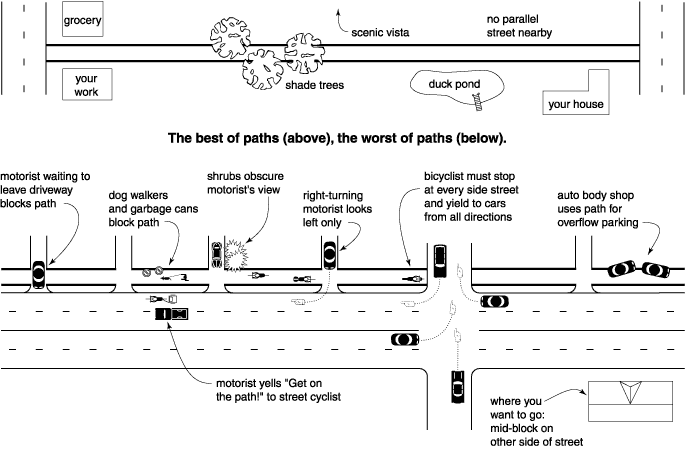
Maryland’s over stress on off-road encourages the worst of off-road facilities (bottom half) over and above more appropriate on-road facilities. And even with the best of paths (top half) most MD paths do not allow for comfortable biking from home to the trail (Per NHTSA survey 89% of bike trips begin at a residence and only 7% at a recreational site), nor do paths generally allow comfortable biking from the trail to work or grocery stories, such an idea is not even in the works. We need a more workable solution then what’s being offered and more verity in the offering of bike facilities at not only the state level but the local level as well.
Public participation is the key to remedying this and the following letter was put forth on one of the advocacy lists, I encourage everyone to write their own letter in support of greater public participation. ]
IC wrote this letter to MdTrailsSummit@dnr.state.md.us
Hi,
I was just informed of the Maryland Trails Summit. Since moving to
Maryland last December, and as I’m a keen cyclist who enjoys riding on
multi-use trails, I’ve been eager to get involved in related issues,
so something like this, which relates directly to cycling, seems like
it would be something I’d like to get involved with. Unfortunately the
Maryland Trails Summit seems to have been specifically designed to
exclude people like me (i.e. a keen cyclist who has a limited budget,
a job and a family) from the event.
Even if concerned people can afford the $50 admission fee (which seems
especially steep in these harsh economic times), the event is
scheduled for a Tuesday during school and working hours. I wonder,
could it have been scheduled for a LESS convenient time? Maybe holding
it on Thanksgiving Day would have kept more people away, but that’s
debatable. How is Maryland’s Department of Natural Resources hoping to
get useful feedback on its programs from concerned citizens when
virtually the only people able to attend are likely to be well-off
seniors or wealthy business tycoons with time on their hands?
Then there’s the venue. Does it really need to take place next to one
of the busiest airports in the country? If anyone wanted to cycle to
the event, they would have to negotiate the numerous freeways that
surround the venue. I mean, this is a summit devoted to trails. Sure,
many people besides cyclists are interested in Maryland Trails, but
surely most of these people live in Maryland and don’t need to fly
into BWI! As a cyclist, I would find it a scary prospect indeed to
negotiate such a labyrinth of freeways and highways to get to the
event on my bike, even if I lived within twenty miles of it.
Then there’s the environmental cost of this event. It seems to me that
the Department of Natural Resources should be discouraging the use of
fossil fuels and encouraging more sustainable modes of transportation,
yet the Department of Natural Resources seems to be going out of its
way to get people to fly or drive to the Maryland Trails Summit.
Honestly, with this lack of concern for the environment, what hope do
Maryland residents have that the Department of Natural Resources is
truly focused on safeguarding the state’s natural resources.
It seems to me that this event is structured to appeal more to the
travel industry than to the people the Department of Natural Resources
are supposed to serve – i.e. the residents of Maryland. I’m eager to
get involved when issues related to our natural resources come up, but
with a limited budget and a kid in school, there’s no way I can do
this.
Please, when planning events like this in the future, have some
thought for the people Maryland’s Department of Natural Resources is
supposed to serve! As for this event, I sincerely doubt anything
useful can come from it, as it effectively prevents constructive input
from the people who are most likely to use Maryland’s network of
trails.
Don’t believe the hype
[B’ Spokes: If I had to summarize the following article, the following analogy would be it:
A practical transportation device that meets 90% of our needs would be like this:

The problem is rather then use another tool for the remaining 10% we would rather use this all the time:
(Not to mention it impresses the heck out of the neighbors.)

A “personal” auto is like taking the space one person needs and doubling it, and double that again, and double that again, and double that again, and double that again, and doubling that yet again so we finally end up with something for everyones personal use. Now let’s find a place to park all these monsters 90% of the time. ]
Written by Bianca Mugyenyi and Yves Engler
Don’t believe the hype. The GM Volt plug-in hybrid electric vehicle is a threat to those who care about livability, equality and the planet.
For over 1300 days GM has touted the Volt and its ability to run for 40 miles on electricity before switching to a gasoline engine. In January 2007 the Financial Times concluded that the Volt was designed to counter the “halo effect that Toyota gained from the Prius, which rivals the iPod as an iconic product.” In fact, iCar was the original name for the Volt. “I admit,” the former head of GM explained, “that it [the Volt] has a secondary benefit of helping to reestablish credibility in technology.” plug
The lure of technological advancement has always been part of the automobile’s formidable ideological prowess. Popular journals, magazines and other media regularly portray the automotive sector as a forerunner of innovation.
While automakers spend huge sums on R&D the mode of transport is inherently inefficient. These 3000-pound metal boxes carry on average one and a half people, approximately 300 pounds – a mere ten percent of the vehicle’s weight. At the same, the car’s appetite for space is insatiable. Requiring 300 sq feet for home storage, 300 sq feet for storage at destination, 600 sq feet while traveling and another 200 sq feet for repairs, servicing or sale, an automobile occupies about 1,400 sq feet altogether – more space than most apartments.
Buses, trains, streetcars, bikes as well as pedestrians (and just about every other animal, plant or mineral) use space and infrastructure more efficiently than personal cars, whether moving or at a standstill. At approximately four meters across, road lanes are about the same width of railroad tracks, yet rail carries twenty times the number of passengers.
Despite the environmental fanfare, the Volt’s electric battery merely relocates tailpipe pollution to the source: power stations. Yet over half of all US electricity comes from coal, which produces more carbon emissions and pollutants than regular oil. If the goal of the electric car is to limit global warming, using carbon based fuels is puzzling.
Even with alternative fuels or better fuel efficiency the private car will continue to be an ecological catastrophe. From steel and aluminum, to paint and rubber production, to automotive assembly, manufacturing an average automobile generates enormous pollution. A Summer 2007 study titled, From Dust to Dust, concluded that half the energy a car uses in its lifecycle is in the production and destruction phases. Growing awareness of these energy costs prompted Norway to make it nearly impossible for car companies to advertise as “green”, “clean” or “environmentally friendly” without proving that this was the case in every aspect of the lifecycle from production to emissions to recycling.
The basic point is this: there is no such thing as a green car. It is not sustainable for individuals to hop into a two, four or eight thousand pound metal box for mobility.
Beyond ecological costs, car hegemony has a slew of negative side effects. Auto travel leads to significantly higher rates of injury or death than other forms of transportation. Additionally, infrastructure designed for the car undermines walking and biking, which are vital elements of a healthy lifestyle.
An incredibly expensive form of transportation, the amount of time devoted to the car is immense. It’s been calculated that the average person in the U.S. works from January 1st to March 31st to pay for their automobile(s). April 1st has been declared auto freedom day; the day people begin earning money for food, board, clothing, education and the other necessities of life.
When the automobile serves as the primary mode of mass transit, the poorest are hardest hit. Low-income U.S. families spend over a third of their take home pay on transportation, twice the proportion of affluent families. The Volt, which starts at $41, 000, will not alter that. But, it will give a boost to the image consciousness. Since the dawn of the auto age, the car has been a conspicuous symbol of status in a hyper materialist world.
North America’s transportation system, based on individual ownership of vehicles, is inefficient, environmentally destructive and dominates cultural, economic, and political systems in a wide variety of negative ways. Will the Volt revolutionize transportation or will its smoke and mirrors reinforce the dominance of the private car?
It may be time to look beyond private automobility.
Continue reading “Don’t believe the hype”
THE GOOD OLE DAYS

Bikes on trains – us vs them
from BikeHacks by Matt
I travel a lot by train. Prior to moving to the East Coast I didn’t, but part of my job involves quite a bit of travel to D.C. and I have found the train a much more pleasant experience than flying from NYC to D.C. In all liklihood the time it takes is probably the same or less when you figure in getting to the airport in the first place and having to pass through security.
I live about a 10 minute walk from the Penn Station so it’s convenient, you don’t have to pass through security (yet), and on the train is a pretty laid back environment. Most trains even have quiet cars so you can get away from annoying loud mobile phone talkers. What is it with these people? Don’t they know that you could practically whisper into their phone and have the person on the other end of the line hear them? Quite the opposite it seems, they feel the need to talk twice as loud as they normally would with little regard for the sanity of those around them . . . but I digress.
Back when I wrote some posts about bike camping I squaked about the fact that public transit is not too bike friendly in the eastern corridor. I will be traveling to the west coast this fall and will need to travel from Portland to Seattle.
In the past I would not have blinked twice and booked an air ticket. My new affinity for train travel had me checking out train ticket prices. I was pleasantly surprised on many fronts.
First, the train drops you off a few blocks from downtown Seattle so I will not have to worry about transit from the airport up the dreadedly clogged I-5.
Second, take a look at the first ticket reservation for a train from NYC to D.C. . . .
And then check out the Portland to Seattle option . . .
“Add Bike to Trip” is an option on every freaking train I looked into! How dope is that? If you click further you get to this:
On the NYC to D.C. trip there are only about two trains per day that allow bikes and you have to box them up. Tyranny I tell you! Portlanders, count your blessings. And if you have not traveled by train recently and don’t need to go too far, check it out. I’m a convert for sure.
Now if only we could get national high speed rail . . .
Second ciclovia will be held on Roland Avenue Oct. 31
By Larry Perl

(Enlarge) Bicyclists ride along Roland Avenue during last year’s Sunday Streets ciclovia. The even–in which the street is closed to traffic and open to pedestrians, runners, skateboarders, picnickers and bike riders–is back for its second year and will be held Oct. 31 from 8 a.m. to 1 p.m. 33rd Street will also be closed. (File photo /2009)
For the second year in a row, Roland Avenue will be closed to traffic for one day next month so the street can be taken over by bicyclists and pedestrians in an effort to promote recreation, fitness, neighborhood cohesiveness and local sustainability.
And this year, organizers are adding a second street — 33rd Street between Druid Hill Park and Lake Montebello.
The Oct. 31 ciclovia (pronounced sick-low-VEE-ah; it’s Spanish for bike path) was first organized by the Roland Park Civic League as “Sunday Streets” on Oct. 23, 2009, and drew hundreds of people.
Southbound Roland Avenue was blocked to motor vehicles between Cold Spring Lane and Northern Parkway from 8 a.m. to 1 p.m., so that people of all ages could walk, run, have picnics, and ride bikes and skateboards. Area students and other volunteers were trained and deployed as safety officers. Northbound Roland Avenue remained open to cars because it was the side with businesses and city officials wanted to leave it open, organizers said then.
At the time, organizers hoped to have a larger Sunday Streets event in March 2010, connecting Roland Park, Lake Montebello and Druid Hill Park.
Now, the concept is growing even bigger — and is being co-sponsored by the Mayor’s Office of Neighborhoods, making it a city event.
The BMore Streets for People Coalition, a group of community and business leaders, is working with the city to sponsor a series of Sunday morning ciclovias, as often as four times a year, in which selected streets would open Sunday mornings, exclusively for nondrivers.
BMore Streets for People became an official city program in May, said Mike McQuestion, a co-organizer and member of the Roland Park Civic League.
The coalition tried to organize a ciclovia for this past March, but the expected funding never materialized because the city failed to get a $4 million federal anti-obesity grant — of which $200,000 per year was earmarked for Sunday Streets, McQuestion said.
The budget for next month’s event is about $40,000, much of it for city permits and most of it being raised by the civic and business communities, said McQuestion, who is a member of the Roland Park Civic League. The city police department will help defray costs by charging less for security and traffic control, he said.
McQuestion said he is encouraged that the city is getting more involved in the event. He said organizers thought the city had given up on the project until a few weeks ago, when the mayor’s Office of Neighborhoods called him and suggested the Oct. 31 date. It turned out the office had been holding planning meetings about the ciclovia without his knowledge, he said.
The ciclovia will again be from 8 a.m. to 1 p.m. The Roland Avenue route will connect with the 33rd Street route. It’s not clear yet which side of 33rd will be closed off — or whether both sides will be, McQuestion said.
Bicyclists on 33rd Street will be allowed to cross North Charles Street and use roads near University Parkway, including Art Museum, Wyman Park and San Martin drives, as well as a carriage road behind the Homewood campus of Johns Hopkins University, he said.
McQuestion said 38 cities in 11 countries have organized such ciclovias or programs like them.
The 2006 Baltimore Bicycle Master Plan called for a network of streets that can be used for bicycling and that the city’s 2009 Sustainability Plan incorporates the plan and proposes citywide ciclovias, he said.
Ultimately, McQuestion hopes to see the ciclovias citywide and simultaneously, with as much as 40 miles of streets being closed to motor vehicle traffic.
That could happen next year.
“Every time we do it, we want to add more miles amd get more neighborhoods involved,” McQuestion said.
Continue reading “Second ciclovia will be held on Roland Avenue Oct. 31”
Mollusks on Wheels
Reading the various stories recently about driving on beaches, as vexing for safety reasons as environmental and simple quality of life factors, I couldn’t help but think back to Edward Abbey’s classic reproach, in Desert Solitaire, to those tourists who traveled via car in the national park at which he was stationed. I know Abbey the man is something of a thorny subject but the book is one of those rare titles that leaves an incendiary impression, the date and place of first reading forever fixed in one’s mind.
What can I tell them? Sealed in their metallic shells like mollusks on wheels, how can I pry the people free? The auto as tin can, the park ranger as opener. Look here, I want to say, for godsake folks get out of them there machines, take off those fucking sunglasses and unpeel both eyeballs, look around; throw away those goddamned idiotic cameras! For chrissake folks what is this life if full of care we have no time to stand and stare? Take off your shoes for a while, unzip your fly, piss hearty, dig your toes in the hot sand, feel that raw and rugged earth, split a couple of big toenails, draw blood! Why not? Jesus Christ, lady, roll that window down! You can’t see the desert if you can’t smell it! Dusty! Of course it’s dusty – this is Utah! But it’s good dust, good red Utahn dust, rich in iron, rich in irony. Turn that motor off. Get out of that piece of iron and stretch your varicose veins, take off your brassiere and get some hot sun on your old wrinkled dugs! You sir, squinting at the map with your radiator boiling over and your fuel pump vapor-locked, crawl out of that shiny hunk of GM junk and take a walk – yes, leave the old lady and those squawling brats behind for a while, turn your back on them and take a long quiet walk straight into the canyons, get lost for a while, come back when you damn well feel like it, it’ll do you and her and them a world of good. Give the kids a break too, let them out of the car, let them go scrambling over the rocks hunting for rattlesnakes and scorpions and anthills – yes sir, let them out, turn them loose; how dare you imprison little children in your goddamned upholstered horseless hearse? Yes sir, yes madam, I entreat you, get out of those motorized wheelchairs, get off your foam rubber backsides, stand up straight like men! like women! like human beings! and walk – walk – WALK upon our sweet and blessed land!
The 3,300 calories diet for the 165-lb. male cyclocross racer
While this is a bit shy of the average American diet I hope that it shows that exercise can really help offset those calories. And there is nothing like cycling to help motivate you to get that intense workout needed, at least in my humble opinion. If you are a cyclocross racer more diet info after the fold…
Continue reading “The 3,300 calories diet for the 165-lb. male cyclocross racer”