
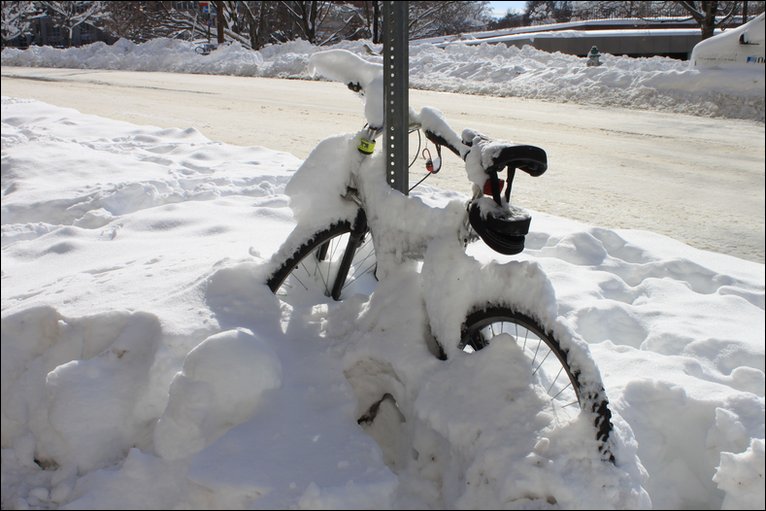
Like most Washingtonians, I’m sick of trudging over the snow. I’m especially tired of walking over increasingly icy sidewalks that should have been shoveled by the adjacent property owners. It is, after all, required by law that all sidewalks be cleared within eight hours of final snowfall.
But rather than complain, shame them in a listserv they’ll never read, demand government assistance, or report them to the government, some Tenleytowners are going to just clear the snow for the public good. In doing so, we will make the area safer for residents and name the businesses that failed in their legal and civic responsibility.
Jon Bender and I are organizing the First Tenleytown Volunteer Snow Removal Battalion. At 4 pm this afternoon 3 pm tomorrow, we will go forth from the Tenleytown Metro entrance to destroy the slush piles. We will clear paths through sidewalks swamped by plowed snow, unusable bus stops, several elderly residents, and even a few frontages untouched by those responsible for them.
To prevent any businesses from taking advantage of our labor, we will post "You’re Welcome" posters on the windows of miscreants and publish names and photographs of them online. I hope that residents will participate in a brief boycott of listed organizations.
Continue reading “Tired of business not shoveling there sidewalks? Here’s an interesting idea:”
Area cycling and the weather in the news



Garrett Trails Helps Government ‘Get It’
As a supporter of Garrett Trails This is great news!!! I sit in on the board meetings and know first hand how valuable this trail system and some help can be for Garrett County and Deep Creek Lake. Dont forget Taste of Garrett May 17, 2010.
This article is from the CUMBERLAND TIMES
Mountain Marylanders back governor’s plan for state trail network
Kevin Spradlin
CUMBERLAND — The mountain side of Maryland and those living closer to metropolitan centers can at least agree on one thing — there is value when investing in local trail systems.
With many legislative initiatives, there often is a split on what is good for one part of the state and what is good for Mountain Maryland.
This time, “I think the two sides do agree,” said Bill Atkinson on Friday, two days after Gov. Martin O’Malley announced the state’s first Maryland Trails: A Greener Way To Go plan.
The development of the plan was spearheaded by the state Department of Transportation. It focuses on a long-term projection of how a seamless trail network throughout the state can increase commuter options. Atkinson works for the Maryland Department of Planning and is a local representative for the Pennsylvania-based Trail Towns Program. He also is appointed as an advisory member to the Garrett Trails organization by the Garrett County commissioners.
Atkinson said the annual PACE reception in Annapolis about a week ago, where both Garrett Trails and the Allegany County-based Mountain Maryland Trails organization collaborated on a booth to showcase their positive economic impact, was “the first time we really joined forces.”
“We received a lot of interest at PACE with the combined booth,” said Mike Dreisbach, Mountain Maryland Trails president. “It looks like MMT and Garrett Trails can help the governor add about another 200 miles to make it 1,000 miles in Maryland.”
Atkinson, an avid bicyclist, said people already are using portions of the 20.47-mile Great Allegheny Passage in Allegany County as a commuting option on good-weather days. The gradual decline from Frostburg east to Cumberland provides an easy ride to work, he said.
“We found that to be one of those sidebars to the trail experience,” Atkinson said. “It’s easy to get to work that way. It’s recreation, it’s transportation and it’s economic development.”
State officials appear eager to agree.
“Working together, we can create a great transportation trails network that takes residents to where they need to go by bicycle or foot without ever having to get into their cars,” said Transportation Secretary Beverley Swaim-Staley in a news release.
Continue reading “Garrett Trails Helps Government ‘Get It’”
Bike the Tred Avon Circle, Maryland, USA
Three charming towns, one small ferry, and an afternoon full of greenery and water views make for a great day of bike riding and exploration.
Bike enthusiasts can find all the enjoyment of country riding, water views, historic towns, and opportunities for good food and exploration all within a 90-minute drive of Washington, D.C. The flat terrain of the Tred Avon Circle bike ride appeals to both experienced and inexperienced riders on this 35-mile route near the Chesapeake Bay in Maryland that’s perfect for an outing with friends or family.
…
Continue reading “Bike the Tred Avon Circle, Maryland, USA”
Right to use crosswalks and roadway even if shoulder is present – Hearing 2/25 at 1:00 p.m.
SENATE BILL 624 Vehicle Laws – Bicycles and Motor Scooters – Rules of the Road
Synopsis:
Authorizing a person operating a bicycle to ride the bicycle in or through a crosswalk in specified locations under specified circumstances; requiring a vehicle to yield the right-of-way under specified circumstances to a bicycle that is in a crosswalk; authorizing, under specified circumstances, a person who is operating a bicycle or motor scooter to use the roadway even if a shoulder is present; etc.
Continue reading “Right to use crosswalks and roadway even if shoulder is present – Hearing 2/25 at 1:00 p.m.”
NJ’s ‘Bicycle Bandit’ Pleads Guilty To 8 Bank Jobs
CAMDEN, N.J. (AP) ― A man police dubbed the “Bicycle Bandit” has admitted committing eight bank robberies in southern New Jersey and Delaware.
Forty-eight-year-old Brian Layton of East Greenwich Township pleaded guilty Tuesday before U.S. District Judge Jerome Simandle in Camden.
Layton was arrested Sept. 25 while trying to flee from a New Jersey state trooper on the Garden State Parkway.
…
[Which brings this unrelated video to mind.]
Continue reading “NJ’s ‘Bicycle Bandit’ Pleads Guilty To 8 Bank Jobs”
Industrial-Strength Fungus
Industrial-Strength Fungus
By Adam Fisher
…
Mycelium doesn’t taste very good, but once it’s dried, it has some remarkable properties. It’s nontoxic, fireproof and mold- and water-resistant, and it traps more heat than fiberglass insulation. It’s also stronger, pound for pound, than concrete. In December, Ross completed what is believed to be the first structure made entirely of mushroom. (Sorry, the homes in the fictional Smurf village don’t count.) The 500 bricks he grew at Far West Fungi were so sturdy that he destroyed many a metal file and saw blade in shaping the ‘shrooms into an archway 6 ft. (1.8 m) high and 6 ft. wide. Dubbed Mycotectural Alpha, it is currently on display at a gallery in Germany.
Nutty as "mycotecture" sounds, Ross may be onto something bigger than an art project. A promising start-up named Ecovative is building a 10,000-sq.-ft. (about 930 sq m) myco-factory in Green Island, N.Y. "We see this as a whole new material, a woodlike equivalent to plastic," says CEO Eben Bayer. The three-year-old company has been awarded grants from the EPA and the National Science Foundation, as well as the Department of Agriculture–because its mushrooms feast on empty seed husks from rice or cotton. "You can’t even feed it to animals," says Bayer of this kind of agricultural waste. "It’s basically trash."
After the husks are cooked, sprayed with water and myco-vitamins and seeded with mushroom spores, the mixture is poured into a mold of the desired shape and left to grow in a dark warehouse. A week or two later, the finished product is popped out and the material rendered biologically inert. The company’s first product, a green alternative to Styrofoam, is taking on the packaging industry. Called Ecocradle, it is set to be shipped around a yet-to-be-disclosed consumer item this spring.
…
Continue reading “Industrial-Strength Fungus”
First Lady Launches Childhood Obesity Push With Nod to Biking & Walking
Many kids today aren’t so fortunate. Urban sprawl and fears about safety often mean the only walking they do is out their front door to a bus or a car. Cuts in recess and gym mean a lot less running around during the school day, and lunchtime may mean a school lunch heavy on calories and fat. For many kids, those afternoons spent riding bikes and playing ball until dusk have been replaced by afternoons inside with TV, the Internet, and video games. – First Lady Michelle Obama
Continue reading “First Lady Launches Childhood Obesity Push With Nod to Biking & Walking”
Transport-Related Apps for Your Smartphone
To highlight the biking one:
CycleTracks
CycleTracks, a tool developed by the San Francisco County Transportation Authority, uses your smartphone’s GPS support to record your bicycle trips, display maps of your rides, and help transportation planners make San Francisco a better place to bike. At the end of each trip, real-time data representing the trip purpose, route, and the date and time are sent to the Transportation Authority. Planners use the data to improve the bicycle-use component of their computer model and better predict where cyclists will ride and how land development and transportation infrastructure will affect cycling. Users get to see maps and statistics of their rides.
Continue reading “Transport-Related Apps for Your Smartphone”
Bikes on Board: The Latest Research on Bicycle/Transit Integration
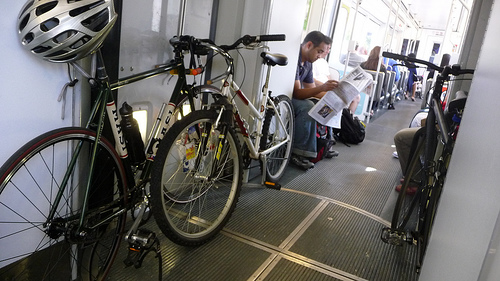
Bikes on Los Angeles County Metro’s Gold Line. Photo by Nate Baird.
…
Kevin Krizek and Eric Stonebraker’s paper Bicycling and Transit: A Marriage Unrealized summarizes the latest trends on the issue, and reports that several studies suggest that recent growth in transit and bicycling modes may be in small part a result of synergy between the two modes. That marriage, still very much in its infancy, can work via at least five broad possibilities:
1. transporting a transit customer’s bicycle aboard (inside or outside) a transit vehicle (see photo above!);
2. using and parking a transit customer’s bicycle at a transit access (or origin) location;
3. sharing a bicycle (publicly or privately provided), primarily based at the transit access point;
4. using a transit customer’s bicycle at the egress (or destination) location;
5. sharing a bicycle (again), but primarily based, this time, at the transit egress point.
The authors focus on four factors that affect the mode share percentage of cycling-transit users (CTUs): 1) transport mode, 2) location in the urban fabric, 3) egress catchment area, and 4) trip purpose.
Their review suggests that transit services that quickly transport users relatively long distances—30 miles plus—with relatively few stops (i.e. commuter rail or express buses) tend to draw larger shares of CTUs than slower and shorter-distance routes. Catchment areas (the area that a transit stop serves) tend to shrink or expand depending on the speed of the transit mode, with bicyclists willing to ride farther for a faster service. Finally, research confirms the obvious observation that most trips are work- and education-related. As such, CTUs often bypass inefficient feeder systems, to save time, while also preferring fastest, most efficient transit services.
…
Continue reading “Bikes on Board: The Latest Research on Bicycle/Transit Integration”