
BY BRUCE SICELOFF – Staff Writer
Like father, like daughter – only more so.
Tyler Strandberg of Rocky Mount has a hard time getting her mind off her BlackBerry when she drives.
She has crashed three cars in the past three years.
Each time, she was distracted from her driving because she was typing text messages or talking on the phone.
"Sometimes I will zone out and forget I’m driving," said Tyler, 23. "If I’m on the phone talking about something that takes up all my focus, I’m looking straight ahead – but not even seeing what’s there."
Her dad, Buckley Strandberg, worries that she will never curb her dangerous habit.
But Buckley, an insurance executive, confesses his own weakness for Blackberry and Bluetooth. He feels compelled to conduct business by phone and e-mail on long, lonely drives between his offices in Rocky Mount and Nags Head.
"That’s more than two hours," said Buckley, 49. "I’m not just going to sit there in the car. I get a lot of work done on that straight, dead stretch of U.S. 64.
"And if I run off the road, there are rumble strips that divert me back onto the road. That has happened occasionally. They seem to work, those rumble strips."
Buckley and Tyler Strandberg contacted The News & Observer to come clean about a problem they share with each other – and with a lot of us. They expressed embarrassment but spoke candidly about how they rely on their phones when they drive, and how they try to reduce their risks.
As many as 60 percent of drivers use their phones occasionally, researchers say, and 11 percent are on the phone at any one time. Cell phone use is a deadly distraction that causes as many as 28 percent of all traffic crashes, the National Safety Council says.
…
Continue reading “Can’t stop phoning while driving”
ROAD RAGE DOC GETS FIVE YEARS – TEXAS KILLER GETS ONLY TWO
By: Steve Magas, January 11, 2010
COMPARING SENTENCES – THEY DON’T ALWAYS ADD UP
What a difference a state makes – or so it seems.
CALIFORNIA ROAD RAGE CASE – FIVE YEAR SENTENCE
In California, Dr. Christopher Thompson was convicted in a well reported “road rage” incident. Testimony in the case included stories from several cyclists who were involved in road rage incidents with Dr. Thompson – the key event was not his only reported transgression! It took a couple before the prosecution decided to go after him.
The paper trail of prior reports was helpful in getting the prosecutor, and the court, to believe that an Emergency Room physician could actually be so cold-hearted towards human life. The testimony from those on the scene that Dr. Thompson said he “wanted to teach them a lesson” was chilling. You can read Bob Mionske’s take on the case here.
As shown in this LA Times pic, Dr. Thompson was crying in court during the sentencing and was led out of the courtroom in handcuffs the other day after learning that the judge gave him a FIVE YEAR sentence for causing the road rage incident. You can read the whole LA Time story here.
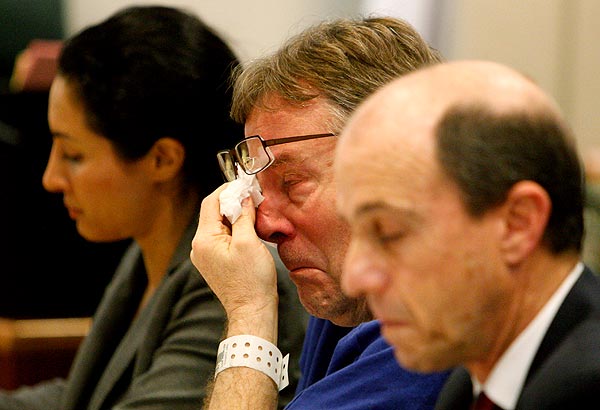
If only justice worked as well in every case.
TEXAS CASE – TWO CYCLISTS KILLED – TWO YEAR SENTENCE
On December 17, 2009, “justice” was handed down in the Kenneth Bain case out of Texas. Mr. Bain had allegedly been driving home in his Lincoln Navigator from a bachelor party at 8:15 am, after ingesting both alcohol and pot, when he ran into, and killed, two cyclists.
The two cyclists, Meredith Hatch and Mike Alfaro, were members of a local cycling group and were training for an event when they were struck from behind and killed. The photo of the huge Lincoln Navigator, from a local CBS television station’s website, shows the damage to the front of vehicle.
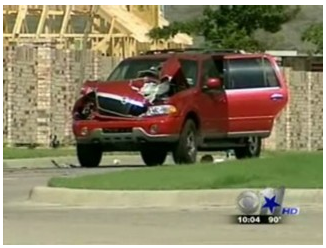
Mr. Bain was sentenced on December 17. His sentence was TWO years in prison with an additional 10 years of probation.
The families of the two cyclists, and local cycling advocates, were shocked and outraged. You can read about it here.
How do you get such different results? A guy in a road rage case who hurts, but does not kill, two cyclists gets five years. A guy who ingested pot and alcohol at a party and then kills two cyclists by striking them from behind gets two years?
I wish I had an answer. There are usually personal, legal or political factors that come into play in these cases, unfortunately.
In the the Texas case there were reports that the BAC for the driver was not over the limit and that there was some reluctance of the family of one victim to put the children on the witness stand. There were additional reports speculating that Mr. Bain’s lawyer, a sitting Texas State Senator, or Mr. Bain’s family/money may have played a role. Perhaps the prosecution was worried about some factual or legal issues and didn’t want to take a chance of this one getting away. We’ll never know.
In the California case, you had clear evidence that the doc was actually INTENDING to do some harm. There was testimony that the doc said he wanted to “teach them a lesson.”
In the Texas case, the driver was stupid, careless and maybe feeling the effects of a long night of partying, but there was no evidence of ill intent. There was no evidence that he intended to hit the riders. That would have led to murder charges.
That distinction – what the judge or jury believe is inside the MIND of the wrongdoer – is a typical dividing line for sentencing. Intentional and malicious actions are usually punished more severely than careless or stupid actions.
Indeed, in Indiana a few years ago FIVE motorcyclists were killed [and many suffered life changing injuries] in 3 separate accidents on the same day, all occurring within an hour of so of each other in broad daylight. In each case a relatively young motorist did something stupid and careless to cause the crash. None of the motorists were drunk or high – just careless. None of the motorcycle operators did anything wrong. The prosecutor, in each case, refused to press criminal charges saying “We don’t prosecute negligence in Indiana.”
When alcohol or drugs are involved, though, many states crank up the sentencing, even for “careless” and non-intentional actions. In the Texas case, while there was evidence of both, there may not have been enough evidence to show “impairment.” Compare these two cases to the two Ohio cases discussed below…
Continue reading “ROAD RAGE DOC GETS FIVE YEARS – TEXAS KILLER GETS ONLY TWO”
BICYCLE INSURANCE – WHO’S GOT IT?
Is anyone writing bicycle insurance in the USA right now? If so, I’m out of the loop. As far as I can tell, no insurer is writing such a policy in the United States right now.
What do I mean?
If you have a car, you get car insurance. That policy typically contains a number of different coverages. If you hit someone in your car, you are covered. If your car is damaged, your policy can cover it. If you are hit by an uninsured motorist, or one without enough insurance, this policy may provide a pool of money to pay your claim. The “Medical Payments” coverage can be used to pay your medical bills.
What if you are a true transportation cyclist and give up your car? Who pays the claim if you run somebody over? What if you get hit by an uninsured motorist? What kind of insurance is available to protect you?
The short answer, in the U.S., is that it is much easier to protect yourself on the bike if you own a car!
If you do NOT own a car, there is no “Uninsured/Underinsured” policy that will protect you if you are hit by an uninsured motorist. No one is selling this type of “Bicycle Insurance” in the U.S., as far as I am aware.
…
Continue reading “BICYCLE INSURANCE – WHO’S GOT IT?”
Are there best cycling practices that are clearly illegal in Maryland?

Table of changes in crash & injuries after adding side paths

Bikes and coffee

Man driving in fatal hit and run was texting; gets five years
Posted by Jonathan Maus (Editor-in-Chief) on January 22nd, 2010 at 1:26 pm

Screenshot from KGW.com.
The Columbian was at the sentencing hearing for Antonio Cellestine at the Clark County Courthouse in Vancouver today. According to their report, Cellestine was sentenced to 5 years in prison for driving his car into 50-year old Gordon Patterson back in September. A commenter who was at the hearing today, said Cellestine’s attorney plea bargained with the judge to not have the offense become his client’s first strike.
The Columbian also reports that court documents reveal Cellestine was texting at the time of the collision. According to KGW, Cellestine, who was 18 when the crash occurred, was driving with a suspended license at the time of the crash and his record includes two instances of driving with a suspended license, as well as driving without insurance.
In court today, Cellestine was quoted in The Columbian as saying:
“I feel no one knows how I really feel deep down inside and how I feel about things… This was not intentional; this was an accident…He (Patterson) will always have a special place in my heart.”
This tragic chain of events comes as the U.S. Department of Transportation has ratcheted up their focus on distracted driving and one week after The Oprah Winfrey Show featured victims of distracted driving on her show. It will take a lot more than snazzy slogans and some PR to deal with the issues this case so readily illustrates.
On that note, here’s a comment left below by a former transportation planner for the City of Vancouver that I felt was worth more attention:
“Sadly … this is a case influenced by what must be the very low regard that our law enforcement authorities and political leadership place on motor vehicle operators being certified and insured. There is a too common problem – motor vehicle operation on public streets is not a right but a responsibility…
… A plea to our state legislators this session…please make it less easy to buy insurance in order to get license tags and then cancel the account…
Another related legislative issue would be to strengthen the state law about cell phone/texting use [aka distracted driving].
As a bicyclist who has not owned a car for 22 years – this case and many too similar makes me wonder if I need to start driving again for more protection.”
Continue reading “Man driving in fatal hit and run was texting; gets five years”
Cyclists: Your bike is no longer welcome at Fort McHenry (during construction)
Fort McHenry. In spite of numerous markers around Baltimore purporting to be part of a bike trail to Fort McHenry, a cyclist traversing that trail will learn upon arrival that cyclists are no longer permitted to traverse the pathway adjacent to the river–according to some rather permanent looking signs recently erected to provide that information. According to one person purporting to be in authority, cyclists who are discovered upon that now forbidden pathway will recieve a citation.
I understand that no such injunction applies to the many persons leading dogs that continue to deposit feces and urine onto the adjacent greensward.
Continue reading “Cyclists: Your bike is no longer welcome at Fort McHenry (during construction)”
National Household Travel Survey
Highlights the 2009 National Household Travel Survey, released on January 8th, 2010
Mode Share
• Biking and walking make up 11.9 percent of all trips made in this country. This is up from 9.5 percent in 2001, a 25 percent increase.
o Biking is 1 percent, up 25 percent from 0.8 percent in 2001.
o Walking is 10.9 percent, up 25 percent from 8.7 percent in 2001.
Short Trips
• 28 percent of all trips are 1 mile or less.
o 40 percent of all trips are 2 miles or less.
o 50 percent of all trips are 3 miles or less.
• Of those trips 1 mile or less, 2.25 percent are biked.
o 35 percent are walked.
o 60 percent are driven.
• Of all trips 2 miles of less, 2 percent are biked.
o 26 percent are walked.
o 68 percent are driven.
• Of all trips 3 miles or less, 1.8 percent are biked.
o 21 percent are walked.
o 72 percent are driven.
Mode of Short Trip
• Of all biking trips, 59 percent are 1 mile or less.
o 78 percent are 2 miles or less.
o 85 percent are 3 miles or less.
• Of all walking trips, 87 percent are 1 mile or less.
o 97 percent are 2 miles or less.
o 98 percent are 3 miles or less.
• Of all driving trips, 20 percent are 1 mile or less.
o 33 percent are 2 miles or less.
o 43 percent are 3 miles or less.
Urban v. Rural Short Trips
• In non-urban areas, 20 percent of trips are 1 mile or less.
o 30 percent are 2 miles or less.
o 37 percent are 3 miles or less.
• In urban areas, 30 percent or all trips are 1 miles or less.
o 44 percent are 2 miles or less.
o 53 percent are 3 miles or less.
Source: NHTS 2009, FHWA Office of Policy
Continue reading “National Household Travel Survey”
12 ways our region could reform bicycling laws
by David C. (on Greater Greater Washington)
The percentage of people riding bikes for transportation has been rising for the better part of two decades and there is every reason to believe that trend will continue. While engineers and traffic planners work to update the infrastructure and physical elements to encourage cycling, there is more that legislators can do to help too.
Some laws unnecessarily restrict safe cycling or where cyclists can ride or park. There are other laws that haven’t caught up with technology and make the roads more dangerous for all. And there are still other laws that fail to protect vulnerable users or punish negligent drivers.
These laws should be rewritten. In many cases the change in laws will protect pedestrians and/or drivers as well. Below is a summery of recommended changes for the DC region that ran as part of a series on the Washcycle.
- Replace contributory negligence with comparative negligence. Maryland, Virginia and DC are three of only five “states” that use contributory negligence to establish damage awards in civil cases. Under this standard, if an injured road user was even 1% at fault for a crash with another road user they would be unable to recover damages unless they could prove that the other road user had the “last clear chance” to avoid the accident. Last clear chance involves proving four separate facts about the crash, all of which must be true, and can be difficult to prove.
Every other jurisdiction uses some form of comparative negligence, which allows the injured party to recover some of their loses even if they were partially to blame. Contributory negligence is loved by big business and the insurance industry but it punishes victims — who are disproportionally pedestrians and cyclists — twice, and should be changed.
- Close the negligent driving loophole. In Virginia and Maryland, it can be very difficult to convict a negligent driver with a crime. In both states recently, drivers who were over-driving their vision or not paying attention hit cyclists from behind and killed them. In one case the driver got a $313 ticket in the other the driver wasn’t punished at all.
The problem is that simple negligence is only a misdemeanor in Maryland and not a crime at all in Virginia. DC, on the other hand, has a law against “careless, reckless or negligent” driving that can result in 5 years in prison or a fine of up to $5000. Virginia and Maryland should close the loophole that allows negligent driving to be treated as “just an accident.”
- Ban distracted driving. Distracted driving is quickly emerging as one of the major causes of road casualties. DC, Maryland and Virginia should move swiftly to make distracted driving (and that includes cycling) illegal.
This means making texting while driving a primary offense in Virginia, where now it is a secondary offense, and increasing the fine from $20. It means banning the use of electronic devices while driving, including phones, computers, pagers and video games. Hands-free phones aren’t significantly safer than hand-held phones and drivers should not be allowed to use those either. Finally, drivers should not be allowed to manipulate a GPS device while driving, though they can listen to directions.
- Treat cycling as transportation. Complete Streets is a doctrine requiring transportation agencies to build roadways that enable safe access for all users. Several states have adopted complete streets legislation or policies.
Maryland adopted weak Complete Streets legislation in 2000, but it needs to be stronger. Virginia has a policy to accommodate cyclists and pedestrians, but it needs to be expanded. DC has no complete streets policy and should pass legislation to that effect.
In addition, both DC and Maryland should emulate Virginia’s ban on culs-de-sac, as they make for circuitous cycling on traffic sewers. M-NCPPC should end its policy of closing trails at night or when it snows and region-wide, critical trails should be cleared after a heavy snow. People still commute at those times.
- Leave a safe distance. Maryland and Virginia should follow DC’s lead and pass a three feet minimum passing distance law, as well as a law making it illegal to open a car door unless it is safe to do so.
- Fix equipment requirements. Maryland, Virginia and DC require some equipment that isn’t needed, fail to require one piece of valuable equipment and should try to standardize their light rules.
The three have different laws about what kind of lights are required, but a common set of rules would help DC area cyclists. Combining the three state’s laws could create a requirement for, at minimum, a front light visible 500 feet away attached to the bike, a rear light visible at the same distance attached to the bike or the rider and a rear reflector visible 100 feet away.
While bells are nice, they shouldn’t be required. I’ve never met a cyclist who thought their life, or anyone else’s, was saved by a bell. And Maryland and Virginia should match DC’s unique law allowing fixed gear bikes without a separate brake.
- Improve the return of recovered and impounded bikes. All three jurisdictions should create a process that maximizes the number of recovered stolen bikes and impounded bikes returned to owners. They should check all such bikes against the national bike registries. They should place photos of them on a recovered bike web site, as Arlington County does, and make it searchable by serial number.
The serial number of bikes that are auctioned, donated or scrapped should be recorded in a searchable online database so that owners can recover the money or donation receipt for their bike. All jurisdictions should regularly report recovered bike statistics such as total number, number returned, number disposed, etc… as well as registries used to return them.
- Let cyclists decide where to ride. The uniform vehicle code, which most states use to define traffic laws, requires cyclists to ride “as closely as practicable to the right-hand curb or edge of the roadway” and then lists several exceptions. While Denver has rewritten the law to make cyclists the judge of where in the lane a cyclist should ride, a more dramatic change is needed.
It’s not unreasonable to require cyclists to move right to accommodate faster traffic when safe and necessary, but attempting to codify this has led to frequent misinterpretation. A better rule would require riding right only when the lane is wide enough to allow a car to pass a bicycle safely in the same lane (safe), and when there is only one lane in that direction (necessary). Those cases are actually quite rare, so DC, MD and VA could be required to sign those roads as “Ride Right Roads.” In addition, Maryland should repeal its law requiring cyclists to use bike lanes and shoulders when present.
- Let cyclists ride more than two abreast. Most places limit cyclists riding in a group from riding more than two abreast, and only when not being passed. Cyclists riding in an informal group ride often find themselves riding three or even four abreast, and under current law that’s illegal. Instead the law should only require cyclists to stay in a single lane, except when legally changing lanes, and to move right to facilitate overtaking vehicles when judged safe and necessary.
- Improve access and parking. Building rules restricting bike commuters from bringing bikes inside as well as rules restricting bike parking in the public space make it unnecessarily difficult to park a bike. The region should adopt a rule similar to New York City’s Bicycle Access to Buildings law which requires buildings to allow bicycles inside under certain circumstances. Cyclists should also be allowed to park their bikes to poles within bus zones or located within 25 feet of an intersection.
- Decriminalize safe cycling. Laws that were written for cars and drivers shouldn’t necessarily be applied to bikes and cyclists. The Idaho stop law allows cyclists to treat stop signs as yield signs and stop lights as stop signs, which is what many cyclists do anyway. Since it’s inception in Idaho, cycling has actually gotten safer.
Another change should allow cyclists waiting at a light to move past the advanced stop line while the light is still red so as to stay in front of and in view of drivers. And finally, Maryland should review its law requiring cyclists to have both hands available for reaching the handlebars. DC and VA don’t have such a ban and and this law could make it illegal for a cyclist to do something as simple as grab a water bottle.
- Allow more sidewalk cycling. Though sidewalk cycling is a critical tool to effective cycling, it’s illegal in Prince William County, Alexandria and most of Maryland.
While it might make sense to ban it in certain areas with heavy pedestrian traffic, such as DC’s Central Business District, a county-wide ban is excessive and imprecise. These jurisdictions should make bans the exception and not the rule. Even in areas where its been decided that a ban makes sense, the law should allow riding on the sidewalk for the purpose of parking, as is done in Denver.
Continue reading “12 ways our region could reform bicycling laws”