
Last year when we gave Ryan Van Duzer a 3-speed commuter bike to thank him for years of support around the Tour de Fat – he jokingly said he’d ride it across the country. We all chuckled and walked away but Ryan called us this spring and said he was going to ride the 3-speed 3,000 miles – from San Diego to Washington DC – to raise money for Community Cycles in Boulder.
Who are we to get in the way of a young man following his folly?
So, this is Ryan’s coast-to-coast adventure. He’ll be blogging, tweeting and uploading videos along the way. He wants you to come out and ride with him so check back often to see when he’ll be pedaling through your town – he needs your support and a place to wash his sox.
As Ryan says, "If I can ride a 3-speed across the country, everyone can be riding their bikes more to work and to the store."
Ride on, Duzer. We totally agree. We’ll see you in DC late summer.
Continue reading “If I can ride a 3-speed across the country, everyone can be riding their bikes more to work and to the store.”
Lessons for the United States
Public policy can play a major role in reshaping America’s transportation system. The German experience offers five lessons to the United States for improving transportation sustainability through changes in travel behavior:
* Get the Price Right in order to encourage the use of less polluting cars, driving at non-peak hours and more use of public transportation
* Integrate Transit, Cycling, and Walking as Viable Alternatives to the Car, as a necessary measure to make any sort of car-restrictive measures publicly and politically feasible
* Fully Coordinate and Integrate Planning for Land Use and Transportation to discourage car-dependent sprawl and promote transit-oriented development
* Public Information and Education to Make Changes Feasible are essential in conveying the benefits of more sustainable policies and enforcing their results over the long term
* Implement Policies in Stages with a Long Term Perspective because it takes considerable time to gather the necessary public and political support and to develop appropriate measures.
Continue reading “Lessons for the United States”
More people may be biking due to bad gas?
2nd Gas Station Hit With Bad Supply
Hess Corp. Takes Blame For Bad Gas
LUTHERVILLE, Md. — For a second time this month, contaminated gas bought in Baltimore County is being blamed for damaging dozens of cars.
The problems were first reported at the Exxon station in Parkton last week, and the Oceanic gas station on York Road in Lutherville is currently experiencing a similar problem.
Officials with Ocean Petroleum told 11 News the gas came from the Hess Corp. and damaged about a dozen vehicles Saturday night.
Jennifer Biglin’s SUV was one of those vehicles.
"When I was leaving, I pulled out and everything was fine until I got to Ridgley Road, then it started to make noises and hesitate, and it didn’t have any power. It sounded not normal," she said.
Biglin said she called the gas station and the owner admitted the gas was bad.
Continue reading “More people may be biking due to bad gas?”
More on the "right to drive"
…
CYCLISTS FLOUT COMMON SENSE, ENDANGER THOSE IN CARS ON MOUNTAIN ROADS IN THE NAME OF SELFISHNESS; CARS WILL BE FORCED TO CROSS DOUBLE YELLOW LINES ON DANGEROUS LIMITED VISIBILITY ROADS DUE TO THE EXPANDED RIGHTS OF CYCLISTS.
Yadda, yadda, yadda. Where to begin? Give the author credit for getting the spelling right, at least.
Let’s start with the Universal Right of Speed, a part of the vehicle code so obscure that no one has been able to find it. URS states that drivers in motor vehicles have the inalienable right to drive as fast as they want whenever they want. Speed limits are merely advisory and can be ignored if there are no law enforcement vehicles in the immediate area. Drivers may operate at or above the speed limit even when the road ahead is obscured by terrain, fog, rain, snow, or smoke. Anything that forces them to slow down (other than a police car parked alongside the road) is most likely illegal, unconstitutional, and immoral.
…
Motorists who say it is too dangerous for bicyclists to be on the public roads as they are likely to be hit by a car, are simply roadway bullies exactly like the playground bully who says, "This is my playground and I am bigger than you, and if you get hurt it is your own fault." They are simply blaming the victim.
We had similar comments on a news article here after a motorist killed two cyclists last week. ‘Bicyclists shouldn’t use ABC Road because it’s four lanes with heavy, high-speed traffic.’ And of course, someone else chimed in with ‘cyclists shouldn’t use XYZ Road because it’s only two lanes with hills and curves.’ The underlying complaint is that ‘cyclists shouldn’t use the road I’m on -they should go somewhere else.’
Continue reading “More on the "right to drive"”
Complete Street Quotes
“Transportation systems dramatically affect the design of communities in which we live, in turn the design of our communities affects our ability to engage in healthy behaviors. Transportation systems, therefore, can be used to support healthy communities essentially by allowing people to use all modes of transportation to move through the community they occupy in a safe and efficient way.”
– Dr. Ileana Arias, Director of the National Center for Injury Prevention and Control of the Centers for Disease Control and Prevention, at June 5’s briefing on Complete Streets: Integrating Safety and Livability into the Next Transportation Bill
“The signing of this Executive Order is just one in a number of steps that we are taking to make Philadelphia an even better place to walk, bike and take SEPTA. Making it easy for residents, commuters and visitors to choose to not use their cars is among the most meaningful contributions the City can make toward our goal of becoming America’s number one green city.”
– Philadelphia Mayor Michael Nutter, in the accompanying press release
“The widespread lack of physical activity in our nation has played a major part in the perpetuation of the obesity epidemic. A key factor contributing to the lack of physical activity is the absence of infrastructure to support or encourage pedestrian and bicycle travel as modes of transportation. The result of our collective inactivity has burdened New York State with over $6 billion annually in medical costs. That is why this bill is so important.”
– New York State Assemblyman Sam Hoyt, in Buffalo Rising
EPA Offers $10M for Climate Change Showcase Communities
WASHINGTON, DC, June 15,
2009 (ENS) – For the first time, the U.S. EPA is opening a competitive grant
program for local and tribal governments that want to establish and implement
climate change initiatives to reduce greenhouse gas emissions in their
communities.
A total of $10 million
will be distributed next January in Climate Showcase Communities grants.
“Ending climate
change and moving to a sustainable, clean energy future begins on the ground in
our communities,” said EPA Administrator Lisa Jackson, announcing the new
grants program today.
“We’re offering a
helping hand to local areas that are leading the way in confronting climate
change, and a call to action for anyone concerned about making a difference
where they live,” she said.
The EPA is requesting
proposals from local governments, federally-recognized Indian tribal
governments, and inter-tribal consortia to create replicable models of
sustainable community action, generate cost-effective greenhouse gas
reductions, and improve the environmental, economic, public health, and social
conditions in a community.
The agency expects to
award about 30 cooperative agreements, each one ranging from $100,000 to
$500,000.
Approximately five
percent of the funds, or about $500,000, is being set aside for tribal
governments.
A 50 percent cost-share
is required for recipients, with the exception of tribal governments and
intertribal consortia, which are exempt from matching requirements under this
grant.
“We can cut energy
costs and reduce harmful emissions at the local level, and build a model for
fighting climate change in every community,”
Jackson said.
The Climate Showcase
Communities grant program aims to create models of sustainable community action
that generate cost-effective and persistent greenhouse gas reductions while
improving the environmental, economic, public health, or social conditions in a
community.
|
|
Knoxville ,
|
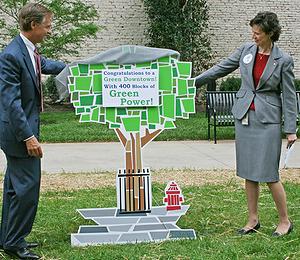
Continue reading “EPA Offers $10M for Climate Change Showcase Communities”
New city rules shield cyclists
Columbia MO
…
An incident of cyclist harassment by a driver in February prompted Sixth Ward Councilwoman Barbara Hoppe to introduce an ordinance that would make harassment of bicyclists, including shouting threats and honking for the purpose of frightening a cyclist, a Class A misdemeanor, punishable by $1,000 fine or a year in jail.
After hearing testimony at last night’s meeting, the council passed the ordinance unanimously.
Continue reading “New city rules shield cyclists”
Bike and Build dipping their wheels in the Atlantic Ocean!

Kerri and crew start off on their nine week journey biking across the country and helping to build houses for Habitat for Humanity.
Continue reading “Bike and Build dipping their wheels in the Atlantic Ocean!”
Transportation Chief Wants Delay in Highway Bill
WASHINGTON – Transportation Secretary Ray LaHood said Wednesday said he wants Congress to extend the current transportation-funding formulas for an additional 18 months, putting himself at odds with some senior congressional Democrats.
Mr. LaHood’s proposal to put off a wholesale overhaul of federal transportation policy until after the 2010 elections is an acknowledgment that the administration is too tied up in legislative battles over health care, energy and financial overhaul to tackle the contentious issue of how to pay for an upgrade of the nation’s roads, bridges and other transportation infrastructure.
"I recognize that there will be concerns raised about this approach," Mr. LaHood said in a statement. "However, with the reality of our fiscal environment and the critical demand to address our infrastructure investments in a smarter, more focused approach, we should not rush legislation."
But the Chairman of the House Transportation Committee, Rep. James Oberstar (D., Minn.), opposes such a long delay in attacking the nation’s long-term infrastructure-financing problem, and he wants to increase highway funding significantly starting in October.
Mr. Oberstar’s committee is crafting a new $450 billion, six-year transportation-spending bill. The Senate has introduced a similar bill, but the House is expected to move its version to a vote first. Mr. Oberstar plans to unveil his bill this week and hopes to bring it to the House floor for a vote before the August recess.
In a meeting with reporters Wednesday, Mr. Oberstar was adamant that Congress must pass a new law before the current one expires.
"Extension of current law is unacceptable," Mr. Oberstar said. "Now is the time to move."
The debate over how to fund transportation improvements has been simmering for months. The White House hasn’t put forward a solution to the central problem: gasoline taxes and levies on vehicle purchases aren’t generating enough money to pay for the projects that federal and state officials say are necessary.
Continue reading “Transportation Chief Wants Delay in Highway Bill”
EPA, DOT and HUD Announce Interagency Partnership for Sustainable Communities
The Partnership for Sustainable Communities established six livability principles that will act as a foundation for interagency coordination:
1. Provide more transportation choices.
Develop safe, reliable and economical transportation choices to decrease household transportation costs, reduce our nation’s dependence on foreign oil, improve air quality, reduce greenhouse gas emissions and promote public health.
2. Promote equitable, affordable housing.
Expand location- and energy-efficient housing choices for people of all ages, incomes, races and ethnicities to increase mobility and lower the combined cost of housing and transportation.
3. Enhance economic competitiveness.
Improve economic competitiveness through reliable and timely access to employment centers, educational opportunities, services and other basic needs by workers as well as expanded business access to markets.
4. Support existing communities.
Target federal funding toward existing communities – through such strategies as transit-oriented, mixed-use development and land recycling – to increase community revitalization, improve the efficiency of public works investments, and safeguard rural landscapes.
5. Coordinate policies and leverage investment.
Align federal policies and funding to remove barriers to collaboration, leverage funding and increase the accountability and effectiveness of all levels of government to plan for future growth, including making smart energy choices such as locally generated renewable energy.
6. Value communities and neighborhoods.
Enhance the unique characteristics of all communities by investing in healthy, safe and walkable neighborhoods – rural, urban or suburban.
Continue reading “EPA, DOT and HUD Announce Interagency Partnership for Sustainable Communities”