
Industrial-Strength Fungus
By Adam Fisher
…
Mycelium doesn’t taste very good, but once it’s dried, it has some remarkable properties. It’s nontoxic, fireproof and mold- and water-resistant, and it traps more heat than fiberglass insulation. It’s also stronger, pound for pound, than concrete. In December, Ross completed what is believed to be the first structure made entirely of mushroom. (Sorry, the homes in the fictional Smurf village don’t count.) The 500 bricks he grew at Far West Fungi were so sturdy that he destroyed many a metal file and saw blade in shaping the ‘shrooms into an archway 6 ft. (1.8 m) high and 6 ft. wide. Dubbed Mycotectural Alpha, it is currently on display at a gallery in Germany.
Nutty as "mycotecture" sounds, Ross may be onto something bigger than an art project. A promising start-up named Ecovative is building a 10,000-sq.-ft. (about 930 sq m) myco-factory in Green Island, N.Y. "We see this as a whole new material, a woodlike equivalent to plastic," says CEO Eben Bayer. The three-year-old company has been awarded grants from the EPA and the National Science Foundation, as well as the Department of Agriculture–because its mushrooms feast on empty seed husks from rice or cotton. "You can’t even feed it to animals," says Bayer of this kind of agricultural waste. "It’s basically trash."
After the husks are cooked, sprayed with water and myco-vitamins and seeded with mushroom spores, the mixture is poured into a mold of the desired shape and left to grow in a dark warehouse. A week or two later, the finished product is popped out and the material rendered biologically inert. The company’s first product, a green alternative to Styrofoam, is taking on the packaging industry. Called Ecocradle, it is set to be shipped around a yet-to-be-disclosed consumer item this spring.
…
Continue reading “Industrial-Strength Fungus”
First Lady Launches Childhood Obesity Push With Nod to Biking & Walking
Many kids today aren’t so fortunate. Urban sprawl and fears about safety often mean the only walking they do is out their front door to a bus or a car. Cuts in recess and gym mean a lot less running around during the school day, and lunchtime may mean a school lunch heavy on calories and fat. For many kids, those afternoons spent riding bikes and playing ball until dusk have been replaced by afternoons inside with TV, the Internet, and video games. – First Lady Michelle Obama
Continue reading “First Lady Launches Childhood Obesity Push With Nod to Biking & Walking”
Transport-Related Apps for Your Smartphone
To highlight the biking one:
CycleTracks
CycleTracks, a tool developed by the San Francisco County Transportation Authority, uses your smartphone’s GPS support to record your bicycle trips, display maps of your rides, and help transportation planners make San Francisco a better place to bike. At the end of each trip, real-time data representing the trip purpose, route, and the date and time are sent to the Transportation Authority. Planners use the data to improve the bicycle-use component of their computer model and better predict where cyclists will ride and how land development and transportation infrastructure will affect cycling. Users get to see maps and statistics of their rides.
Continue reading “Transport-Related Apps for Your Smartphone”
Bikes on Board: The Latest Research on Bicycle/Transit Integration
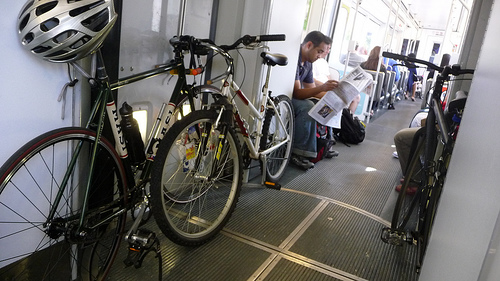
Bikes on Los Angeles County Metro’s Gold Line. Photo by Nate Baird.
…
Kevin Krizek and Eric Stonebraker’s paper Bicycling and Transit: A Marriage Unrealized summarizes the latest trends on the issue, and reports that several studies suggest that recent growth in transit and bicycling modes may be in small part a result of synergy between the two modes. That marriage, still very much in its infancy, can work via at least five broad possibilities:
1. transporting a transit customer’s bicycle aboard (inside or outside) a transit vehicle (see photo above!);
2. using and parking a transit customer’s bicycle at a transit access (or origin) location;
3. sharing a bicycle (publicly or privately provided), primarily based at the transit access point;
4. using a transit customer’s bicycle at the egress (or destination) location;
5. sharing a bicycle (again), but primarily based, this time, at the transit egress point.
The authors focus on four factors that affect the mode share percentage of cycling-transit users (CTUs): 1) transport mode, 2) location in the urban fabric, 3) egress catchment area, and 4) trip purpose.
Their review suggests that transit services that quickly transport users relatively long distances—30 miles plus—with relatively few stops (i.e. commuter rail or express buses) tend to draw larger shares of CTUs than slower and shorter-distance routes. Catchment areas (the area that a transit stop serves) tend to shrink or expand depending on the speed of the transit mode, with bicyclists willing to ride farther for a faster service. Finally, research confirms the obvious observation that most trips are work- and education-related. As such, CTUs often bypass inefficient feeder systems, to save time, while also preferring fastest, most efficient transit services.
…
Continue reading “Bikes on Board: The Latest Research on Bicycle/Transit Integration”
Back to Bicycling Basics in Beijing
According to The Guardian, 20 years ago, four out of five Beijing residents pedaled around China’s capital in some of the world’s best bike lanes. However, this number has decreased as private car ownership has gone up. From 1995 to 2005, China’s bike fleet declined by 35 percent while private car ownership more than doubled. Beijing is currently home to four million cars. Last year, China overtook the U.S. in auto sales, with a 46 percent increase in sales over the previous year. As cities in China have grown, bike lanes have also been eliminated to accommodate more traffic lanes for cars and buses. By all indications, it’s seemed that Beijing was well on its way to usher in a new king – the automobile.
But is the city of 17 million ready for king car? Perhaps not, as Beijing’s air quality continues to be poor (last week BeijingAir’s monitoring station reported a few ‘hazardous’ air quality days). Liu Xiaoming, the director of the Municipal Communications Commission, said in a Xinhua article that the government will “revise and eliminate” regulations that discourage bicycle use and impose greater restrictions on car drivers. Beijing already has limitations to reduce the number of vehicles on the road, continuing the odd-even license plate policy after its successful implementation during the 2008 Olympics. (And read my post about Beijing’s ban on “yellow label” vehicles here.)
The government also plans to restore bicycle lanes that were torn down, as well as to build more parking lots for bicycles at bus and subway stations to encourage additional cycling.
…
Continue reading “Back to Bicycling Basics in Beijing”
Electric cars not so eco-friendly: Green groups
A latest report has claimed that an increase in electric cars is likely to lead to more electricity production from coal, gas and nuclear plants, without necessarily reducing oil demand for conventional cars
…
“We need smart electric vehicles that interact with smart electricity grids so cars can charge up on green power. Dump electric vehicles plugged into a dump electricity grid would only add demand for coal and nuclear power and drive us away from a sustainable energy future,” said Greenpeace’s Franziska Achterberg.
Continue reading “Electric cars not so eco-friendly: Green groups”
More to eat and die for…..!
"Heinz supposedly spent years developing the container–years! Their rigorous R&D even included user-testing in cars. Statistics are unclear on how many of the 100+ car deaths every day are caused by eating, but the National Highway Traffic Safety Administration says about 80% are due to driving distracted–and that includes fry- and nugget-dunking. While it’s clearly not Heinz’s responsibility to police people who might enjoy their savory accoutrement while, say, whipping around a convoy on the New Jersey Turnpike, it does come across as a potentially controversial distraction."[1]
"’The packet has long been the bane of our consumers,’ said Dave Ciesinski, vice president of Heinz Ketchup. ‘The biggest complaint is there is no way to dip and eat it on-the-go.’
Designers found that what worked at a table didn’t work where many people use ketchup packets: in the car.
So two years ago, Heinz bought a used people carrier for the design team members so they could give their ideas a real road test.
The team studied what each passenger needed. The driver wanted something that could sit on the armrest. Passengers wanted the choice of squeezing or dunking. Mothers everywhere wanted a packet that held enough ketchup for the meal and didn’t squirt onto clothes so easily."
Continue reading “More to eat and die for…..!”
Freiker (FREquent bIKER, rhymes with biker)
by JIM BERGAMO / KVUE News
The Round Rock School District is rolling out a new way to make fitness fun. The program combines biking and computers.
Friday afternoon, the Patsy Sommer Elementary School will become the first school in Texas to join a unique bike to school to program. By then, something will sit at the top of a pole in the schoolyard that the kids will think is really cool. It’s called a RFID reader, and its "readin’, ‘ritin’ and ‘rithmetic" is designed to help cut down on the obesity epidemic.
"It is really an epidemic of inactivity, kids need an hour a day minimum and they do not get that in PE," said Leslie Luciana, the Director of Advocacy and Community relations at Bicycle Sport Shop.
Continue reading “Freiker (FREquent bIKER, rhymes with biker)”
End Hunger Bike Ride April 24, 2010 Southern Maryland

The End of the Cul-de-sac?
The cul-de-sac is perhaps the quintessential symbol of suburban America. Perhaps millions of them have paved over greenways throughout the country. Hailed for their safety (no traffic that can run over kids) and prized by developers because they allow more houses to be built into oddly shaped tracts and right up to the edges of rivers and property lines, planners and town officials are beginning to realize their downside.
Early last year the state of Virginia became the first state to severely limit cul-de-sacs from future development. Similar actions have been taken in Portland Oregon, Austin, Texas, and Charlotte, North Carolina. What they are beginning to realize is that the cul-de-sac street grid uses land inefficiently, discourages walking and biking, and causes an almost complete dependence on driving, with attendant pollution and energy use. Furthermore, town officials are beginning to realize that unconnected streets cost more money to provide services to and force traffic onto increasingly crowded arterial roads, which then, in many cases, need to be widened (more tax money).