Secretary of Transportation Responds – Things have gotten better in the last three years

“Both traffic crashes that involve pedestrians and injuries suffered by pedestrians have declined in Maryland in each of the last three years.” – Beverley K. Swaim-Staley Secretary of Transportation

So while pedestrian injuries have gone down 10%, what she fails to mention is that pedestrian fatalities have gone up 20%. But what’s even more alarming is how Maryland compares to other states:

2006 The base year (Note: A rank of 1= the highest pedestrian fatality rate.)
image

2007 The first year
image

2008 The second year
image

2009 The third year
image


MY MAIN POINTS MISSED BY MDOT: Please do MORE. Please make BIKE/PED FEDERAL AID EASER for the LOCALITIES to obtain for projects that are designed to reduce bike/ped crashes. OTHER STATES are improving faster then Maryland.

I would ask you to write but it seems MDOT is more interested in covering their rear ends then making measurable improvements with an implied “We don’t look at traffic fatalities, just crashes. If more people are dying in fewer crashes then that’s a good thing. ” The suggestion of writing to Tom Hicks, Director of Traffic and Safety personally I find offensive. The guy should have retired several decades ago with his 1950 road safety mentality. Not to mention being the runner up for the prestigious award of “The Most Ludicrous Statement by a Public Official on Bike/Ped Issues” with his opposition to bicyclists having the right-of-way in bike lanes in 2009 because of “The problem of striping a bike lane through an uncontrolled intersection.” (A fictitious joining of unlikely to happen striping with rare intersection type.) (To be fair at least Delaware cyclists like him.)

image
On the left: Tom Hicks, Director of Traffic and Safety — Michael Jackson, Director of Bicycle and Pedestrian Access – on the right.
…with an implied “We don’t look at traffic fatalities, just crashes. If more people are dying in fewer crashes then that’s a good thing. “

Maybe it is unfair of me to put words in someone’s mouth but how do you address the continued avoidance of answering the hard questions. What am I to think about the redirection from fatalities to injuries. What am I to think about the mention of Maryland’s Strategic Highway Safety Plan and how it is supposed to address these issue but there is no mention of pedestrians nor bicyclists on this page. On further reading the SHSP has some “idealistic” mention of improving pedestrian safety but with no mention how money is supposed to get this stuff on to the ground to make things better. A plan with no funding is the same as no plan at all. One way we have tried to do that is by law and to create Bicycle-Pedestrian Priority Areas and finally after a decade we get one and just one in an area with a low pedestrian fatality rate (Montgomery County.)

Current 5 year bike/ped project plans are probably at an all time funding low but the real issue is most of these projects DO NOT address reducing bike/ped crashes nor are they in areas of high pedestrian fatality rates. Is this a problem of the localities not willing to spend the money on improving the situation or MDOT in administrating Federal funds for bike/ped safety is just not willing to spend Federal money on this issue? (To be clear MDOT is under obligating all Federal funds that could be used to help problem areas, sans Safe Routes to School but that is a very tiny pot.)

The Secretary also mentioned crosswalk sting operations, are there pedestrian sting operations going on in Montgomery County? Sure but in Baltimore County we just ticket j-walkers. Again note the difference in pedestrian fatality rates between the two counties.

Overall the Secretary seems to be saying MDOT is doing something, for sure but there is a world of difference between doing things that have PROVEN to be effective and doing things that blame the victim. Further reading: Blaming the pedestrian won’t solve the problem.

Read more for the Secretary’s letter.
Continue reading “Secretary of Transportation Responds – Things have gotten better in the last three years”

STUDY: OLDER DRIVERS OVERLOOK PEDS 2X AS OFTEN AS YOUNGER DRIVERS

from CenterLines, the e-newsletter of the National Center for Bicycling & Walking.
-> According to a Mar. 7th L.A. Times article, "Older drivers may have a breadth of driving experience working for them behind the wheel. But a new study finds they tend to have a narrower field of vision than younger drivers and often miss developments on the curb or sidewalk that could demand their attention. The study, published online Monday by the journal Accident Analysis and Prevention, found that drivers over 65 were half as likely to notice pedestrians near or moving toward the street as were experienced drivers between the ages of 28 and 45. Placing the two groups of drivers in a simulator and in front of videos taken from a driver’s eye view, researchers from Ben-Gurion University of the Negev found that older drivers took longer to respond to road hazards as well."
"And compared to younger drivers simulating a drive through a variety of streetscapes, those over 65 tapped on their brakes in response to a ‘roadside hazard’ about half as often, suggesting either that they did not see it or that they did not consider it something they needed to attend to. The good news (unless you’re driving behind one of these motor vehicle operators and you’re late for an appointment) is that the older drivers drive more slowly — about 20% more slowly — perhaps to compensate for shortcomings in their peripheral vision and attention…"
Source: https://tinyurl.com/6dnjgp6
-> "’Motor vehicle crashes are still the leading cause of death for from ages 3 through 34. They are taking our youngest people away. There are 93 deaths every day, one death every 16 minutes."
— Dr. Federico Vaca, professor of emergency medicine, Yale School of Medicine
https://tinyurl.com/6eapseb

Small Talk Paradox: "How Was Your Commute?"

from Cycle Jerk

Most of the time coworkers take the path of least resistance and go for the simple "So! How was the ride?", followed by "You’re crazy man!" after my response. Don’t get me wrong, it’s a nice gesture and I do appreciate the thought. This person wants to hear how cool my commute was, and that’s cool. However, the question is asked of me so often I started giving it right back to the source.
"My ride was awesome! How was your drive in?"
This is met with a wide spectrum of responses;

This led me to ponder the trend… it seems to be a common assumption that being a bike commuter, my daily ride in is always great and that any commute by car is always shitty. If that assumption is both true and common why aren’t people more open minded about bike commuting?
The same person who complains about the traffic every day gets to work with two assumptions, that my ride in was awesome and that I’m crazy for doing it.
My assumption is that a good percentage of these people live an easily rideable distance from the office.
I apologize, that was way too many assumptions for one post.

PSA Bike to Work Day in the DC Area: https://www.waba.org/events/btwd/
In the Baltimore Area: https://www.baltometro.org/commuter-options/bike-to-work-day
Continue reading “Small Talk Paradox: "How Was Your Commute?"”

Save the Date for These Special Programs!

Bike Maryland

Dynamic presentations by Gil Peñalosa.  April 6 (Baltimore, MD)
and April 7 (Columbia, MD). 

Mr. Penalosa is an internationally renowned livable city adviser who is passionate about vibrant and healthy communities. He has delivered presentations at events across North America, Latin America, Australia, New Zealand, and Europe. As Executive Director of the non-profit organization 8-80 Cities and former Commissioner of Parks, Sports and Recreation in Bogota, Colombia, Gil’s tireless commitment to fostering healthy communities remains front and center. He also works as Senior Consultant for the renowned Danish firm Gehl Architects. Furthermore, he serves on the Boards of Directors of American Trails, Ciclovias of the Americas, and City Parks Alliance. Gil holds an MBA from UCLA and advises municipal, corporate and community leaders around the world. Centered on the promotion of creating interconnected networks of pedestrian, cycling and public transportation infrastructure and building vibrant parks and public spaces, Gil’s presentations are an inspirational method to build capacity in government, business and community settings. These free events are sponsored by the Columbia Association and Bike Maryland.  

Wednesday, April 6th, 2011, 7-9PM at the First English Evangelical Lutheran Church, 3807 N. Charles Street, Baltimore. Presentation – Moving from Talking to Doing!

This presentation will inspire and instruct the audience on the creation of vibrant cities and healthy communities. 880 Cities promotes walking and bicycling as activities and urban parks, trails and other public spaces as great places for all. These activities and public spaces improve our environment, advance economic development, boost and complement our transportation systems, make better recreation for all, and enhance our personal and public health. We invite you to join us in experiencing a presentation by Gil Penalosa! RSVPs Preferred: click here

Thursday, April 7th 2011, 7-9 PM at the Bain Center, 5470 Ruth Keeton Way Columbia, MD 21044. Presentation – Walking, Cycling, & Public Places for All!

As part of Columbia Association’s on-going Community Building Speaker’s Series, the Columbia Association is excited to co-host this keynote presentation by Gil Peñalosa, Executive Director 8-80 Cities. As the Commissioner of Parks, Sport and Recreation for the City of Bogotá, Colombia, Gil’s team initiated the “new Ciclovia” – car-free Sundays – today an internationally recognized program that sees over 1.3 million people walk, run skate and bike along 75 miles of Bogotá’s city roads. RSVPs Preferred: Event.Rsvp@ColumbiaAssociation.com

What’s an 8-80 City?
Step 1. Think of a Child
Step 2. Think of an Older Adult
Step 3. Ask yourself, would you send a child to bike to the store? Would you have her grandmother cross that intersection? What if, everything we did in our cities was great for the 8 year olds and 80 year olds? We’d end up with cities that are good for all — 8-80 Cities.


Continue reading “Save the Date for These Special Programs!”

No accountability for driver who hit bicyclist

On behalf of my colleagues, I send best wishes for a speedy recovery to 20-year-old Nathan Krasnopoler, the bicyclist who is recovering from a coma after being hit by a motorist on February 26th. Mr. Krasnopoler was safely riding his bike in a marked bike lane on University Parkway in Baltimore when he was hit by a motorist who failed to yield.

Mr. Krasnopoler’s injury is disturbing, but it is made even more disturbing because there will be no reckoning. That is to say, the driver who hit Mr. Krasnopoler will face no criminal charges despite the apparent violation of the law. Just last year, the legislature passed and the governor signed the "three foot rule" with the specific intent of preventing this type of accident. The "three foot rule" requires motorists to yield the right-of-way to the cyclist lawfully riding in the designated bike lane or on the right-most side of the road and to give a 3-foot buffer when attempting to pass. Therefore, the motorist’s action, while possibly accidental, was nonetheless illegal. We cannot hope to deter this type of horrible accident unless the police enforce the three foot rule and other laws which both protect the lawful cyclists and cite bicyclists when they violate the rules of the road.

Legislation such as the "three foot rule" is not intended to punish drivers but to preserve the right of cyclists to ride safely. More and more people are using their bikes for commuting, recreation and other reasons. As cyclists merely want to ride from place to place safely, drivers need to be made aware of the increasing number of cyclists and their right to arrive without injury.

Del. Jon S. Cardin, Annapolis

The writer, a Democrat, represents District 11 in Baltimore County.

Continue reading “No accountability for driver who hit bicyclist”

PG County wants to remove bike/ped planners from road review process

from TheWashCycle by washcycle

WABA reports that PG County Executive Rushern Baker’s transition team wants to remove M-NCPPC from the review process of roads in an effort to make the process more efficient. DPW&T would do all of the reviews on their own.

To minimize the ability of [M-NCPPC]’s qualified bike and pedestrian planners to provide input on the need for road improvements and the nature of those improvements is to undermine the very improvements in bicycle and pedestrian connectivity and livable, sustainable development that County Executive Baker has extolled.

DPW&T remains, by and large, a traditional, automobiles-first transportation agency, and has been reluctant to take the steps necessary to improve roadways for the benefit of cyclists–even going so far as to recommend that a cyclist not travel a certain roadway in the county with his child due to its unsafe conditions, while refusing to make improvements.

Hopefully Baker will not follow this recommendation (and will add a bike/ped coordinator position at DPW&T).

Continue reading “PG County wants to remove bike/ped planners from road review process”

We Need to Make Alternatives Attractive

By Patrick J. Natale, P.E.
P.E., Executive Director, American Society of Civil Engineers

The price of gas is irrelevant. Fluctuating gasoline prices are not the problem, but they do serve to intensify the challenges we face after decades of under-investing in surface transportation. If the price of gas goes up, drivers start using other modes that cannot handle the volume. If it goes down, we still have a massive congestion problem and current revenues from gas taxes are not sufficient.

The cynical person might interpret that trend as a clear sign that Americans prefer driving over other modes of transportation. That may well be, but it could also be an indication that we have not done a good enough job making the alternatives attractive.

Continue reading “We Need to Make Alternatives Attractive”

Announcing a new Meetup!

Why:
The Rando Ramble is a monthly series of unsupported century rides (100+ miles) leaving from Baltimore. We spend the day in the saddle riding various well-cued routes exploring the surrounding counties and states and we make it back in time for dinner
When:
Sunday, March 20, 2011 8:00 AM
Where:
The Maryland Zoo in Baltimore
Druid Hill Park
Baltimore, MD 21217
exact start here: https://tinyurl.com/5trp6ox
more details about the next ride here: https://randoramble.posterous.com/

Missing at least three points about sustainable transportation

from Rebuilding Place in the Urban Space by Richard Layman

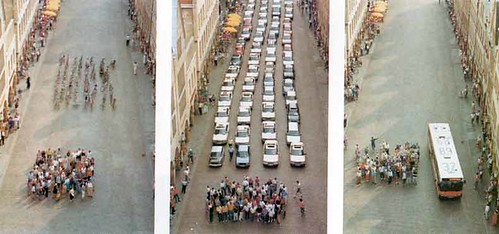
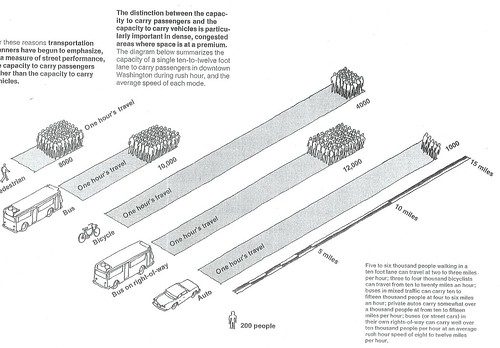
1. The primary reason that I don’t talk about “how great it is” “to expand people’s choices” when it comes to bicycle, pedestrian, and transit infrastructure is because it’s not about choice, it’s about efficiency and optimality.

The issue isn’t giving people more choices, it’s about using scarce resources more effectively.
Muenster bike vs. car vs. bus vs. walking poster
First image: Muenster, Germany bike vs. car vs. bus vs. walking poster. Second image: Mobility efficiency, Central Washington (DC) Transportation and Civic Design Study, 1977. John Passonneau, lead investigator.
Mobility efficiency -- Passonneau

It’s much more optimal–given the right spatial form–to walk or bike or use transit than it is to use a car–at least for a community, if not for an individual.

It’s why we talk about “mass” transit.

2. The desire to maintain the primacy of the automobile in transportation planning on the part of drivers especially is the source of the animus with regard to prioritizing (or rebalancing) transportation infrastructure development towards biking, walking, and transit.

This is what’s behind the fight against bike lanes everywhere, not just in NYC. See “Battle of the Bike Lanes” from the New Yorker and “Suit Over Brooklyn Bike Lane Challenges City Initiative” from the New York Times.

While various people have written counter-pieces to the New Yorker article, the reality is that it comes down to the question of optimality and yes, externalities and properly pricing them (see “Tragedies of the commons: The world is his parking spot” from the Economist blog).

3. The third point is something deserving of a blog entry of its own, but it’s not like I haven’t written about it ad infinitum already.

The issue is that reframing and rebuilding the transportation mode split where walking, biking, and transit are significantly used to conduct a majority of trips _is a process_ that will take a long time.

John Cassidy writes in the New Yorker:

But from an economic perspective I also question whether the blanketing of the city with bike lanes—more than two hundred miles in the past three years—meets an objective cost-benefit criterion. Beyond a certain point, given the limited number of bicyclists in the city, the benefits of extra bike lanes must run into diminishing returns, and the costs to motorists (and pedestrians) of implementing the policies must increase. Have we reached that point? I would say so.

He is missing the point entirely. You don’t build infrastructure for today’s use only, but to provide the means to achieve your mode split goals.

In Copenhagen, close to 40% of all daily trips–not just trips to work–are conducted by bike.

Continue reading “Missing at least three points about sustainable transportation”