Race Pace Busts Bike Thief!

By Race Pace, via Facebook

A series of events unfolded at one of our stores yesterday…it went a little something like this:
-Mr. Thief brings a bike to a local shop, who notes shifty eyes and a fishy story, and that shop refers the customer to our store.
-Our staff greets the guy and begins the stall process.
-Another of our mechanics contacts the manufacturer, who tells us the shop that originally purchased it.
-We call that shop and get contact info for the person who bought it last month
-We call that customer, who didn’t know his bike had been stolen, and they call the police to file a report.
-We call the police, and they drop by to pick up Mr. Thief and his pocket full of drugs.
Blam! The streets are safer – go bike them!

Continue reading “Race Pace Busts Bike Thief!”

The Law of Unintended Consequences in Government Regulations: Example Transportation

By Klaus Philipsen, Community Architect


ISTEA was the landmark legislation that tried to put transportation planning and funding on a much sounder footing:

  • It recognized that transportation policy should be more about moving people and less about moving cars. To this end it stressed that it was supposed to be “mode blind” and “intermodal”. 
  • It recognized that there can be efficient and inefficient ways to move people and so it stressed efficiency. 
  • It recognized that traffic doesn’t know jurisdictional boundaries and needs to be approached regionally. So the law required Metropolitan Planning organizations (MPOs). 
  • The law tried to eradicate unwarranted “wish list” projects by requiring “Major Investment Studies”.
  • The law understood that car focused transportation has environmental impacts and mandated linkage to the Clean Air Act. It required transportation projects to show that they did not worsen air quality in “non-attainment areas” or they couldn’t be funded.  
  • One of the most enlightened elements of the law was the objective to address not only the supply of transportation infrastructure but also the demand by requiring “demand management” strategies  
  • One of the most effective demand reduction strategies is a change in land use patterns and ISTEA clearly highlighted the link between land use and transportation.
  • Finally, the Act recognized that outcomes need to be measures and included specific metrics to do that, for example VMT (Vehicle Miles Traveled).

In short, the law was a dream for fiscal conservatives and for enlightened planners alike: To the former for its aspirations towards efficiency, to the latter for the goal of solving transportation, air quality and land use problems rather than just building stuff. But, with so many good intentions, one can easily guess that not all went by the plan. Reality took a different route.(For Robert Fuentes’ of Brookings assessment of ISTEA read here).

I remember ISTEA well. I had just been appointed to a Maryland State Planning Commission Committee (resulting from the 1992 Maryland Growth and Resource Protection Act, an early smart growth legislation). At the same time, highly motivated by the new law I started consulting with the Baltimore Metropolitan Council (BMC) which was the newly anointed regional MPO. I co-authored a manual for public involvement under ISTEA.  Most interesting, though, was a pilot project in which the six member jurisdictions of the MPO dealt with the land use-transportation nexus: They modeled the impacts land use changes would have on transportation performance.

I soon learned first hand that provincial interest in project funding would easily trump any effort of finding a rational planning approach. Carroll County, for example, found it much more important to get its own freeway (“we are the only county in the MPO that doesn’t have one”) than protecting its open spaces from development. The other counties with rural areas, Anne Arundel County, Harford County and even Howard County were not very enthusiastic about shifting growth towards existing infrastructure either. When the modeling study clearly showed that 10% growth reallocation made traffic perform better than the billions of anticipated transportation projects, the pilot project became a hot potato. Chairman Stoney Frailey had to promise the participating counties that this study result would not become public. And so it happened, the study was terminated and remained unpublished.

With the intent of ISTEA in plain view “work-arounds” and “pseudo compliance” began to proliferate. What surprise, then, that in spite of ISTEA and all the following transportation bills since then, the reality of how transport projects come about remained the same to this day: In Maryland a “road tour” organized by the State Highway Administration (SHA) in which local politicians and administrators tell the agency which projects they want.  And precisely those projects wind up in the Consolidated Transportation Program (CTP). Non attainment? No problem, the region will get waivers and extensions. Major investment study? Sure, it will show how well the dream project will perform. Intermodal? Efficient? Conforming with equity and social justice? Paper after paper will be written. A cottage industry of consultants and administrative employees knows precisely how to provide all the required reports. The projects remained the same, the justifications changed.In this manner Maryland built the Inter County Connector and doubled the lane capacity of I-95 north of Baltimore to name just the two most expensive road projects that a rigorous application of the ISTEA metrics should have prevented. Meanwhile construction for new transit projects such as the Red and Purple Lines remain unfunded.

Maybe Congress should learn from the Disabilities Act when it considers again how it wants to make transportation investments more effective. Mobility and mode choices as civil rights? This isn’t as far fetched as it may sound considering that by far more than half of the US population doesn’t have access to cars because of age, disability, poverty or choice. Consider that the age pyramid will rapidly increase that portion of the population even further. Consider that fossil fuel is powering almost all of our mobility options. Given that climate change, increased demand and rising cost will make that source less and less desirable, wouldn’t it behoove us well to consider better land use that reduces demand for trips? Or a transit option for everyone? Walk and bike options for shorter trips in cities, towns and villages? Or proof that our scarce dollars really improve mobility and have the largest possible benefit?

These questions track the exact issues ISTEA tried to address. As frustrating as it is, we cannot give up on those goals. In spite of the “law of unintended consequences” the alternative, continued waste and inefficiency is not only too frightening, it is beyond our means.

https://archplanbaltimore.blogspot.com/2013/03/the-law-of-unintended-consequences-in.html

Foods That Heal

To mend muscles and fix fractures more quickly, look no further than your local market.
By Kelly Bastone, Bicycling
WHEN AN INJURY SIDELINES A CYCLIST, the natural reaction is to cut back on calories until it’s time to ride—and burn energy—again. But the healing process demands fuel, too. "It’s like fixing a house," says sports dietitian Cynthia Sass, RD, CSSD. "A crack in the foundation requires raw materials to patch things back together, and in the body those raw materials come from what we eat."
Proteins, vitamins, minerals and antioxidants help heal wounds, relax stressed tendons and mend fractured bones more quickly. So in addition to your doc’s advice to elevate and ice, choose the right combinations of foods to speed recovery and get back on your bike. Here’s where to aim your cart at the Stop & Shop.

https://www.bicycling.com/training-nutrition/nutrition-weight-loss/foods-heal?cm_mmc=Facebook-_-Bicycling-_-Content-Slideshow-_-foods-heal

Bike Symposium News: More Politics than Policy

By Ron Cassie, Baltimore Magazine
The breaking news from the 16th Annual Maryland Bike Symposium was more political than legislative or policy focused.
Del. Jon Cardin (D-Baltimore County), chair of the state’s Bicycle and Pedestrian Caucus and a longtime member of state’s Green Caucus, confirmed what he’s long been openly mulling — that he will be a candidate to become Maryland’s next attorney general in 2014.
Cardin, of course, holds uncle Sen. Ben Cardin’s old seat. Montgomery County state Sen. Brain E. Frosh has previously announced he will run for attorney general in 2014. Current Maryland Attorney General Douglas F. Gansler is expected to be a leading contender for governor in 2014, along with Lt. Gov. Anthony G. Brown, Comptroller Peter Franchot and Howard County Executive Ken Ulman.
Coincidentally, Ulman, pictured above (right) with Race Pace Bicycles owner and Bike Maryland board president Alex Obriecht, delivered the keynote address at the symposium, hosted by Bike Maryland, and was received warmly by the bicycling community. Ulman, who initiated the Healthy Howard program to increase access to health care in the county, also created the Howard County Office of Environmental Sustainability and has supported efforts to expand safe bicycling in the county, including the development of the county’s first Bicycle Master Plan.
Legislatively, in terms of bicycling bills, there doesn’t seem to be much moving in Annapolis this session.

https://www.baltimoremagazine.net/bikeshorts/2013/03/bike-symposium-news-more-politics-than-policy

No Respect – Pedestrian Crossing [could be anywhere]


[B’ Spokes: Things like this happen all over yet there still is the persistence that distracted pedestrians are the problem. I will further assert if this is a typical pedestrian experience (which I think it is) it is no wounder more and more pedestrians are choosing to cross mid-block. We need to enforce traffic laws on BOTH pedestrians and motorists.]

Don’t Pass Me Yet, Bro!

By William Smith, Frederick News Post

Dear Motorist Person,

In your haste the other afternoon to pass me as I was riding my bicycle, you came fairly close to hurting or killing someone. You see, my mom always told me, “Don’t start a pass you can’t finish.” She was not discussing driving, but the point was well-taken.

You might recall that, at the time you chose to begin your pass, there was a hill just ahead of us that hid the oncoming car from your view, but not mine since I was forty feet in front of you. I imagine that you chose to go completely across into the other lane on this skinny country road in order to provide sufficient room to pass me, which in some circumstances could be quite appropriate and desirable, but not in this case. Your haste to pass me created a situation where, had I not intervened, was going to either

  • cause you to have a head-on collision with the unseen oncoming car (perhaps killing one or both of you)
  • force the oncoming car off the road into the trees (perhaps killing her),
  • lead to you swerving to the right in order to avoid the oncoming vehicle (crashing into and possibly killing me).

I hope you did not mind that I decided to quickly move into the center of the roadway to prevent you from passing me and that my frantic waving and yelling “NO!” did not alarm you to a large degree. Fortunately for all of us, you chose to take my actions seriously and pull back into line behind my bike. Also pleasing was the fact that you then waited ten seconds for me to signal “clear” and wave you on so that you could pass safely. Not as pleasing was the one-finger salute that followed, despite the likely crash that my attentiveness prevented. A “thank-you” would have been more appropriate. I imagine it was the last token of affection displayed when one realizes that he/she has done wrong and needs to proclaim victory and withdraw.

Sincerely,

Bill

I see this type of situation often enough. With decades of bicycling experience and a fine mirror mounted on my helmet, I can usually spot a potentially dangerous situation brewing and take action in time to avoid the danger. Motorists will unsafely pass bicyclists for various reasons, some of which are: (a) impatience, (b) incompetence, (c) anger, (d) inattention and (e) misjudging the speed of the bicyclist. On every bicycle is a human being such as myself. A motorist’s haste to more quickly reach his/her destination does not override the rules of the road, nor the courtesy that we should extend to each other, nor is sufficient reason to put another person’s life in danger.

Sometimes I hear the common motorist rant, “He was riding in the middle of the lane!” There is often a reason for this. If the lane is too narrow for a motor vehicle and bicyclist to safely share (think Rosemont Avenue or 7th Street), the bicyclist should move far enough to the left to dissuade the motorist from passing in the same lane. If the bicyclist does not move left, the motorist will be tempted to try to squeeze past the bicyclist, often passing within a few inches, setting up a dangerous situation. In 2012 it became law in Maryland that a motorist must pass a bicyclist with at least three feet of clearance space.

So – please, my motorist friends – be patient and pass safely.

Another situation that a bicyclist must be careful to avoid is called the “right hook.” This is when a motorist passes the bicyclist and then immediately executes a right-hand turn in front of hm/her, causing the bicyclist to (a) get pushed off the road, (b) get crushed underneath a tire or (c) if fortunate, quickly slam on the brakes in order to avoid a collision. To avoid the situation, I will move into the center or center-left of the lane as I approach an intersection where there is a potential for a trailing car to perform a right turn. This persuades the motorist to execute the correct and safe maneuver of remaining behind the bicyclist and turning right behind him/her instead of in front.

The following link shows how these situations can be avoided under the caption “How to Not Get Hit By Cars”: https://www.bicyclesafe.com/ There are ten situations covered here, accompanied by some very good advice on how to ride safely in traffic. Every bicyclist and motorist should read this web page. We would all be safer as a result.

See you out there.  And always listen to your mother.  She also requested that we all use our turn signals.


https://www.fredericknewspost.com/sections/blogs/blog.htm?bid=206&headerTitle=Bicycling+In+and+Around+Frederick+%E2%80%94%C2%A0Citizen+blog
A Rustwirian Travel Guide: Baltimore in a Few Days

By: Jeff La Noue, Comeback City

Action Oriented

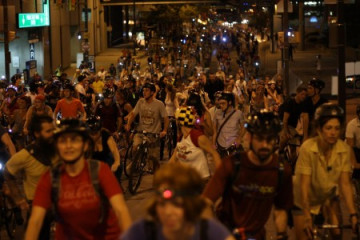
I wish our town had a well-marked sightseeing loop for bicyclists, but sadly we don’t.  Therefore, the best way to see Baltimore by bicycle and not get lost is to time your visit with Tour Dem Parks or Tour Du Port, two well-organized rides that show off a lot of the city. The new Baltimore Bike Party offers riders a short dusk/night-time ride and takes places the last Friday night of the month. It departs from the Washington Monument and generally ends at a brew pub.  Check ahead to see what the theme for the ride is. Bicycles can be rented at Light Street Cycles and Race Pace Bicycles, both in Federal Hill or Twenty20 Cycling in Hampden.

Baltimore Bike Party (Last Friday of every month)

Baltimore Bike Party (Last Friday of every month)

https://comebackcity.us/2013/02/23/a-rustwirian-travel-guide-baltimore-in-a-few-days/

Designing Communities for Longevity: The Blue Zones Project

by Angie Schmitt, Streets Blog
Is your neighborhood designed to make people healthy or sick? With the right characteristics, the place where you live could add years to your life.

The team boiled down their research to nine principles for longevity and health. The number one principle? “Move Naturally.”
“The world’s longest-lived people don’t pump iron, run marathons or join gyms,” the researchers wrote. “Instead, they live in environments that constantly nudge them into moving without thinking about it.”

https://dc.streetsblog.org/2013/02/08/designing-communities-for-longevity-the-blue-zones-project/
**********************************************************************************************************
[B’ Spokes: Note that Maryland ranks 33 in terms of longevity (below average.) Ref: https://en.wikipedia.org/wiki/List_of_U.S._states_by_life_expectancy ]