
Pursuant to the Living Shorelines Protection Act, MDE has prepared rules on where and how one can build erosion-control structures. Those structures often eliminate the public pathway along the shore (all land below mean high water is owned by the public so unless it is high tide, you can walk or ride a fat-tire bike along the shore). Some of the environmentally friendly techniques (planting marsh) also impair access along shores that were previously pebble and sand beached. In some states, to get a permit, property owners must create pathways inland of the shore protection–but these rules are silent entirely on public access. As written, MDE can allow property owners to eliminate public access along shores that people currently use to go somewhere.
Continue reading “MDE ignores bike/ped again”
Bike Freindly State Feedback
The Bicycle Friendly State program has again ranked all 50
states on their bike-friendliness. Maryland ranked 16th for 2009. You can see the overall
results of the ranking, including by category here.
The rankings are based on overall scores to the ranking questionnaire
that was sent to your State
Bike Coordinator.
The overall scoring was very close, with the separation of
many states being the difference of just a few items. Passage of key
legislation, updated traffic code, increased education programs or accurate
funding reporting can lead to a significant impact on your state’s
ranking. Our hope is that this brief bit of feedback can serve as a
checklist on to help you improve your ranking as you continue to work with your
Department of Transportation and state legislature. In partnership with Bikes
Belong we have assisted the National Conference of State Legislators in
creating Encouraging
Bicycling and Walking: The State Legislative Role. Please forward this link
along to your state representatives and their staff. If you would like
hard-copies to put in the hands of your representatives, please let me know,
though quantities are limited.
My commute rocks/sucks

|
Hey-
What’s your commute like? Maybe you crank up the A/C, put in a Yanni CD and zone out. Maybe you peruse the morning paper while on the express bus that stops just blocks from your home and office. Or maybe you leave frustrated tooth-marks on your steering wheel each day. We want to hear your commuting story – no matter how terrible your lows or how blissful your highs. We can’t read minds, so you’re just going to have to spell it out for us: My commute rocks; it’s practically the best part of my day! My commute sucks… please, please make it stop. Hundreds of commuters from locales far and near have already chimed in. User “Cantabrigian” bragged: “I adore my commute! 10 minutes by bicycle on a marked bike lane, or 15 minutes by foot, passing by convenient coffeeshops…This is one reason why I choose to live and work where I do.” On the flip side, Christine let out a little rage:
Ouch. If your commute’s as lousy as Christine’s – or, traffic forbid, worse – we want to hear you rage about your lousy commute! Hearing stories like yours – the good, the bad, and the ugly – helps us flesh out what commuting in America is really like. And we’re using the stories you write on MyCommuteSucks.org – and the groundswell of support we’re seeing – to press home our message with Congress: let’s turn our frustration into smart transportation solutions. Sincerely, Ilana Preuss |
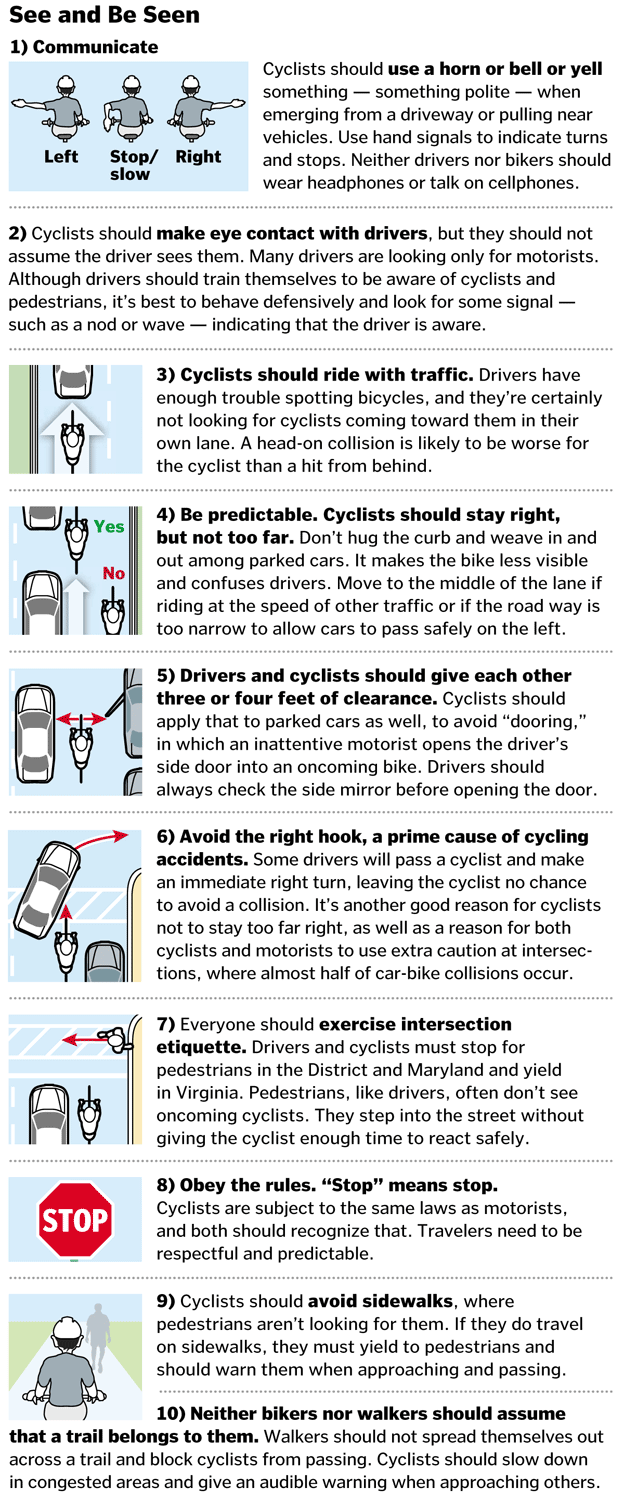
Sharing Street Space Safely
MWCOG: Priorities for a Growing Region
…
While traffic is a leading irritant, it is not where the public would place the most effort over the long-term.
In one of the study’s more challenging findings, residents do not place great emphasis on solving the region’s transportation problems. By a large margin, traffic and transportation are listed as the top “long-term issue or challenge facing the Washington region.” The concern is particularly acute in parts of Northern Virginia. But when asked how much of a priority they would place on transportation if they were making decisions for the region, citizens rank transportation ninth out of a list of sixteen broad items tested – in other words in the middle of the pack. With this finding, residents are not saying “do not solve it,” but they are identifying a number of other pressing priorities that need greater attention in their view.
…
The second leading priority for the long term is producing safe streets and neighborhoods. On safety as well as education there are strong differences in performance among jurisdictions, but near total consensus that public safety is a high priority.
…
One’s commuting choice heavily impacts this number. Compared to the 54% overall number, only 38% of people who typically commute to work or school by driving alone mention transportation as a top regional challenge. The number is 50% among people who commute by mass transit, carpooling, or another means like walking or biking. Among those who do not commute regularly, the number jumps to 71%. Despite daily frustrations, commuters who drive alone are the least concerned about the region’s transportation challenges. [So why does the region over stress accommodating the SOV (Single Occupancy Vehicle?)]
Continue reading “MWCOG: Priorities for a Growing Region”
It was the best of times, it was the worst of times.
Dateline Friday June 12th; Maryland Bicycle and Pedestrian Advisory Committee (MBPAC.)
Martin Harris MDOT’s Legislative Officer gave an excellent overview of "Maryland’s Legislative Process" and presented a very optimistic view of MDOT supporting bicycling and addressing advocates issues at least in terms of general principles but cautioned that in some details we may not see exactly eye to eye. But overall there has been tremendous improvement from MDOT at least in not opposing everything we but forth and we are improving our working relationship thanks to the efforts of One Less Car.
But we do have a major problem from the Chair of the Environmental Matters Motor Vehicles & Transportation Subcommittee (just to note I am filling in a blank here, this paragraph was not part of MH’s overview.) We have cyclists in his district working on this, whether there is hope he is his getting closer to our position or if he will continue his one man crusade against bicyclists is hard to say at this time. His district houses one of the few hardly any one bikes university campuses in the nation and a hot bed of bike/ped crashes (not at the campus obviously,) improving conditions for cycling is important issue for his constituents and all of Maryland. When we have word on which way the wind is blowing on this we will post in the Politics topic, in the mean time try to keep an open mind and if you approach him be positive.
Continue reading “It was the best of times, it was the worst of times.”
RAAM
Greetings
fellow cyclists! I just wanted to invite you all to share
with us the experience of Race Across America 2009.
I am the
Crew Chief for Alls Wheels 4 Fibromyalgia, a 4 person mixed team based out of
New Jersey, but with team members from Arizona to the UK and yours truly right
here in DC.
You can
check out our AW4F Web site, join our Facebook team, follow us on Twitter, or read
all about it on my blog. And you can come out to the dock in
Annapolis and welcome us home! Hope to see you
there.
We leave
Oceanside, California on June 20th and hope to reach Annapolis by
June 27th.
Thank you
for your support,
Yvette and
everyone from All Wheels 4 Fibromyalgia
Federal-Aid Highway Program Funding for Pedestrian and Bicycle Facilities and Programs
OK so how does Maryland compare in spending… are you sitting down. Over the last 10 years Maryland spent $48M compare that to Pennsylvania who spent $40M JUST LAST YEAR (10 year total $166M.) For the last three years D.C. has spent more then Maryland per year.
Continue reading “Federal-Aid Highway Program Funding for Pedestrian and Bicycle Facilities and Programs”
FREE Complete Streets webinar – from FHWA and CSS 6/11 at 2 pm
TOMORROW (Thurs.) (6/11) from 2:00 – 3:30 there will
be a FREE Complete Streets webinar hosted by FHWA and CSS https://www.contextsensitivesolutions.org/
|
Calendar Event Details: |
|
|
Title: |
CSS Webinar – Complete Streets and Context Sensitive |
|
Description: |
ContextSensitiveSolutions.org and the The Webinar will be presented by Gabe |
Continue reading “FREE Complete Streets webinar – from FHWA and CSS 6/11 at 2 pm”
It’s fun, practical and it does reduce VMT
Since I started doing most of my grocery-store and other short rides on my utility bike (mountain bike with a pair of wire baskets hanging off the rear rack), I’ve dropped my car mileage from 9000/year to less than 6000/year. Miles on my utility bike don’t account for the difference, but my change in attitude does. I just drive less.
-Jonathan Krall