
Safe Routes to School Network Organizer for 1000 Friends of Maryland

Location: Maryland
Salary: Contract, 20-hours/week, $20-$28/hr
Schedule: Closing Date: Wednesday, January 5, 2001, 5:00 p.m. EST

Description:

Background: Safe Routes to School (SRTS) is a federal program designed to make it safe, easy and convenient for children in grades K-8 to walk and bicycle to schools. The federal government passed SRTS legislation in 2005, making funding available for infrastructure improvements (sidewalk, bike lanes, pathways, street crossings, etc) and for educational programs throughout the state of Maryland.
This funding provides a critical opportunity to bring together organizations and leaders within Maryland to ensure the best use of the funds, and to initiate policy changes which improve opportunities for children to walk and bicycle to schools, increasing their levels of physical activity and safety. The Safe Routes to School National Partnership is hosted by the non-profit Bikes Belong Foundation, and is a network of more than 500 organizations. Its mission is to serve a diverse national community of organizations that advocates for and promotes the practice of safe bicycling and walking to and from schools throughout the United States.

Contract Description: Provide support and technical assistance to the Safe Routes to School Maryland Network for 2011. The Organizer will influence policies at the state-level to benefit walking and bicycling for children and families, especially lower-income communities most vulnerable to childhood obesity. The State Organizer will work 20 hours/week on statewide issues, following a Scope of Work and program direction by the SRTS National Partnership’s State Network Manager.

Continue reading “Safe Routes to School Network Organizer for 1000 Friends of Maryland”
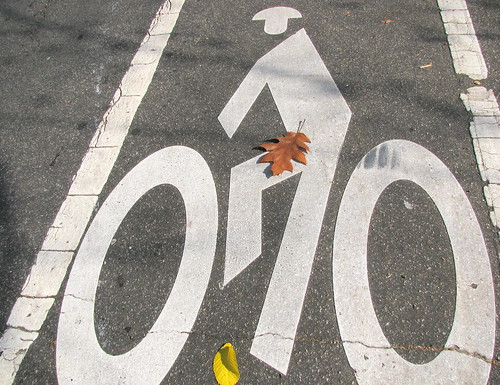
No funding for a Bike Friendly Fredrick

"[Frederick] Mayor Randy McClement (R) said the city is behind the committee’s efforts, and agreed with O’Connor that the potential obstacle to implementing the group’s ideas was cost."
"Paints and signs are cheap, but they cost money. We need to know what this is going to cost and how to go about getting it. … Your ideas are wonderful. We don’t want them to go away. Come up with the dollars."
Another case of too expensive but too cheep to get the States attention that there is a problem with how it administers Federal funding.
Yep, thanks to Maryland’s highest in the nation local match requirement of 50% that enables bike/ped money to go further (at least that’s what the State claims), another plan for accommodating bicyclists will not receive any funding. Of course that’s probably not the only reason, other made up rules by the State to "promote" bicycling such as: it’s for on-road bike accommodations, it’s not part of a trail, it’s not a stand alone project and it’s not a capital expenditure probably all have something to do with not getting funding as well.
In the meantime if anyone has any ideas on how to spend the $25 million of unspent/unobligated Transportation Enhancement money that Maryland has on bike/ped projects get them into the long rang plans.
You see the problem is not lack of funding but that of trying to shoehorn bike/ped improvements into a process that is designed solely new and very expensive transportation projects. In other words you really cannot go back and enhance existing roads for bike/peds with Enhancement funding per rules our State made up.
Continue reading “No funding for a Bike Friendly Fredrick”

Boohoo, it takes me a half hour to get to work

The results are in from the U.S. Census American Community Survey and Maryland with it’s second worst commute time of 31.1 minutes. Really? This is a problem?
Well you can probably look forward to that little factoid promoting faster and more car centric road designs rather then looking at the lack of transportation options (just to name one factor.)
From the Getting Back on Track: Aligning State Transportation Policy with Climate Change Goals report I covered earlier:
"Although the new highway [Maryland’s ICC] was intended to relieve congestion on local roads, it will actually create more traffic by triggering sizable changes in the local travel demand patterns."
Yep more roads are going to fix the problem, not.
Continue reading “Boohoo, it takes me a half hour to get to work”

MD Gets Transportation Policy for Positive Climate Change Goals but Not Non-Motorized Transportation :(

* State Support for Non-Motorized Transportation
Walking and bicycling are the only modes of transportation that produce zero greenhouse gas emissions, and there is tremendous potential to shift short car trips to these modes if the infrastructure is there to support them. Installing walking and bicycling facilities and building out these networks is relatively inexpensive compared to other surface transportation improvements. A little bit of funding goes a long way. Virtually all of the aid from the Federal Highway Administration can be used for non-motorized projects. Nationally, pedestrians and bicyclists make up 13 percent of all road fatalities, yet less than 1 percent of the federal safety funds are used to make these travel options more secure. This study examines what proportion of the FHA’s Surface Transportation Program (STP) funds states actually use for pedestrian and bicycling infrastructure.
A state can receive a maximum of 17 points for its financial support for non-motorized transportation through the flexible federal Surface Transportation Program (STP). A state receives 17 points for spending more than 2.5 percent of STP funds on non-motorized transportation. Point allocations decrease gradually to 0 for a state that spends less than 1 percent of STP funds on non-motorized transportation.
>>> MD >>> ZERO points!!!
************************************************
* Bicycle and Pedestrian Master Plans
Bicycle and pedestrian master plans indicate whether the state department of transportation is evaluating and planning for the needs of non-motorized users. Master plans are also important in prioritizing infrastructure investments and ensuring there are uninterrupted networks of walkable, bikable streets. While ad hoc improvements may be useful on a granular scale, walking and bicycling do not become real options for people unless there are reliable, safe, and completed networks in place.
*****************************************************************************************************************
[B’ Spokes: This is an interesting as we got the points for having this even though there is nothing about our Bicycle Master Plans that prioritizes infrastructure investments. If 20% of our State roads that are unbikeable, interrupt a bike route or are all in urban areas where there is a need for better bicycling conditions… well that’s is according to our bike master plan. 🙁 ]
Continue reading “MD Gets Transportation Policy for Positive Climate Change Goals but Not Non-Motorized Transportation :(“

Rockville – Trends in Crime and Public Safety in 2010


5) Pedestrian and bicycle safety.
"A big concern in the City of Rockville, and certainly in the whole area here is pedestrian safety and bicycle safety," Treschuk said. "We’ve had some tragedies in and outside the city of pedestrians being struck and fatalities."
City police have responded with "major internal programs" including information sharing about dangerous roads and intersections. The department has also shot public service announcements for Rockville 11 about how to safely cross streets, while the city has upgraded crosswalks and traffic lights and offered brochures at libraries, recreation centers and schools focusing on pedestrian safety.
A big concern for police is the morning rush, particularly between 7:10 a.m. and 8:45 a.m.
"We have people at bus stops all around the city going to high schools, middle schools and elementary schools," Treschuk said. "We have people walking to high schools, middle schools and elementary schools. This is the exact same time that you have the crunch of commuters."
As main roads such as Veirs Mill Road, Rockville Pike and Interstate 270 become clogged the tendency of motorists is to cut through residential neighborhoods.
"Well as you get into the communities, you come to intersections and there’s 15, 7, 20 kids at a corner waiting at a corner. And kids are kids. They’re pushing each other. They’re playing around. And if people don’t pay particular attention at the stop signs and everything we could have a real tragedy. So we try to monitor that on a daily basis."
Continue reading “Rockville – Trends in Crime and Public Safety in 2010”

Bicycles on St Mary’s Campus

UPDATE 5PM:  He sent out another email clarifying, he wants all bikes removed by winter break so that they can get rid of the broken/abandoned bikes.  Awesome!

Santiago just sent out an email regarding bicycles on Campus which I will repost below

I hope that this e-mail finds you well and winding down the semester. As you prepare for Finals, I want to make a quick announcement about bicycles. I am currently working on creating more bicycle storage (racks, etc.) on various places on campus and in an effort to do that I would like to make a request of you. If you have a bicycle on campus and it is secured to something other than a bike rack (i.e. a bench, a tree, a fence, a log, etc.), please remove it and either secure it to an outdoor bike rack or the bike rooms provided in your residence halls. Any bikes that are left elsewhere will be considered abandoned and removed from where they are. I thank you for your assistance and attention in this matter, and look forward to some bicycle safety programs during the Spring semester.

Fuck that.  There are no where near enough bicycle racks, they would need to triple the number of racks, and there aren’t enough areas to place them that are aesthetically pleasing.  Have you ever seen the campus center/library at night?  There are dozens of them everywhere!  The bike rooms in residence halls are always full of bikes that no one ever uses, and the racks outside are also generally full.

I feel like this is something that was initiated without any input from the campus community (and if there was then he failed to mention it).  Additionally, people can’t use the designated bike areas if there is not enough room, so I feel like they should implement these new bike storage areas first before making a request like this.

Lastly, I think a bigger issue is bikes that are left on campus and never use, or that are locked up and broken.
Continue reading “Bicycles on St Mary’s Campus”

Chestertown bicyclist killed on Route 213

CHESTERTOWN — A Chestertown man died Thursday after being struck by three cars on Augustine Herman Highway, according to police.
Maryland State Police said 49-year-old Randy Thomas Littleton was riding his bicycle along the highway near Round Top Road when he turned directly into the path of a 2010 Subaru Forester driven by 58-year-old Barbara Siaman Efland of Church Hill.
*****************************************************************************************************************************************
[B’ Spokes: This sounds highly suspicious to me. Route 213 is straight, flat and has nice wide shoulders and at the T intersection of Round Top Rd there is a left turn run around lane, not exactly the most bike friendly design there is. So is the cyclists being punished simply for the "need" for cars to go straight and fast? Maybe the motorists had a hard time understanding why a cyclist would leave this nice wide shoulder and have the audacity to make a left turn like a car and failed to exercise due care. Maybe the driver was distracted? These are all speculations but I thought our 3′ safe passing law was to help guard against the excuse "but the cyclist swerved" did the police fail to examine this point due to the poor summaries issued by the State? I have lots of questions about this tragedy and by the State Police past record, I am doubtful we will see justice here.]
Continue reading “Chestertown bicyclist killed on Route 213”

A cyclist dies, and a motorist drives on

This is a confession and, well, something else. Years ago I was driving my big old van through the streets of Pigtown on a terribly windy day. Trash was everywhere, including the streets. Tired of dodging all the trash bags, I drove over one. As I did, I had the unmistakable impression of having run over flesh. I can’t say how it felt different from a rear wheel running over anything else, but I know my gut reacted and a tremor passed through me. The next moments are hazy — pulling over, seeing the dog lying motionless but for short gasps, calling 911. People gathered, asking questions, and I answered without looking at their faces. A dog-owner myself, I knew the heartbreak of what I had done. Rather cowardly, I agreed with the animal control agent to put the dog down. No one could locate the owners. My apologies went to the dying dog and the people gathered round. I don’t think I’ve ever described this incident to anyone before. Now I can’t stop thinking about it.
This week the Yates family settled out of court with a truck driver who ran over Jack Yates and his bicycle last year, killing him ("Family of cyclist killed in crash settles with truck driver, employer," Dec. 1). The truck drove off after the accident and was later found by police. Several months ago, Natasha Pettigrew, the Green Party candidate for Maryland’s U.S. Senate seat was hit by an SUV while on her bicycle. The woman who hit her drove home, with the bicycle lodged under the car. In both cases, the authorities evidently felt that the drivers would not have known they ran over a human being, much less a human being and a large piece of metal. Neither person was charged with a hit-and-run or with failure to render aid.
Life today is not quite as simple as in the days when the parable of the Good Samaritan was first told. But today’s societal constructs do not require us to relinquish our capacity to care. Everyone can make a mistake — I am personally aware of that — nevertheless, we can still hold fast to our humanity amid the fears of legal proceedings and rising insurance rates and what-will-the-neighbors-think. And for the authorities? Shameful as it is that rendering aid must be legislated, it is made more so when authorities aren’t conscientious about holding people accountable to it. Drivers are getting more aggressive and impatient, and turning a blind eye to hit-and-runs cannot but embolden them.
This is a cautionary letter for all drivers and the authorities who guide them: We are entering a month of busy lives packed with work, shopping, parties and visits, all crammed in and tied together by the roadways. A cyclist recently told me she didn’t want to ride alone, not because she was afraid of being hit — she was afraid of being the victim of a hit-and-run, of being left to suffer alone on the roadside. And that shouldn’t happen to a dog.
Penny Troutner, Baltimore
The writer is the owner of Light Street Cycles.
Continue reading “A cyclist dies, and a motorist drives on”