
No More Senseless Bicycle Deaths!
Targeting: The Governor of MD, The MD State Senate, and The MD State House
Started by: Kenniss Henry
Update: 2/9/11: Kenniss Henry, mother of Natasha Pettigrew who was killed on her bicycle last Fall, has been working tirelessly to convince Maryland’s state legislature to enact stricter vehicular manslaughter laws. Now, Delegate Luiz Simmons has offered a new bill, HB 363, that would help achieve this goal. The petition letter has been updated to reflect this latest development by offering support for this bill. Kenniss Henry has also "adopted" the petition under her own name. Please continue to sign and share. Maryland’s House of Delegates will hold a committee hearing on the bill on Wednesday, February 23rd.
Continue reading “No More Senseless Bicycle Deaths!”
Mayor’s Bicycle Advisory Committee February 15th
from Bike Baltimore by Nate Evans
The Mayor’s Bicycle Advisory Committee meets Tuesday, February 15th at 6pm in the Planning Department’s Conference Room on the 8th Floor of 417 E. Fayette St. [bring I.D.]; The meeting is open to the public and all interested cyclists are encouraged to attend. Major Tony Brown from the Baltimore Police Department will join us to address concerns from area cyclists. Please bring your bike inside & up the elevator to the 8th floor. (More bikes have disappeared from these racks lately.)
[B’ Spokes: Note that I am still waiting for some acknowledgment from Baltimore Police that bicyclists are NOT operators of a motorcycle and cannot be charged with violating laws pertaining to the operation of motorcycles (which exist in part to make it illegal to drive a motorcycle like a bicycle.) And to have Baltimore Police attempt to correct the inflammatory remark “There is no “right to the road” as a cyclist.” Everyone has rights and obligations on the road. (More detail Yates – discussion of the “facts” and why the police got it wrong
Continue reading “Mayor’s Bicycle Advisory Committee February 15th”
Personal income stats: older cities in the East & Midwest are rebounding
from Switchboard, from NRDC › Kaid Benfield’s Blog by Kaid Benfield
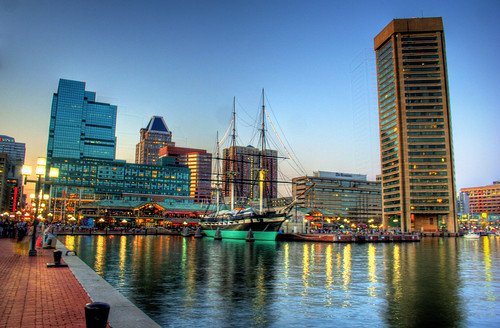
Throw out those old notions that the sprawling regions of the Sun Belt are where the economic action is, while traditional regions in the Northeast and West have had their day and will only lose traction from here on. The facts show that eastern and midwestern metro areas with older, more traditional central cities claimed the biggest gains in personal income in the last decade, while boom-and-bust newer areas showed more evidence of slide. Personal income per capita for various regions remains all over the place (as does the cost of living), but the years 2000-2009 were much kinder to some places than others in the changes they brought.
Your top ten metro areas with the biggest personal income gain per capita:
- Baltimore 9.7%
- Pittsburgh 8.2%
- Washington 5.0%
- Philadelphia 4.6%
- St. Louis 4.4%
- Milwaukee 4.2%
- Los Angeles 3.5%
- Houston 3.2%
- Cleveland 2.5%
- Chicago 2.3%
…
Continue reading “Personal income stats: older cities in the East & Midwest are rebounding”
Police need to be first to obey traffic laws
Michael Dresser makes some good points which I’ll highlight:
…
2. Perceptions that traffic enforcement is a low-prestige assignment that impedes career progress. Would it be presumptuous to suggest that all officer should pull at least an occasional traffic enforcement shift and that command of a traffic patrol would be one of the expected career steps for any officer who aspires to top command. For citizens, it is a priority right up there with violent crime. Most of us face a greater risk to life and health from bad driving than from handguns.
3. A reinforcement of the message that it is every officer’s job to be a model for other drivers both on-duty and off-duty. Officers should be proud of enforcing traffic laws well and should be professionally recognized for doing so.
4. A determined effort to overcome any "front-seat" bias under which officers see issues from the point of drivers at the expense of bicyclists and pedestrians.
…
Continue reading “Police need to be first to obey traffic laws”
Strongest Cities 2011
You probably don’t exercise much mental energy wondering just how much strength is bundled up in your city. That’s our job. Based on a wide range of criteria, we pitted the top 25 most populous U.S. cities against each other in an ultimate strength smackdown. Those with the most USA powerlifters, strongman competitors, personal trainers and fitness instructors got the highest points. Then we compared statewide physical activity and obesity rates. Extra points were awarded for the quality of the city itself based on the amount of park space, the number of bicycle commuters or the most baseball diamonds, basketball courts and other game spaces per capita. The results may surprise you.
1) Seattle
2) Boston
3) Denver
4) Baltimore
5) San Diego
6) New York
7) Philadelphia
8) Los Angeles
9) San Francisco
10) Chicago
11) Austin, Texas
WINNER: SEATTLE
If all of the powerlifters, personal trainers and aerobics instructors in Seattle got together and invaded the south, the obesity epidemic would be practically vanquished. Only Austin, Texas, and San Antonio can claim more USAPL members than Seattle. This wet northwest burg also hosts the most bicycle commuters (massive quads are the norm), has high overall physical-activity rates, and fewer smokers than Boston and Denver.
…
Continue reading “Strongest Cities 2011”
Driver gets 13 years in prison in fatal hit-and-run of Hopkins student, 20
By Tricia Bishop, The Baltimore Sun
Serial drunken driver Thomas Lee Meighan Jr. was sentenced Wednesday to 13 years in prison for the fatal hit-and-run in 2009 of a Johns Hopkins University student described in court by friends and family as a promising young scientist who might have changed the world.
Meighan, 40, was given an additional nine-year-suspended sentence in connection with a similar hit-and-run that occurred several months previously, in July 2009. Five people were injured in Northwest Baltimore after he drunkenly slammed into their compact car before fleeing on foot. If he violates probation after his release from prison, he could be forced to serve the suspended term.
The combined sentence, which came after a guilty plea, is the first significant amount of prison time Meighan has received despite nine prior drinking-and-driving convictions going back to 1994. But it, too, was a compromise.
…
Continue reading “Driver gets 13 years in prison in fatal hit-and-run of Hopkins student, 20”
Enforcement, not big fines, key to traffic safety
From Baltimore Sun
A study released Tuesday by the Insurance Institute for Highway Safety demonstrates that Baltimore and 13 other cities made a smart move. An estimated 159 lives were saved over a five-year period by the enhanced enforcement effort. Baltimore alone saw a 14 percent reduction in deaths attributed to red-light running; some cities saw reductions several times as great.
…
Nevertheless, not all traffic-related fines are so effective. Last week, Gov. Martin O’Malley submitted a budget proposal that included a new surcharge of $300 to $1,500 on traffic fines for more serious offenses, such as drunken driving and excessive speeding.
…
Continue reading “Enforcement, not big fines, key to traffic safety”
The Anti-Automobile Age – and what we can learn from it
From copenhagenize
I’ve continued reading the excellent Fighting Traffic – The Dawn of the Motor Age in the American City by Peter D. Norton. It’s a digestive book. I find myself reading a few pages at a time and then putting it down, finding it necessary to reflect.
Norton has divided it up into three parts and the first part deals with the way automobiles were regarded in the public eye between 1900 and up through the 1920’s. To put it mildly, automobile traffic was not popular.
Almost a century on it seems that certain myths persist. That apart from some growing pains at the beginning, cars were always just a given in cities. I’ve been quite amazed to learn how massive the resistance to them was. Norton writes about the ‘street’ and the perception of what the street was for.
The public at the time regarded the street much in the same way as people had since cities were first formed. It was a space for people. A place to walk, a place to play, a place to alight from a streetcar. Cars were regarded as violent intruders in this common space.
The challenge of Motordom, as it was called, was quite simple. It was a question of re-branding the street as a place for cars and the whole marketing angle was instrumental in achieving this goal. Amazingly, at the end of the day it was down to clever marketing and spin to change 7000-odd years of percieving the street as a place for people, not machines.
But first, the resistance. Norton highlights in the first part the massive public uprising against the automobile. The carnage caused by cars and trucks was enormous.
“In the first four years after Armistice Day more Americans were killed in automobile accidents than had died in battle in France. This fact was widely publicized and the news was greeted with shock.”
It says a lot about the victory of Motordom in changing the mindset that the current annual toll of 40,000 deaths in the US – not to mention the injured – doesn’t even register in the public consciousness.
“… before the mid 1920’s, cities were not at fault for failing to provide safe accommodation for motorists. To frightened parents and pedestrians the problem was far simpler: they blamed automobiles and their drivers, regardless of the circumstances. City people were angry. Their anger is shown in mob attacks on reckless motorists, and in newspapers that played up automobile accident stories when the victim was easy to represent as innocent (a child, a young woman, an old person), the victim of an unambiguous ‘villain’ (the motorist (…) the ‘speed maniac’, the fleeing criminal, the drunk).”
Here are some examples that Norton presents showing the public reaction.
“In 1920 the Philadelphia Public Ledger found that ‘any time an automobile collides with a post, a pedestrian, or other obstacle the crowd that gathers always displays prejudice against the driver…’ The newspaper advised readers who wished to be ‘in the height of fashion’ that if a pedestrian is ‘hurt or annoyed’ in an encounter with a car, ‘don’t ask whether the victim was wholly or in part to blame. Suggest that the driver of the motor-car be lynched’.”
“One pedestrian, nearly struck down at a streetcar stop, published a threat: ‘I am now ready for this brute, and if he ever makes a similar move where I am concerned it will be his last one, and there will be no court costs either’.” St. Louis Post-Dispatch, 1923.
Letters to the editor often featured the rage of city dwellers.
“‘After reading advice in the newspaper to look both ways when crossing streets, the writer sent a letter signed Sic Semper Tyrannis: ‘When you get to the crossing, look to your left, pull out your automatic from the holster, step into the street and level the gun at the chauffeur coming. When in the middle of the street level it at the nearest chauffeur coming the other way’.” St. Louis Star, 1923.
“The more intelletual critics often called the automobile a pagan idol demanding sacrifice. The car was, for example, a juggernaut: a wheeled object of idolatry which crushed lives out under its wheels. (…) In 1916 an authority on the automobile industry wrote: ‘In the view of the press, the automobile is to-day a juggernaut, a motoring speed-monster, intent on killing and maiming all who stand in its way’.”
“In 1923 the St. Louis Post-Dispatch editorialized that, even in the case of a ‘child darting into the street’ in ‘the excitement of play,’ the ‘plea of unavoidable accident in such cases is the perjury of a murderer’ and the St. Louis Star called motorists involved in pedestrian fatalities ‘killers’. The City Club of New York published and distributed large ‘municipal murder maps’ showing where children had been killed in traffic accidents’.”
The concept of Strict Liability was in place, it seems, in America at this time. The general opinion in the early 1920’s was that the responsibility lay entirely with the motorist. Much of the campaigning and focus was on children who were killed in traffic.
“Especially in the 1920s (…) Like fallen soldiers, children were publicly memorialized; their mothers, like mothers of the war dead, were honoured as ‘white star mothers’ or ‘gold star mothers'”
Letters to the St. Louis Star in 1923:
“Most accidents are due to fast, careless driving.”
“If accidents are to be reduced, speed must be reduced also; this is, unless speed is more essential than human life.”
“The only way to prevent so many accidents is to force motorists by severe punishment to drive slow.”
“The Balitmore Sun explained that ‘motor-car psychology’ turned even normally prudent prople into deadly menaces; other diagnosed ‘gasoline madness’ or ‘gasoline rabies’.”
Norton tells the tale of one Charles Price, an Iowa shoe salesman who went on to become a leading safety campaigner.
“Price appealed to angry pedestrians. ‘Each year’, he explained, ‘it becomes more and more dangerous for a person to walk the streets.’ Like most of his contemporaries Price put the responsibility on the automobile and its driver. (…) Price urged cities to ‘make their traffic regulations more and more rigid till they can point to low death rates from automobile accidents. Price recommended more pedestrian crossings (not just at corners by also ‘in the middle of blocks’). He attacked ‘the tendency of some writers to exonerate automobile drivers and to place the blame of accidents upon pedestrians,’ which to Price revealed ‘lack of full comprehension of the problems involved.'”
During city-wide Safety Weeks, there were all manner of protests aimed at automobile traffic.
“… in a parade for Milwaukee’s safety week in the fall of 1920, a streetcar pulled a flatbed trailer through the city. The trailer displayed a wrecked automobile driven by the likeness of Satan.”
“In 1922 the Safety Commission of Oak Park, Illinois, posted fifty large signs throughout the city warning motorists “DON’T KILL A CHILD.”
Hmm, that sounds familiar if you’ve been reading Copenhagenize…
“The Detroit Safety Council’s Safety First campaign of 1919 drew special attention to street fatalities with the tolling of bells. At City Hall, at a church, at a fire station, and at every school in the city, twice a day bells slowly tolled eight times on any day in which a life was lost to a traffic accident. Teachers or police officers announced the names of the dea and the manner of their deaths to the school children.”
In 1922 Baltimore erected a temporary monument to memorialize the 130 children killed in traffic accidents.
“In New York’s safety week in 1922 a procession of 10,000 children was ‘the most spectacular feature of the week’. Among the marchers was ‘Memorial Division’ of 1054 children, each representing one of the 105 children killed in accidents in the city in 1921. (…) Three days later, in the safety week’s main event, a procession of open cars carried children maimed and disabled in accidents.”
“In the autumn of 1923, (…) the St. Louis Safety Council unveiled an impressive monument inscribed “In Memory of Child Life Sacrificed on the Altar of Haste and Recklessness.”
“In 1925 the Memphis Safety Council began displaying a black flag of mourning at sites in the city where children had been killed.”
All quite amazing. More than two decades of human resistance to the automobile in cities. Hard resistance. By around 1930, things started change. Motordom started applying unique spin techniques to adjust behaviour and public perception of ‘the street’.
Norton describes a popular character of the age that featured on many industrial safety posters in factories, named Otto Nobetter. He ‘stumbled over tools, smoked near explosives, and generally flaunted his ignorance of elementary safety precautions. He invariably paid dearly for his mistakes.’
This approach seems sensible, perhaps, but as Norton points out, ‘Compensation laws gave industry responsibility for workplace accidents, but Otto Nobletter gave it back to the workers.’
This is a key development. It would be later used by Motordom in their counterattack to claim the streets as their own. Caricatures of bumbling pedestrians who didn’t look before crossing the street. The whole invented concept of jaywalking. Placing the responsibility on the individual pedestrian or cyclist and exonerating the automobile driver. Sound familiar and frightfully modern?
The transformation from the anti-automobile mood of the early 1900’s to the perception of streets as space for motorized traffic was quick and efficient, once Motordom figured out how to crack the code. They started portraying the resistance as ‘anti-progress’ and ‘old-fashioned’. Thanks to this spin, the scales tipped around 1930.
The recent anti-pedestrian initiatives like proposing fines for pedestrians wearing headphones at crosswalks and whatnot are merely the result of cleverly-designed marketing that persists from its launch in the late-1920’s. Pedestrian and cyclists are still at the mercy of old-school car-friendly cultural spin.
At least knowing the origins will help us re-transform our cities into places for pedestrians and cyclists and speed the implementation of traffic-calming initatives so badly needed, all while using the same techniques to reversing the perception of the automobile in our cities. Turning motorists into Otto Nobetters.
Fighting Traffic – The Dawn of the Automobile in the American City, by Peter D. Norton is published by MIT Press.
Continue reading “The Anti-Automobile Age – and what we can learn from it”
New bike shop coming to South Baltimore
by Anica Butler
A friend recently tipped me off to a new bike shop opening in South Baltimore.
According to its website, Race Pace Bicycles, which already has five locations in the area (though none in the city) will be opening a location on Key Highway in March.
The shop will be across the street from Little Havana and the BMI.
I’m an occasional recreational cyclist at best, and I have to admit, I am almost always intimidated when I go into a bike store, but it’s still great to hear of a new shop in the hood. I’ve still not been to Hampden’s new-ish bike shop, Twenty20 Cycling. But if one more opens in the city, we can call it a trend!
Seriously though, as our triathlon training gets going, I’m sure I’ll be grateful for all our options.
Continue reading “New bike shop coming to South Baltimore”