A Baltimore bicyclist’s manifesto

By Julie Gabrielli 
For The Baltimore Sun
March 22, 2011

Dear fellow Baltimore driver:

Now that spring is in the air, I’ve begun riding my bike a couple of times a week. Nothing too ambitious. It’s great for short trips — the gym is 3.7 miles from home and Saturday yoga class is 1.6. I’ll be getting sweaty anyway, so why not?

I also drive in my car, plenty, and I’ve noticed something. When we are driving, we tend only to pay attention to other cars. When we do see a bike, we can be surprised or even resentful. Why is that recreation-seeker getting in my way? Don’t they know how dangerous it is to ride a bike in the street?

This morning on my ride, I decided to let you in on some of the reasons why I choose to ride my bike and my promise to those who share the road with me.

Reasons why I ride:

  • I’m a multi-tasker. I like being able to get somewhere while at the same time burning off some of that winter-stored fat.
  • It’s fun — really.
  • I can hear the birds singing while I ride and say hello to people who are out.
  • It saves me money – have you seen the price of gas lately?
  • My car is overdue for its 105,000-mile checkup, so I’m trying to drive it as little as possible.

Not reasons why I ride:

  • I like climbing hills on Greenspring Ave.
  • I’m addicted to the adrenaline rush of a very loud car horn, as it sweeps past me with inches to spare.
  • I want a new bike, but I have to get rid of this one first.
  • I want to test how low my co-pay will be for an extended hospital stay.

What I will not do while riding my bike near you:

  • Listen to my iPod
  • Talk or text on my cellphone
  • Change lanes right in front of you
  • Run red lights
  • Ride on the sidewalk (this is actually illegal)

What I will do:

  • Watch traffic in my rear-view mirror (yes, I do have one, and yes, I can also hear you coming, so you really do not have to honk)
  • Go around parked cars (so if you see me in the parking lane and you happen to notice a parked car up ahead, you can safely assume I’ll be in your lane in short order)
  • Ride as far to the right as possible and/or in the paint-marked bike lane.
  • Go around road hazards (OK — it’s Baltimore and we just finished winter. You know and I know the roads are in sorry shape, so, yes, I will go around potholes, gravel patches, big cracks and those deadly storm grates with the bars going parallel to my tires. Rest assured that I’m not pulling into your lane just to tick you off, hear your car horn up close, or draw you into some sort of altercation).
  • Stay upright and moving (this is why I will go around road hazards, the alternative being my becoming suddenly horizontal in the road right in front of your tires).
  • Signal lane changes and turns.
  • Continue to pay my taxes, which gives me every right to be on the roads, whether in my car or on my bike.
  • Expect you to honor the three-foot rule. When you see me, give me a berth of three feet, and I promise to make it as easy as possible for you (I won’t push you into oncoming traffic; don’t worry).
  • Invite you to join me at any time, so you can experience the joys and benefits of self-propelled movement on two wheels.

Continue reading “A Baltimore bicyclist’s manifesto”

Bike Dictionary – The Social Sharrow

[B’ Spokes: I find it incredible that so much of our built environment forces anti-social behavior on us. Lovers walking hand-in-hand, not on these sidewalks. Even our trails are built to only handle one cyclist per direction. And when 10 cyclists get together to have a social ride on a 4 lane road (two lanes in the same direction) on a Sunday morning with little traffic, drivers get really indignant about having to change lanes to get around. If you look at the historical films of early city life they are full of clumps of people. We are not ants that like to travel single file, we are social and it’s just a shame that this isolationism is forced on us from so many directions. So when I see something like what’s below, it’s not only cool but has the possibility to reunite humanity with itself.]


from Bike Baltimore by Nate Evans

A ‘social sharrow’ not on Fait & Montford St in southeast Baltimore

Social Sharrow – (so-shul shair-0), n. – a unique bicycle facility installation that allows cyclists to ride side by side and converse while pedalling city streets.  Sure to upset motorists, this facility definitely increases bikesposure.

Continue reading “Bike Dictionary – The Social Sharrow”

Violence highlights lax traffic law sentencing — was gun sentencing

I am going to take Justin Fenton article from The Baltimore Sun and rewrite it so it is talking about traffic "accident" crime and put the gun related number in brackets.

***

After a weekend in which 43 [18] people in the city were run over or ran into and all sent to the hospital, including a police detective who was injured and a 8-year-old boy who died, Baltimore Police Commissioner Frederick H. Beal III used the normal occurrence of traffic carnage to argue Monday for even less traffic enforcement in the city.

Beal, who has accompanied Mayor Stephanie Rawlings-Blake to Annapolis to push for tougher penalties for gun offenders but traffic law offenders are still not a big problem in the city. The recent cycling accident where a young man still lies in a coma and the police have said no charges against the driver will be likely underscores the point, traffic accidents and enforcement are not that big of concern for the police department.

"After drivers crash one car, they get another car again. To say it minimally, it’s [exasperating] that more people don’t understand the enormous ramifications of these guys running around the city with these 150 horsepower machines with little thought of others or the law," Beal said at a Monday morning news conference. "The … people living in this city expect that when people do bad things, they’re going to be held accountable unless of course they do bad things with an automobile, that is after all understandable."

Continue reading “Violence highlights lax traffic law sentencing — was gun sentencing”

Say hello to your new bicycle themed restaurant

From The City That Breads

Well that settles it, Bill’s Lighthouse Inn had its transfer of license approved the other day and new owner Marla Streb (the Strebinator, as I call her) will be occupying the space for South Baltimore’s second attempt at a Bicycle themed restaurant – hehehehe get it?

At any rate, seems like the establishment will now be named Cafe Velocity and will feature some sort of cycling theme, as the owner is a professional mountain biker and probably a triathlete and/or Parkour expert or something. Whether or not the joint will be bicycle themed “in name only” much like The Bicycle, the failed defunct wine bar / restaurant where Centro Tapas now resides, remains to be seen. Beyond that, the neighborhood where Bill’s sits is a bit rough around the edges, to the point where prior ownership often times had to bolt the doors shut to keep drunkards out. Yeesh. Beer Baron Steve Fogleman noted “She’s a tough woman. I mean really tough,” so it’ll be interesting to see how this whole thing flies – er, pedals.

And being that I am personally an expert on all things restaurant, here are my suggestions for the upcoming Cafe Velocity that will enhance the experience, the cycling ambiance, the essence of biking:

  • When customers enter the restaurant, rather than having some sort of little bell or beeper to alert the staff there are customers, the door should set off a bike ringer, alternatively the full length version of Queen’s “Bicycle Race.”
  • Everything on the menu must absolutely somehow work bicycles into the title. Perhaps a fried onion strips app called “Onion Spokes?” Or a burger called “the Lance Armstrong,” made with beef from a cow that survived cancer and later dumped its wife for a pop star?
  • Replace all of the barstools with bike seats, really thin bike seats.
  • Actually, replace all chairs and stools in the establishment with really thin bike seats.
  • NEVER, EVER refer to Cafe Velocity as a “biker restaurant” or you may get some undesirable clientele.
  • Servers should, on occasion, deliver plates of food to tables on unicycles. Or maybe tiny trick bikes.
  • Absolutely, positively jury rig one or two bike helmets to function as Foam Domes for happy hour. You’ll thank me later!

Am I missing anything? Who’s got some other suggestions?

Continue reading “Say hello to your new bicycle themed restaurant”

The Talk: A Baltimore bicyclist’s manifesto

From the Baltimore Sun – Second Opinion

The story of Nathan Krasnopoler, a Johns Hopkins student who has been in a coma since being struck by a motorist while riding his bicycle in a designated bike lane, has sparked a significant reaction from other Baltimore bicyclists who are upset that the driver was not charged or fed up in general with rude and dangerous behavior by motorists. (The latest is that his parents are suing the driver, Jeanette Marie Walke, alleging that she violated multiple traffic laws.)

Del. Jon Cardin wrote in last week to protest the lack of charges against the driver, saying it goes against the intent of the General Assembly.

Katharine W. Rylaarsdam disagreed, saying the accident was a mistake but not a crime.

Jeffrey H. Marks says the problem is a failure of city officials to educate cyclists and drivers alike about how to make safe right turns.

And yesterday, Julie Gabrielli wrote an open letter to Baltimore drivers, setting out the code of conduct she will adhere to on her bike — and what she expects of motorists in return. (Hint: It doesn’t involve honking your horn.)


Continue reading “The Talk: A Baltimore bicyclist’s manifesto”

Guest Post: Penny Troutner on Cycling Advocacy in Baltimore

From Baltimore Velo

Light Street Cycles in Baltimore, MD

In light of the recent Krasnopoler tragedy and the frustrating situation over at Loch Raven, it has become obvious that despite the strides we’ve made as a cycling community in Baltimore, we still have a long way to go.  So where do we go from here?

Penny Troutner, owner of Light Street Cycles, has an idea of where we can start.  Penny has put together her thoughts about cycling advocacy in Baltimore in a guest post for Baltimore Velo.  It’s definitely worth the read,….


I used to do some lobbying
for a health care non-profit, trying to expand heath care coverage in Maryland.  The message, that increasing affordable health care is a moral and economic imperative, is a tough sell, you know.  Someone with a corporate or government job may have no idea what it is like to go without health care.  And getting the message through is quite a challenge – the political world is full of advocates, and it’s difficult to get a coherent idea through all the noise.  There was no room for apologies regarding the problems of Medicare fraud, or disputes about whether we’re going in the exact right direction, or complaints that our own personal health care issue wasn’t being addressed.   The message had to be organized, focused, positive, and relentless.

Bicycle advocacy is a tough sell also.  Most government administrators don’t know what it is like to use a bicycle for commuting, rigorous exercise, competition, socializing, exploration, or escape (from life’s frustrations – not the other kind, …although, there’s that).

Anyway, just when it seemed as though Baltimore City was poised to make real progress in our direction, we have been dealt blow after blow of disappointments.  A very obvious and tragic case of a car not yielding the right of way to a bicyclist in a bike lane is still not resolved by the police.  Loch Raven Reservoir, long loved, long ridden, and consistently maintained by mountain bikers is being yanked away – every proposal and partnership offer from the mountain bike community being immediately dismissed.  A resolution by the Baltimore City Council for Complete Streets design is rejected by the City Administration.   Pretty lousy, right?  So, we could whine about it… or we could do something.

Let’s say we should do something – it has to be the right thing. The bicycle advocacy movement needs operate in the same manner as any good lobbying effort. The group needs to be organized, focused, positive, and relentless to break through the noise and earn respect outside it’s domain.

It’s not there yet.  There are significant hiccups.  Here are some of our common, negative actions:

  • When experienced cyclists critique the value of bike lanes, progress for the inexperienced cyclist crumbles and takes a back seat to internal bickering.  Those already enamored of our sport need to advocate for conditions that encourage more people to take up our sport and increase our numbers.
  • When cyclists rise up on one issue, their own, and ignore the plight of other cyclists, the potential strength of the message dissolves, and we devolve into just a few small inconsequential and unconnected groups, easily dismissible.  There is strength in numbers and we are stronger as a whole.
  • Finally, when cyclists criticize other cyclists or apologize for cyclists’ behaviors, or bring negative cycling behavior to the attention of the officials we lobby, it’s as disruptive as nails on a chalkboard.  When  advocating for an underrepresented group, the officials already hold all the cards – there’s no sense handing them a whole new deck.  Casting cyclists in a bad light reinforces the very opinion we are trying to reverse – that we are a problem.  There is no reason to demonize your own,  others are doing that very nicely already. Stand up for your own and deflect criticism from officials.  That is the job of the advocate.  It is about the whole – it is not about you.

So how do we know what to say?  Face time with someone who has many pressing issues to deal with is precious.   When speaking to government officials or the press, are we making the best use of the time?

  • Are we staying on point and pounding in the group message?
  • Using a few key phrases that frame the argument?
  • Giving the official some positive action he/she can take to alleviate a bad situation and feel productive?
  • Making it clear to whomever is your audience: our issue is their issue, our gain will be their gain?
  • Conveying the plight of those we are representing?  The official has no interest in developing empathy for this group of people; however, if that empathy develops over time, then we have a convert – the best of all possible triumphs.  Councilwoman Mary Pat Clarke is a prime example.

Those in charge must direct the group to be exactly this –  organized, focused, positive, and relentless.  As they lead, the rest of us need to offer our support and participation.  However, any of the previously mentioned negative actions will demonstrate a lack of solidarity, innate organizational weakness, and a lack of resolve on the part of the advocates.  If I were on the other side and witnessed such actions, I would not take us seriously, either.  So, let’s start our journey with an important thought for all of us:

Primum Non Nocere – Do No Harm.


Continue reading “Guest Post: Penny Troutner on Cycling Advocacy in Baltimore”

$10 million suit says driver pulled a U-turn before colliding with bicyclist

from Baltimore Brew by Fern Shen

The lawyer for the family of a comatose Johns Hopkins University student, critically injured while riding his bicycle last month in north Baltimore, said the family’s $10 million lawsuit against the driver whose car struck him is meant to send a strong message to motorists.

“I don’t think she’ll be (criminally) charged and I’m not sure she should be,” said Andrew G. Slutkin, the lawyer who filed the suit Monday against Jeanette Marie Walke in Baltimore City Circuit Court.

“I don’t think she intentionally did this, I think she made a mistake,” Slutkin said, referring to the 83-year-old Walke, whose car allegedly struck 20-year-old Nathan Krasnopoler on Feb. 26.

But Slutkin argued that judgments like the one Krasnopoler’s family is seeking against Walke are the only way to make Baltimore-area roads safer and prevent similar tragedies.

“The moral of the story is, we need to better educate motorists about the law and about co-existing on the roads with motorcyclists and pedestrians and bicyclists and everyone else,” he said, in a telephone interview. The suit alleges that Walke violated multiple traffic laws in the late Saturday morning collision.

Messages left for Walke today were not returned.

No charges have been filed against Walke. Police have not completed their investigation into the crash, according to Shonte Drake, deputy communications director for the Baltimore City State’s Attorney, who said that media reports that police met to discuss the case today with prosecutors are “a misquote.”

Baltimore city police have backed away from earlier statements that the driver would not be charged and that the cyclist was at fault.

Until other accounts surface, though, the six-page complaint offers the most detailed scenario yet of what may have happened in the crash that has roiled the cycling community and set off a passionate — sometimes ugly – debate among motorists and cyclists about whose behavior most needs to be curbed.

A University Parkway U-turn?

According to the Krasnopoler family’s complaint, Nathan was riding his bike northbound on University that day and Walke was driving southbound on University when she “made a U-turn, and drove past Nathan as both Nathan and Defendant were now traveling northbound on University Parkway approaching 39th St.”

Walke turned right into the driveway of her apartment building, the Broadview, and cut off Krasnopoler’s right of way, the suit alleges. The suit also claims that Walke “failed to properly signal” before making the turn into the Broadview driveway.

The suit says Krasnopoler was unable to stop his bike and was thrown over Walke’s vehicle, which then ran over him, pinning him on his back underneath. Krasnpoler was severely burned because the driver left the car running when it was on top of him, the suit alleges.

His other injuries include eye damage, facial fractures, broken ribs and collarbone, two collapsed lungs and traumatic brain injury, the suits says. The Johns Hopkins engineering student has remained in a coma since the crash.

In the phone interview, Slutkin reiterated the suit’s claim that Walke broke several laws, including failure to yield the right of way in a bike lane.

“I mean, how much clearer could it be when there is a bike lane and there’s a law that just went into effect three months earlier that protects them?” Slutkin said.

(He may be referring to a new law that requires motorists to yield the right of way to cyclists when they are in a designated bike lane or to the so-called “three-foot law,” which says motorists overtaking bicycles “must pass safely at a distance of not less than 3 feet.”)

Slutkin’s firm, Silverman, Thompson, Slutkin & White, also handled the case of the family of another cyclist, John R. “Jack” Yates, who was killed by a truck turning right off Guilford Avenue in 2009. “It echoes this case,” Slutkin said.

The defendants (Potts & Callahan Inc. and the driver of the truck) settled the Yates family’s civil lawsuit for an undisclosed sum. In the Yates case, police also made statements early on that the driver was not at fault. “We found video and other evidence to prove that was not the case,” Slutkin said.

He said the firm has spoken with about a dozen people, “some were at the scene, some were there shortly thearefter,” and “people tell us (Krasnopoler) wasn’t flying, he wasn’t doing anything unusual, he was in the bike lane going maybe 15 miles an hour. She had passed him right before and must have forgotten about it. She turned, cutting him off and causing him to go flying over the car.”

Slutkin said even though he knows some cyclists are reckless, most are not and that he finds some peoples’ hostility toward cyclists “especially in the Sun comments section . . . really annoying.”

“There are a lot of people with this terrible animosity toward cyclists,” Slutkin said. “And the police have their bias against cyclists too.”
Continue reading “$10 million suit says driver pulled a U-turn before colliding with bicyclist”

Bicylists can be road ragers too, it seems

Michael Dresser posted an “interesting” complaint letter from a motorist against a cyclist and Michael’s comments were very balanced in response to that letter (his article follows.) I think bicyclists in the Baltimore Metro Area should be appreciative of Michael’s understanding of these issues and being able to address these issues in a more mainstream fashion. Michael calls on both motorists and bicyclists for more civility and does a good job of giving the motorist a new framework on how to rethink the issue but fails in my opinion to give cyclists a new framework. So here is my attempt:

The root of the problem: I am right and you are wrong

This goes for both bicyclists and motorists, let me begin with a true story: In a parking lot there were two motorists one pulling out and one pulling into parking spaces. Both proceeded till blocked by the other persons actions, they honked, they cursed and then finally got out of their cars to discuss the issue “rationally.” One insisted that the person pulling into a parking space has to yield to the one pulling out. The other person insisted that you can’t backup till the area is free of cars so the person pulling in has the right-of-way. And there they sat for 15 minutes with neither one budging and insisting that they are right and the other one is wrong.

This can be easily fixed be replacing “I am right and you are wrong” with LOOK FOR OPPORTUNITIES TO DO A RANDOM ACT OF KINDNESS. And this goes both for motorists as well as bicyclists.

The two levels of “I am right and you are wrong”

It is important to note that there are two levels to this kind of thinking. The most problematic is where the person’s who THINKS they are right reacts to the other persons actions in a negative way, honking or a one finger salute are common reactions and both are wrong. And there is more aggressive behavior of cars swerving across the cyclists path “to teach them a lesson” and such as the cyclist In Michael’s post. But there is a subtle lower level that is equally hazardous for bicyclists.

To explain; picture a j-walker standing on the center line and how much care, courtesy, passing space you give them when driving by in your car. Now picture a person lawfully crossing in a crosswalk and.how much care, courtesy, passing space you give them when driving by in your car. If you are like most people you will give more care to the lawful crossing pedestrian then to the unlawful one. And generally no one finds fault in this kind of behavior UNLESS there is a mismatch of “rules” like in my first story.

This mismatch of “rules” is a very real problem bicyclist face as they are given less courtesy by motorists if the motorist “thinks” the cyclist is in the wrong. If we were to poll people in Maryland we would find that people think bicyclists must: ride on the sidewalk, ride against traffic, ride with traffic, ride in the middle of the traffic lane or ride to the far right of the roadway as possible.

I imagine right now people are going “I know which one is right.” Stop it! No seriously, stop it. Look for opportunities to be kind and considerate, even to crazy bicyclists or motorists. If you want bicycle advocates to wag their finger at this cyclist we need everyone to focus on their safe and lawful behavior on the roadway and not other people’s, enforcement is the job of the police and you can get into a lot of trouble if you try to enforce the laws on your own.

There is little doubt that cyclists feel frustrated and possibly a bit helpless in the onslaught of everyone trying to force what they “think” is right on them and it’s all different. My typical response to an aggressive motorist is “If you think I am doing something wrong call the police. If you try to enforce the law on your own, I call the police and you can go to jail.”

No arguing what is or is not the accepted rule just a plain statement that you can put another person’s life in danger when you act out with your car and there can be serious consequences. This is step one to help a bicyclist feel less helpless and approach conflicts more constructively then a one figure salute. Step two, is the bicycling advocates are working with the State and Baltimore City to improve education and enforcement on ALL sides.

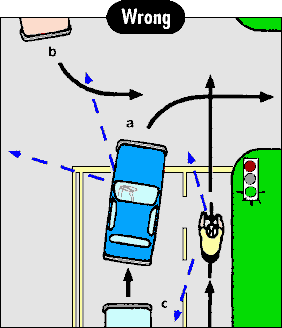
The lack of education and the right turn problem at intersections

image
Most cyclists know this is a dangerous position to be in, after all who wants to be in a crash like Nathan Krasnopoler? But how do we deal with this problem? Where is the guidance for bicyclists besides just riding far right? So most bicyclists just try to get out of that uncomfortable situation as fast as possible… by running the light. While that is not a good resolution of the problem it is compounded by unlawfully and impatient drivers who refuse to wait behind the bicyclist before making their right turn. Where is the motorists guidance not to do this? No one is fully innocent with this problem.

When the rules are not clear for all road users and how they are supposed to interact, chaos results.

Bicyclists please see: Must read for bike safety
Motorists please see: Turning across bike lane graphics and Bicycle Safety: It’s a Two-Way Street

And please everyone, lets look for opportunities to do a random act of kindness. Being on the road has enough junk for everyone to deal with but if we all did something nice for someone else, who knows we could make being in traffic a pleasant thing. – B’ Spokes
Continue reading “Bicylists can be road ragers too, it seems”