
[B’ Spokes: It would be interesting if our new bike/ped master plan (due 2014) included items like this:]
*********************************************************************
By Bridget Doyle, Chicago Tribune reporter
…
The hundreds of recommendations include better-marked crosswalks, the establishment of pedestrian islands in the middle of multilane streets, better signals and beacons, and pedestrian countdown timers at crossings. Other long-term improvements discussed in the plan include staggered midblock bump-outs on residential streets to slow traffic.
Continental-style crosswalks were among the first changes, CDOT Commissioner Gabe Klein said, largely because the department began to weave in the new pedestrian plan in time for already-scheduled construction projects.
The crosswalks have big rungs across the walkway for higher visibility and are made of a reflective material, Klein said. More than 100 such crosswalks were installed in 2012, Klein said.
Pavement markings — on crosswalks and stop lines for vehicles — are faded across Chicago, and Klein said millions would be spent this year repainting such markings so they are visible to drivers, pedestrians and bicyclists.
"Our goal is to bake these new standards into everything that’s being done in public right of way," he said.
The plan also establishes what the agency’s announced "Zero in Ten" goal: reducing pedestrian fatalities in Chicago to zero in the next 10 years.<br>
…
Continue reading “Chicago unveils 1st pedestrian safety plan”
Simple understanding

A pong traffic light in Germany [video]
One of my complaints about accommodating pedestrians is the technology is so 1950s and fails to meet modern User Interface Design standards, well that is starting to change… in Germany at least.
Legally Speaking – with Bob Mionske: You gotta fight for your right to slooooow down
An interesting summary of a cyclist getting a traffic ticket for “impeding traffic” in Trotwood, Ohio. Who originally lost in court but won on appeal.
https://www.bicyclelaw.com/articles/a.cfm/legally-speaking-you-gotta-fight-for-your-right-to-sloooow-down
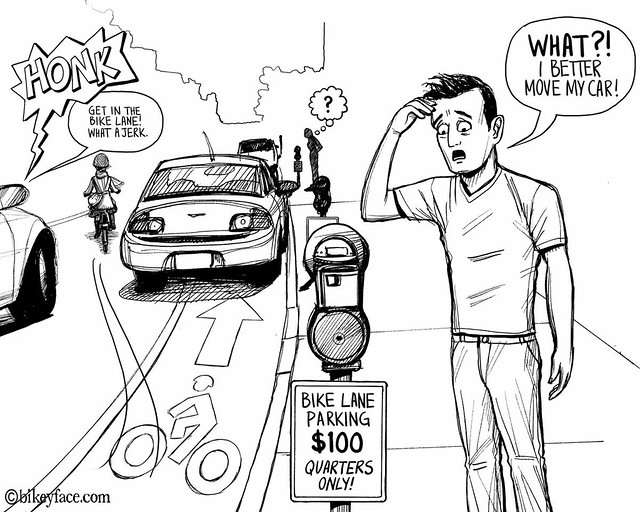
How to stop parking in the bike lane, a sign – Bikeyface
The more they burn, the better they learn – CDC

California Bike Lanes May Be Exempted From Environmental Review
B’ Spokes: This is cool because of those who support it.
***************************************************************
Surprisingly, a major supporter for the bill is none other than the Automobile Club of Southern California who are quoted in the Aug. 15 legislative analysis: "The encouragement of greater bicycling as a viable mode of transportation through the provision of these facilities should provide a net environmental benefit."
Also quoted is the California Chamber of Commerce, an organization known for its ability to "kill" legislation. "Additional bikeways will promote tourism and benefit the residents of the area where the project will take place", they write.
https://www.planetizen.com/node/58346
Top 10 Transportation Projects in Country Compete for National Awards
Washington, D.C. – Across the nation, state transportation departments are completing projects that make us safer, our drives shorter and less stressful, and our communities better and stronger. Now, the top transportation projects across the U.S. are going head to head in a competition that will determine which of those projects earns the title of best in the nation.
…
“This year’s projects are marked by innovation and discipline,” said John Horsley, AASHTO executive director. “Whether it was deploying new technology or trying unique contracting methods – these projects show how states can deliver projects that make sense ahead of schedule and under budget.
…
Maryland—Intercounty Connector: Maryland State Highway Administration’s $2.4 billion Intercounty Connector, a 19-mile long multi-modal highway connecting the I-270 and I-95 corridors north of Washington, D.C., earned the nickname of “America’s Greenest Highway” after allocating roughly $375 million to ensure the project was done with good environmental stewardship.
https://www.americastransportationaward.org/
Cough, cough. Ah yes “a highway is not an environmental problem, but a bike path is an environmental problem” project, great example of environmental stewardship, NOT!
One candidate is Maryland’s $2.4 billion Intercounty Connector, a “19-mile multimodal highway.” This road was “designed for 20 years of future sprawl,” wrote Greater Greater Washington , and today its wide asphalt expanses are a testament to how little the region needed this project to be built. Here’s an actual headline from a local radio station: “Why does ICC seem so empty? “
But they forgot to mention:
At $2.56 billion, the ICC is the most expensive road ever built in Maryland. Although it will be financed largely by tolls — and hefty ones at that — building this road and the $1 billion worth of express toll lanes on I-95 north of Baltimore means that the Maryland Transportation Authority is on course to nearly reach the limit of its borrowing capacity in fiscal 2017.
https://thedailyrecord.com/2011/12/01/editorial-the-icc-conundrum
And when you take this all together, this is in competition for the best transportation project in America??? Costly, over built, and destroying a master planed bike trail project is the best? With the price of gas going up and the amount of money available for road projects going down this is an exemplary project? May the bicycle saints protect us.
As Streets Blog points out, all our choices are road projects. :/
Dear American Association of State Highway and Transportation, Can we please be allowed to vote for none of the above?
When to take the lane and when not to
B’ Spokes:
I have yet to see a good discussion on this subject and the article that has promoted this tangent discussion is no exception (over all I’m not impressed but with the article but there are good points in there and some thought provoking points as well.) In general the cycling safety camp is dived up into the always take the lane and the always ride far right (with some exceptions.) So who’s right? Well it just depends on road and traffic conditions… and that’s the sticky part, how to describe those conditions. My own rule of thumb for when to move further left into the roadway is if a motorist passes too close or right hooks you MTFTTL (Move Two Feet To The Left.) Over time you’ll learn a good road position for the roads and traffic conditions you ride in. And in the other direction, always look for an opportunity to be courteous to your fellow road users and move to the right when it is safe to do so.
Vigilante Vehicular Cyclists
This is my term for those who insist on always taking the lane to prevent right hooks even when no right hook opportunity exists. Even John Forester the author of “Effective Cycling” and who coined the term ” Vehicular Cyclists” says “I would not bother to control [take] the lane because there is no reason to do so.” Of course the gotcha is in the reasons why not to.
Gutter Bunnies
This seems to be the term for those who always ride far right. The point I would like to make on this is being timid in aggressive traffic is a no win situation for cyclists, you need to learn to be assertive in aggressive traffic. For that I recommend reading the links I have here: Must read for Bike Safety.
What’s generally missed when encouraging cyclists to ride far right.
With all things what is safe is a matter of degree, not absolutes and there are things you can do to mitigate issues. To that end I will point out if you ride far right the Quick Stop and the Quick Turn should be part of your defensive riding arsenal. (This is good as well.)
Points I would like to make from the article
Note this is not a point by point rebuttal but simply tangents I would like to put forth.

If you are in Howard County this is good advice, in other counties we need to get the same attention from the police as we do in Howard County. The issue is too often the police feel they must witness a crime in order to issue a citation but with too few plain clothes police officers out on bike the reality motorist can get away with assault with a deadly weapon. But in Howard County the owner of the vehicle (if you get the plate number) will get a letter from the police, this is a nice compromise position or at least it is a place to start.

The point I would like to make here is imagine what is pictured is one of Baltimore’s one way streets and instead of riding far right (position B) imagine it far left. This has two advantages 1) Drivers know where the left side of their big honking SUV is a lot better then they know where the right side is. 2) The danger from the door zone is considerably less on the left (no driver side doors opening) then on the right.
Proper response to motorist honking is better motorist education NOT cyclists should move to the far right
Too often cycling advocates feel they are limited to just talking to other cyclists while drivers seem to have no problem telling cyclists what they are “supposed” to do even if flat out wrong. Well, a bunch of cycling advocates in Maryland got an improvement in the Maryland Driver’s Handbook. IMHO This should be promoted by other cycling advocates over always promoting deferring to aggressive motorists.
Continue reading “When to take the lane and when not to”
NYC: Most City Pedestrians and Cyclists Killed by Drivers Who Broke the Law
B’ Spokes: Besides the interesting breakdown of the major cause of bike/ped fatalities, they also make a case for better enforcement. But I’ll give NYC Police credit for having crash and ticket data available… something that is very hard to get around here, heavy sigh.
Here’s the link: https://www.streetsblog.org/2012/08/06/ta-most-city-pedestrians-and-cyclists-killed-by-drivers-who-broke-the-law/