
[B’ Spokes: I’ll note that the graphic does a good job on what the safety priorities need to be and I’ll point out that enforcement is near the top and "Hey, drivers too!" To that I will reply "I am still waiting for good traffic law enforcement for all road users."]
***********************************************************************************
via bikeyface
Every bike commuter knows is that safety is a complicated issue. They face it every day. However, some safety campaigns focus entirely on helmets. But that means there’s been a crash. What if it could have been prevented? Wouldn’t that be safer?
See graphic: https://bikeyface.com/2012/10/18/serious-about-safety/
There’s many points along the way where an individual, a community, and a city, can prevent more tragedies from happening. Helmet or not, when you put a car against a vulnerable road user, you know who the victim will be. Cities need to get real about safety. No excuses.
https://bikeyface.com/2012/10/18/serious-about-safety/
Will Transportation Investments Keep Up With the Way Americans Travel?
by Phineas Baxandall, Streets Blog
Phineas Baxandall is a senior analyst at the U.S. Public Interest Research Group.
It’s now common knowledge that annual changes in the volume of driving no longer follow the old patterns.
For 60 years, the amount of vehicle miles traveled (VMT) rose steadily. Predicting more driving miles next year was like predicting that the sun would rise or that computer chips would be faster. The only direction seemed to be up.
Then, after 2004, per-capita VMT fell 6 percent, which has led to a decline in total VMT since 2007.
The most recent data are from July, traditionally America’s biggest month for driving. In July 2012, Americans clocked over 258 billion miles behind the wheel, a billion fewer miles than the previous July despite a slightly stronger economy and cheaper gasoline. In fact, you’d need to go back to 2002 to find a July when Americans drove fewer miles than July 2012.
Has America’s long increase in driving turned a corner or just taken a prolonged pause? The answer matters a lot. Consider four scenarios:

Graph: Phineas Baxandall, U.S. PIRG
- If the volume of annual vehicle miles traveled switches back to the average rate of increase between 1987 and 2005, then by 2025 VMT will be 27 percent greater than the 2012 level.
- If VMT changes at the average rate it sustained over the entire period between 1987 to 2012, then it will grow by almost 19 percent by 2025.
- If instead VMT changes at the average rate that has prevailed since 2004, then the number of miles driven will fall 2.3 percent by 2025.
- And if VMT changes at the average rate that has prevailed since 2007, then VMT would fall off by almost 8 percent by 2025

Table: Phineas Baxandall, U.S. PIRG
The difference spanning these scenarios amounts to over a trillion vehicle miles per year. How we decide to invest in transportation should be very different, depending on which scenario we are planning for – especially since the roads, railways and other infrastructure we build today will be with us long past 2025. Continuing to build new highways at the current pace might arguably make some sense if driving were to return to pre-2005 rates of growth. But those outlays indisputably would be a colossal waste if more recent trends prevail.
…
https://dc.streetsblog.org/2012/10/22/will-transportation-investments-keep-up-with-travel-behavior/
Racklove Helps You Find Your Stolen Bike (and Also Buy and Sell Bikes)
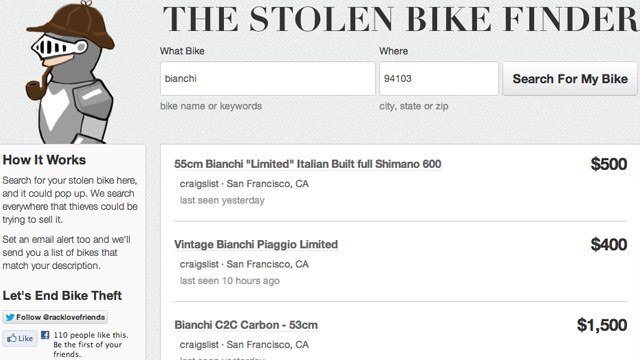
By Melanie Pinola, Lifehacker
Bicycle theft is a rampant problem in this country; even if you lock your bike properly, professional thieves can still take it. Priceonomic’s new site Racklove is not only a nice place to buy and sell bikes, it’s a way to search for your stolen bike.
The stolen bike finder webapp searches everywhere thieves could be trying to sell your bike online, including Craigslist and Ebay. If you find a match for your bike, you could meet with the seller under the pretense of wanting to buy, and see if the serial number matches. (The serial number is found in your owner’s manual and usually on the underside of the bike. This site shows locations of bike serial numbers for different manufacturers.) If you’ve found your stolen bike, then get the police involved.
Racklove is also a nice community for buying and selling bikes (as opposed to Craigslist where lots of stolen bikes get flipped). The Racklove folks are trying to help end bicycle theft and encourage the ad descriptions to show you’re the owner of the bike you’re selling. You can search by bike type as well as your height. I found a couple of bike shops around the country selling old and new bicycles for decent prices (some with free shipping).
If you’re a bike lover, go ahead and check Racklove out.
https://lifehacker.com/5953230/racklove-helps-you-find-your-stolen-bike-and-also-buy-and-sell-bikes
An epidemic of speeding on Staten Island
By Staten Island Advance Editorial
…
Earlier this year, the Advance documented what we found to be a “culture of aggression” by Island motorists. Stuck behind a car deliberately driven at the speed limit, motorists in a hurry resorted to honking horns, changing lanes and speeding by – often making their frustrations known with shouts and gestures.
“Just about every day on every street on Staten Island we have people speeding,” said City Councilman James Oddo about the danger.
The fact is, speed kills. As Transportation Alternatives, an advocate for safer streets, points out: “Hit someone at 30 mph, there is an 80 percent chance they will live. Hit someone at 40 mph, there is a 70 percent chance they will die.”
What is the city doing to limit speeding here?
…
https://www.silive.com/opinion/editorials/index.ssf/2012/10/an_epidemic_of_speeding_on_sta.html
MassDOT Secretary: “We Will Build No More Superhighways”
by Tanya Snyder, Streets Blog
OK, everybody, pack your bags. We’re all moving to Massachusetts.
The Bay State’s transportation secretary, Richard Davey, has launched a “mode shift” campaign, saying in no uncertain terms that it’s time for people to get out of their cars and onto trains, buses, bikes, and their own two feet. His goal is to triple the share of trips taken by those modes, as opposed to single-occupancy vehicles, by improving transit service and active transportation amenities like lighting, sidewalks, curb cuts and rail-trails.
Here’s the part that gives me the shivers: “I have news for you,” Davey said at a news conference yesterday. “We will build no more superhighways in this state. There is no room.”
…
Davey says a shift toward sustainable transportation will “foster improved quality of life by improving our environment and preserving capacity on our highway network; by letting other travel options absorb travel demand that contributes to highway congestion that is slowing our potential for economic growth.” He also says the mode shift will “achieve positive public health outcomes by providing more healthy transportation options.”
…
Richard Davey is the only state transportation chief who doesn’t own a car .
https://dc.streetsblog.org/2012/10/10/massdot-secretary-we-will-build-no-more-superhighways/
What you need to know about e-bikes and the law
from Road Rights by greg

Illustration: Harry Campbell [A local Baltimore cyclist BTW]
For cyclists who ride for fitness, electric-assist bicycles, or e-bikes, may seem to miss the point. But when it comes to pedaling for transportation, more people might decide to get around on two wheels if they had access to one of these motorized machines. However, where and even whether it’s legal to ride an e-bike depends on a complex mix of federal, state, and local laws. Here are some of the rules involved.
Under federal law, if an e-bike has pedals that the rider can use to power the bicycle without the assistance of the electric motor, a motor of less than 1 horsepower, and a top motor speed below 20 mph, it is defined as a “low-speed electric bicycle,” and legally is considered a bicycle. But if the e-bike does not meet those requirements, it is classified as a motor vehicle. The federal law does not apply to e-bikes that are owner-assembled from a kit or from scratch—but some states do regulate such models. However, even when e-bikes are legally considered bicycles, federal law specifies that they may not be used on bike paths that have been built with the assistance of federal funding, unless a state or local law specifically permits e-bikes on bicycle or pedestrian paths.
E-bikes are also regulated by each state. When checking the specifics of your local laws, consider these questions.
…
Read the rest here: https://bicycling.com/blogs/roadrights/2012/10/15/power-to-the-people/
Encourage biking to the office
By Mary Lauran Hall, New Organizing Institute
Get the Tip of the Day via email.
Riding a bicycle to work isn’t just a FUN way to get around, it’s also good for you! It’s even more fun when you have friends who bike with you. Here are some ideas for how to organize your office to be more bike friendly, and recruit your coworkers to start biking
- Start a bike group. The group can launch bike-to-work programs, serve as a liaison for building management, and advise leadership on bike-friendly facilities, incentives, and education. It can also serve as a forum for team members to exchange information and to promote safe cycling to others within the organization.
- Find your local bike advocates. These groups can plug you into local bike-to-work day events and help you determine which streets around your office are best for riding. The Alliance for Biking and Walking has a great tool to find your state or local bike advocacy group.
- Provide facilities for bike commuting. Ideally, every office would allow bikes in the elevator or offer sheltered bike parking. If your building doesn’t, strike up a relationship with building management to discuss options for bike storage. Many local bike advocacy groups and departments of transportation will also install sidewalk bike parking upon request.
- If you can, invest in an office bike. Buy a lightweight commuter or folding bike for the office so that staff can travel to nearby meetings by bicycle. Don’t forget lights and a good lock!
We all need encouragement and support to try something new, and drastically altering a morning commute can be a little intimidating. With the help and support of your coworkers, it is a little easier and you are on your way to a healthier and more eco-friendly commute!
What’s your eco-friendly way to commute to work? Let us know in the comments on our blog.
Mary Lauran Hall is the Communications Coordinator at America Bikes.
Boston’s Over-the-Top “Bike Safety” Campaign
B’ Spokes: Just to note there is something similar going on in Maryland (but not so over the top and in your face.) Stay tuned for correction.
Via Streets Blog
Our friends at Boston Biker say this is the wrong approach:
This is some seriously violent imagery for a public safety campaign.
The idea being that you make not wearing a helmet socially unacceptable by appealing to the fear people have of getting injured. Anti-smoking campaigns work in a similar way, appealing to people’s fear of mortality in order to get them to make different choices. However there are some important differences.
- Smoking is an addiction, addictions require stronger pushes to get people to fight them.
- Cycling is GOOD FOR YOU! Showing bloody images of people on posters is not going to encourage people to cycle.
- More cyclists seem to equal safer cyclists. Several studies have shown that increasing the number of cyclists on the road will actually make them safer.
- Most fatal crashes involve vehicles and cyclists. Helmets are good, but driver/cyclist education, better engineered roads, and enforcement will go a lot further in preventing these crashes than helmet usage will.
So adding it all up, these bloody ad campaigns might actually do more harm than they avoid.
THE MYTH OF THE OPEN ROAD
I just love Bikeyface and here she does an amazing job of contrasting car advertising with the reality of owning a car. And she does not stop there, she goes one step further to show some of the advantages of being on a bike in the same situation that is disadvantageous for being stuck in a car.
https://bikeyface.com/2012/10/11/the-myth-of-the-open-road/
Biden, Ryan Trade Automobile Horror Stories, Talk Up Car Jobs in VP Debate
by Tanya Snyder, Streets Blog
…
When people are injured or killed in car crashes, it somehow never casts a pall over driving or U.S. car culture or the way our cities and towns are designed. Get hurt on a bike and your loved ones will line up to beg you never to ride again, but get hurt driving and no one will ever consider that you could break up with your car.
https://dc.streetsblog.org/2012/10/12/biden-ryan-trade-automobile-horror-stories-talk-up-car-jobs-in-vp-debate/