
BY JEFFERSON SIEGEL, The Villager
…
In certain circles, there is even a saying: If you want to kill someone in New York and get away with it, use a car.
…
“The N.Y.P.D. is charged with investigating serious crashes and enforcing traffic laws, including the requirement that motor vehicles be driven with due care. Yet in each of these cases, and in the vast majority of cases in which pedestrians and cyclists are killed by automobile, the N.Y.P.D. declared ‘No criminality suspected’ within hours of the crash,” said traffic analyst Charles Komanoff. He added that accident investigation reports in recent crashes have not been released to the public or to the victims’ families.
The New York City Department of Transportation reports that deaths resulting from traffic accidents increased 23 percent from 2011 to 2012. In 2012 there were almost 300 fatalities; more than 150 of those involved the deaths of bicyclists and pedestrians. “The N.Y.P.D. is whitewashing traffic violence to the public, withholding potentially emotionally healing information from grieving families, and robbing safer-streets activists of the information they need to best advocate for a livable city,” said Keegan Stephan, the Time’s Up! ride organizer.
…
https://www.thevillager.com/2013/03/21/cyclists-draw-a-line-demand-accountability-in-car-accidents/
CDC: Americans Drive Distracted Waaaay More Than Europeans
by Tanya Snyder, Streets Blog
Adults aged 18–64 who said they had talked on their cell phone while driving in the past 30 days, by country. Image: CDC
…
Cell phone use while driving is an enormous safety problem in this country. NHTSA reports that distraction-related crashes kill more than nine people and injure more than 1,060 every day in the U.S. The effects of distraction are severe: According to U.S. DOT’s website on the issue, Distraction.gov, “Sending or reading a text takes your eyes off the road for 4.6 seconds. At 55 mph, that’s like driving the length of an entire football field, blindfolded.”
[Updated link from one of our readers: https://www.sr22insurance.net/distracted-driving/
Thirty-three U.S. states and the District of Columbia have laws restricting cell phone use while driving, at least for teens, but these laws haven’t yet proven effective at getting people to change their behavior.
https://dc.streetsblog.org/2013/03/15/cdc-americans-drive-distracted-three-times-more-than-brits/
Driver Safety Laws: An Old Approach That’s Worth Reviving
by Steve Vaccaro, Streets Blog
In the aftermath of a crash, we inevitably ask: How can a dangerous driver be kept off the road? It seems that the entire automobile transportation regime is aimed at keeping the driver behind the wheel. Absent impairment or flight from the scene of the crash, police quickly conclude that “no criminality is suspected.” The name of the responsible driver may be carefully guarded by police, even when the name of the victim or selective details are not. Government compels the insurance market to continue insuring the responsible driver, even if the market would consider the driver too risky to insure. The under-resourced legal system and insurance industry neglect and obstruct crash litigation, pressuring victims to simply accept whatever insurance is available without holding the driver personally responsible.
But it wasn’t always that way.
Before the advent of compulsory auto insurance laws in the 1950s, New York and most other states had “safety responsibility” laws instead. Under these laws, drivers involved in crashes had their licenses suspended until they posted a bond or demonstrated insurance in an amount sufficient to compensate the crash victim. Based on their involvement in a crash, these drivers would also be required to maintain insurance as a condition of keeping their driving privileges.
Under New York’s safety responsibility law (codified as Section 94-b of the Vehicle and Traffic Law), the crash victim had the right to directly petition the commissioner of the Bureau of Motor Vehicles for suspension of license of any driver involved in a crash causing personal injury or $25 of property damage. Absent the requisite showing of financial responsibility, the commissioner was required to suspend the license of a driver within 45 days — even if there had not been any finding of fault. At least for those drivers without insurance and financial means, this approach resulted in prompt suspension of driving privileges for drivers involved in crashes.
Though ensuring compensation of victims was clearly the primary purpose of the safety responsibility law, it also had an undeniable deterrent effect. As one New York court explained in 1942, “the penalty which § 94–b imposes for injury due to careless driving is not for the protection of the [crash victim] merely, but to enforce a public policy that irresponsible drivers shall not, with impunity, be allowed to injure their fellows.”
…
https://www.streetsblog.org/2013/03/19/driver-safety-laws-an-old-approach-thats-worth-reviving/
DMV Reconsidering ‘One For The Road’ Driver Relaxation Campaign
SPRINGFIELD, IL—With the drunk-driving fatality rate nearly tripling in Illinois in the past year, the state’s Department of Motor Vehicles announced Monday it will re-examine its controversial "One For The Road" driver-relaxation promotional campaign.
"Driving a car can be an incredibly stressful experience," DMV spokesperson Dale Penn said. "That was the idea behind One For The Road—we felt it was important for motorists to loosen up a bit before getting behind the wheel."
"It does seem, though," Penn added, "that the program may have needed some fine-tuning."
According to Penn, the One For The Road program had its roots in a DMV study revealing a positive correlation between alcohol consumption and driver confidence.
"We found that people who had consumed at least four beers or two mixed drinks before getting behind the wheel were twice as likely to believe they were in no danger of getting hurt or killed," Penn said. "When operating a serious piece of machinery like a car, that’s just the kind of confidence you need."
Among the DMV study’s other findings: A majority of elderly respondents and female college freshmen reported being "more mellow" and "really tuned into the road" after just a single drink.
Launched last fall, the $3 million One For The Road campaign included talks by police officers at Illinois high schools encouraging kids to start "thinking about drinking"; a statewide drunk-driving poster contest; and a series of print and television ads featuring the slogans, "Before You Hit The Road, Hit The Sauce," and "Unwind… To Survive!"
In the time since the September 1996 launch of One For The Road, some 2,300 DUI-related fatalities have occurred in Illinois, a 275 percent increase over the previous year.
"Perhaps we need to reconsider certain aspects of the program," said Bill Gerhardt, co-creator of the program. "We need to ask ourselves, ‘What parts of this program are not working, and how can we fix them?’"
Despite the widespread criticism of One For The Road, some safety experts have expressed concern over what might happen without the program.
"If this program is cut, there are going to be countless alcoholics driving around sober, their hands shaking so bad they can’t even keep them on the wheel. It’s just not safe," said Hal Knauer, a safety advisor for the Illinois Board of Transportation. "A person like that relies on alcohol for steady nerves."
Added Glenn Sturbert, an Illinois-licensed driver-examination official: "Some of these 16-year-olds come in here so nervous that I’m afraid to get in the car with them. Now, I myself can’t give them something to take the edge off—the DMV only has a Class B liquor license—but what’s going on at home that the parental concern isn’t there?"
Penn noted that even with the program’s suspension, many brochures are available from the DMV offering information on "getting loose." "These materials are there so that no driver can ever claim ignorance as a reason for having driven in an unnecessarily tense state," he said.
One For The Road is not the only DMV program currently under fire. Also being investigated are the campaigns "Smoke Up For Safety" and "Pack First!"
https://www.theonion.com/articles/dmv-reconsidering-one-for-the-road-driver-relaxati,941/
***************************************************************************************************
[B’ Spokes: Makes about as much sense as Maryland allowing drivers to go 10 mph over the speed limit in school zones or the MVA saying our 3 foot passing law says you can still pass a cyclists anytime you cannot legally and safely pass a cyclist. Oh, and yes this is satire from the Onion.]
Obama’s Clean Energy Policy Elevates Efficient Cars Over Efficient Modes
by Tanya Snyder, Streets Blog
It has a nice ring to it: using oil and gas revenue to shift transportation off oil and gas dependence. President Obama announced a plan to do just that on Friday — but the details of his plan are disappointing if you want to see the conversation on clean transportation go beyond cars.

Hey, it’s OK — they’re all electric cars. Photo: A Marked Man
The Energy Security Trust would be funded with $2 billion in oil and gas revenues, in what the Washington Post called a “jujitsu” move – using oil and gas money to hasten the elimination of oil and gas as a transportation fuel.
This handy infographic from the Energy Department about what the money will fund shows just how narrowly defined the trust is. Light fuel tanks for natural gas, advanced vehicle batteries, cleaner biofuels, hydrogen fuel-cell technology. But as David Burwell of the Carnegie Endowment’s Climate Program notes, “it has the distinct sound — to use a Zen Buddhist metaphor — of one hand clapping.”
“Certainly, electric vehicles and advanced biofuels are a key tool in drastically reducing the 70 percent of total U.S. oil consumption devoted to transportation,” Burwell said. “However, it misses at least two additional key elements of any oil-back-out scheme — (1) more trip choices and (2) reducing the need to travel.”
…
Bicycles are vehicles

Drive to work… more benefits then you can imagine. :p

Via BikeArlington
Just stop it already
What happens when you promote cars? This:
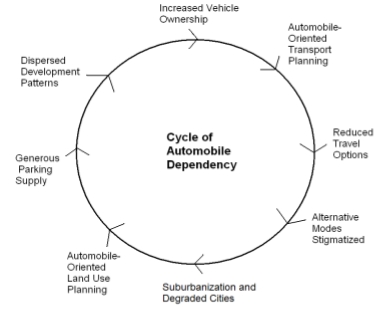
What happens when you break the cycle? All kinds of good stuff, see for yourself:
https://www.copenhagenize.com/2013/03/closing-streets-to-cars-for-good.html
What Do They Really Think? Perceptions of Biking on Capitol Hill
[B’ Spokes: This is probably close to what the Maryland legislature feels as well.]
By Liz Murphy, Bike League
…
The good news: Everyone understands that biking is a key piece of the mobility puzzle.
But Meyer’s research also revealed challenges — and opportunities. Other top findings included:
- Bicycle advocates as “sore winners:” The interviews revealed that federal lawmakers generally believe bicycle advocates don’t get just how successful we were in the passage of the new transportation law, MAP-21. While opponents aimed to eliminate all funding and eligibility for bicycling, Congressional allies and grassroots mobilization kept biking in the bill. By spreading the message that MAP-21 was a loss for bicycling, has painted us as “sore winners” to many on Capitol Hill.
- Dedicated funding is not the end all, be all: While many in bicycle advocacy have pushed hard for dedicated funding streams in MAP-21 and other federal legislation, many on Capitol Hill don’t take well to the idea. They say the funding trend is away from the federal level, and has moved toward local and state decision makers.
- The future is a multi-modal transportation system; embrace it and use it: Rather than pitching Congress on the “bicycling movement,” staffers felt advocates would be more successful if be frame biking as a key cog in a larger multi-modal transportation system.
- Asking for a “fair share for safety” doesn’t resonate: To lawmakers, asking strictly for funding sounds like a money grab. Asking for safer streets through performance measures — or a national goal — is far more compelling. After all, bicyclists are a “cheap date,” and provide tremendous return on little investment.
Click here for Meyer’s full presentation. And stay tuned for more from the Summit…
