
From the Robert Wood Johnson Foundation:
Highlights:
Active Transportation
What the research shows: There is a significant body of evidence linking transportation, planning and community design to increased physical activity.
Land Use for Active Living
What the research shows: Evidence suggests that youth get more regular physical activity when they have opportunities to walk or ride a bicycle from home to nearby schools, parks and businesses.
Quality Physical Activity In and Near Schools
What the research shows: Evidence suggests that students who spend more time in physical education or other school-based physical activity can improve their fitness levels and their scores on standardized academic achievement tests.
Continue reading “Childhood Obesity Action Strategies Toolkit”
BICYCLE MASTER PLANS WEBINAR SCHEDULED FOR JUNE 17th
-> Bicycle Master Plans will be the topic of a one-hour webinar scheduled for June 17th, 3:00 to 4:00 p.m. Eastern Time. A growing number of cities across the U.S. are creating Bicycle Master Plans, or BMPs. These are plans for developing bicycle infrastructure in a city, with emphasis on promoting bicycling as a viable transportation option and fostering a safe environment for bicycling.
Join presenter Peter Lagerwey, who will lead webinar participants step-by-step through the process of creating a successful bicycle master plan. Peter has served for 25 years in the City of Seattle’s bicycle and pedestrian program. He managed the development of Seattle’s Bicycle Master Plan, oversaw construction of more than 150 miles of bikeways throughout the City, and published numerous reports, studies, design manuals, and professional articles. In September, Lagerwey will open a Seattle office for the Toole Design Group. Webinar participants will be given a copy of a guide, "Creating a Road Map for Producing and Implementing A Bicycle Master Plan," authored by Lagerwey and being published by the NCBW’s Active Living Resource Center.
Continue reading “BICYCLE MASTER PLANS WEBINAR SCHEDULED FOR JUNE 17th”
Montreal Inaugurates Continent’s Most Ambitious Bike-Sharing Program
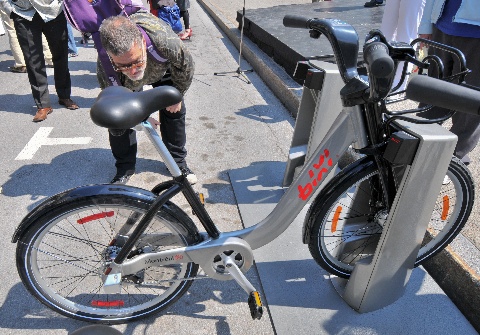
…
Montreal spent 15 million Canadian dollars (about $13 million) to develop and start the system, although it is budgeted to ultimately become financially self-sufficient. But Montreal has received seven patents for Bixi and Mr. Lavallée hopes to sell it to other North American cities.
“We developed this product for Montreal,” he said. “But we were very convinced that it’s good for any city.”
Continue reading “Montreal Inaugurates Continent’s Most Ambitious Bike-Sharing Program”
BICYCLES: Why can’t Johnny ride? (05/12/2009)
BICYCLES: Why can’t Johnny ride? (05/12/2009)
Evan Lehmann, E&E reporter
https://www.eenews.net/climatewire/2009/05/12/2
Schoolchildren are being reintroduced to an old concept.
It is called “active transportation.”
Students in a handful of cities involved in this experiment
probably don’t think much about the carbon emissions they are preventing
as they navigate their bicycles toward beeping devices that count their
rides to school.
Nor do they likely realize that their playful pedaling
has stopped a spark in the family car’s combustion car engine; or that
their bike rides chip a little piece off the mountain of miles that U.S.
school buses travel each year — 4 billion.
But a growing number of teachers and parents see a variety
of benefits from putting kids back on the wheels that earlier generations
took for granted. Getting kids to ride now, they say, will build momentum
for cycling habits they can carry into adulthood.
“It’s all about habit,” said Ned Levine, principal
of Crest View Elementary School in Boulder, Colo., where about 130 students
— or 25 percent — ride to school every day.
Kids, it seems, needed only a little push and a tiny blip
of help from software.
That is what Robert Nagler discovered a few years ago when
he was trying — unsuccessfully — to convince his children to mount up
for the short ride to Crest View. So he began offering cheap prizes that
he bought at the China Trading Co. — not just to his kids but any that
rode over and over again.
“It was pretty exciting,” Nagler recalled. “You
know, you come to school every Friday with a bag full of prizes. It was
like Christmas.”
Continue reading “BICYCLES: Why can’t Johnny ride? (05/12/2009)”
But cars pay for the road they use… ya, right.
Recently we ran some numbers for a small road project here in Cincinnati that would normally never get any attention or second thought by the voting public.
The project totaled $2.4 million and was a street resurfacing for a small stretch of road – pretty typical. We ran the gas taxes paid by the amount of users based on average traffic counts. In the end this small project would take some 630 years to pay off with usership fees (gas taxes). Similarly we ran the numbers on the much larger "Thru The Valley" project that will spend hundreds of millions of dollars to repair/upgrade I-75 through the heart of Cincinnati. When factoring in traffic counts with trucks counted separately (they pay higher taxes), we figured it never be paid off with a discount rate, 80 years to pay off with traffic growth and 123 years to pay off without traffic growth.
In the time it will take to pay these projects off they will have been repaired and replaced several times over resulting in the same net loss right from the get go. The point is not that roadways shouldn’t be maintained and repaired, it’s just that when you hold roadway projects to the same standard as transit it seems ridiculous.
***************************************************************
This latest trend is one more straw in breaking the back of the gas tax as a preferred transportation funding method. Although gas taxes are the largest single source of transportation revenue, we have been moving away from them. Even before the recent rise in gas prices, federal and state gas taxes supplied only 35 percent of the $132 billion in federal, state and local highway funds.
***************************************************************
The Asset Value Index is the ratio of the total expected revenues divided by the total expected costs. If the ratio is 0.60, the road will produce revenues to meet 60 percent of its costs; it would be “paid for” only if the ratio were 1.00, when the revenues met 100 percent of costs. Another way of describing this is to do a “tax gap” analysis, which shows how much the state fuel tax would have to be on that given corridor for the ratio for revenues to match costs.
Applying this methodology, revealed that no road pays for itself in gas taxes and fees. For example, in Houston, the 15 miles of SH 99 from I-10 to US 290 will cost $1 billion to build and maintain over its lifetime, while only generating $162 million in gas taxes. That gives a tax gap ratio of .16, which means that the real gas tax rate people would need to pay on this segment of road to completely pay for it would be $2.22 per gallon.
This is just one example, but there is not one road in Texas that pays for itself based on the tax system of today. Some roads pay for about half their true cost, but most roads we have analyzed pay for considerably less.
To conclude, in the SH 99 example, since the traffic volume for that road doesn’t generate enough fuel tax revenue to pay for it, revenues from other parts of the state must be used to build and maintain this corridor segment. The same is true across the state, meaning that, as revealed by the tax gap analysis, overall revenues are not sufficient to meet the state’s transportation needs.
Continue reading “But cars pay for the road they use… ya, right.”
Wheeling in Employees: How to Keep Cyclists Happy at the Office

YOU’VE DECIDED TO BECOME a bike commuter. Kudos. But how successfully you stick with that resolution depends on whether your office goes the distance.
As cycling gains ground in the D.C. area, some businesses have been bona fide trailblazers. Toole Design — a Hyattsville-based transportation consulting firm — and the World Bank‘s D.C. office have even been recognized by the League of American Bicyclists as two of the nation’s most bicycle-friendly workplaces.
Want to know how your employer can follow their lead? Keep reading.
Be Accessible
Most folks aren’t going to want to hop on I-66 to wheel their way in. So, companies in neighborhoods near multi-use jogging and cycling trials — like Bethesda, which is close to the Capital Crescent — are more likely to lure two-wheelers. Second best are offices near roads with bike lanes (or little traffic).
Employees also have the option of pedaling to the closest Metro station, locking up their Schwinns and riding the rails the rest of the way. For those who want to haul a bike on the train — they’re prohibited during peak riding hours — Toole Design planning director R.J. Eldridge suggests a small, foldable model. “You can take it on the Metro anytime,” he says.

Continue reading “Wheeling in Employees: How to Keep Cyclists Happy at the Office”
Bike vs. Car vs. Transit
Just a little something to get you in the mood for Bike To Work Day, a bike, car and transit race in NYC from last year:
Continue reading “Bike vs. Car vs. Transit”
Craigslist ad leads police to alleged bike thieves
BELLINGHAM — Two Bellingham men were arrested Thursday, May 7, after police discovered the pair had been stealing bicycles and selling them on Craigslist.
The investigation began when a woman, whose mountain bike had been stolen, told Bellingham Police she thought she saw the bicycle for sale on Craigslist, said Mark Young, police spokesman. An officer went to the Web site, tracked down the listing and saw the bike being offered for $1,500. The ad included a picture that matched the description of the woman’s bicycle, Young said.
The police officer called the phone number provided in the listing and set up a time with the seller to buy the bike.
The officer drove an unmarked patrol car to a local shopping center where he met Jeremy Randall Schuitema, 22, who came to the meeting riding the bike, Young said. The officer checked the serial number, which matched that of the woman’s missing mountain bike.
Continue reading “Craigslist ad leads police to alleged bike thieves”
Sorry, Portland
Being involved with the more established bike groups as well as the alt bike culture this article raises an interesting thought, what if bike friendly cities were rated by Critical Mass, Ally Cat races, bike polo and the number of fixed gear riders?


Continue reading “Sorry, Portland”
Drive Less Save more
Cast your vote in the Drive Less Video Challenge!
Vote by May 22

An amazing 77 entries from across Oregon and SW Washington were received in our Drive Less Video Challenge (53 in the General Category and 24 in the Youth Category).
Our judges have narrowed down the list to the top five contenders in each category. It’s now up to you to cast your vote!
Watch the videos below and vote for the one in each category that you think best delivers the drive less message. Only one vote per category.
Your votes will be combined with our judges’ scores to determine the grand prize winner whose video will run as a TV ad.
Public votes will also determine the top three winners in each category. Winners will be unveiled at a film festival at the Hollywood Theatre in N.E. Portland on May 28.