ROAD RAGE DOC GETS FIVE YEARS – TEXAS KILLER GETS ONLY TWO

By: Steve Magas, January 11, 2010

COMPARING SENTENCES – THEY DON’T ALWAYS ADD UP

What a difference a state makes – or so it seems.

CALIFORNIA ROAD RAGE CASE – FIVE YEAR SENTENCE

In California, Dr. Christopher Thompson was convicted in a well reported “road rage” incident.  Testimony in the case included stories from several cyclists who were involved in road rage incidents with Dr. Thompson – the key event was not his only reported transgression!   It took a couple before the prosecution decided to go after him.

The paper trail of prior reports was helpful in getting the prosecutor, and the court, to believe that an Emergency Room physician could actually be so cold-hearted towards human life.  The testimony from those on the scene that Dr. Thompson said he “wanted to teach them a lesson” was chilling.  You can read Bob Mionske’s take on the case here.

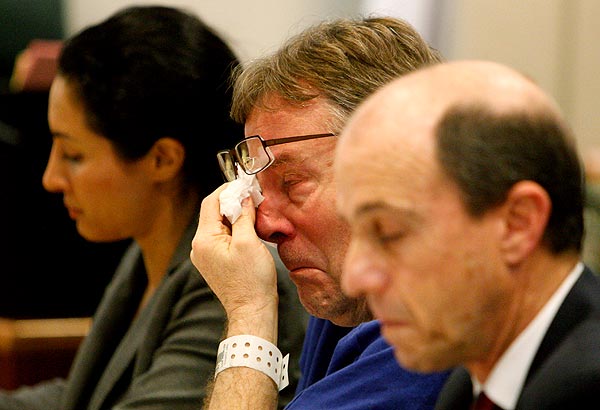
As shown in this LA Times pic, Dr. Thompson was crying in court during the sentencing and was led out of the courtroom in handcuffs the other day after learning that the judge gave him a FIVE YEAR sentence for causing the road rage incident. You can read the whole LA Time story here.
6a00d8341c630a53ef0120a7b780d4970b-800wi

If only justice worked as well in every case.

TEXAS CASE – TWO CYCLISTS KILLED – TWO YEAR SENTENCE

On December 17, 2009, “justice” was handed down in the Kenneth Bain case out of Texas.  Mr. Bain had allegedly been driving home in his Lincoln Navigator from a bachelor party at 8:15 am, after ingesting both alcohol and pot, when he ran into, and killed, two cyclists.

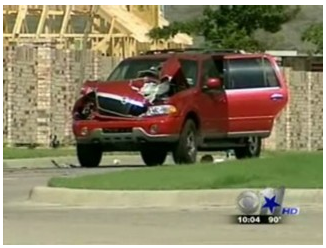
The two cyclists, Meredith Hatch and Mike Alfaro, were members of a local cycling group and were training for an event when they were struck from behind and killed.  The photo of the huge Lincoln Navigator, from a local CBS television station’s website, shows the damage to the front of vehicle.
Screen shot 2010-01-11 at 10.39.31 AM

Mr. Bain was sentenced on December 17.  His sentence was TWO years in prison with an additional 10 years of probation.

The families of the two cyclists, and local cycling advocates, were shocked and outraged.  You can read about it here.

How do you get such different results?  A guy in a road rage case who hurts, but does not kill, two cyclists gets five years.  A guy who ingested pot and alcohol at a party and then kills two cyclists by striking them from behind gets two years?

I wish I had an answer.  There are usually personal, legal or political factors that come into play in these cases, unfortunately.

In the the Texas case there were reports that the BAC for the driver was not over the limit and that there was some reluctance of the family of one victim to put the children on the witness stand.  There were additional reports speculating that Mr. Bain’s lawyer, a sitting Texas State Senator, or Mr. Bain’s family/money may have played a role.  Perhaps the prosecution was worried about some factual or legal issues and didn’t want to take a chance of this one getting away.  We’ll never know.

In the California case, you had clear evidence that the doc was actually INTENDING to do some harm.  There was testimony that the doc said he wanted to “teach them a lesson.”

In the Texas case, the driver was stupid, careless and maybe feeling the effects of a long night of partying, but there was no evidence of ill intent.  There was no evidence that he intended to hit the riders.  That would have led to murder charges.

That distinction – what the judge or jury believe is inside the MIND of the wrongdoer – is a typical dividing line for sentencing.  Intentional and malicious actions are usually punished more severely than careless or stupid actions.

Indeed, in Indiana a few years ago FIVE motorcyclists were killed [and many suffered life changing injuries] in 3 separate accidents on the same day, all occurring within an hour of so of each other in broad daylight.  In each case a relatively young motorist did something stupid and careless to cause the crash.  None of the motorists were drunk or high – just careless.  None of the motorcycle operators did anything wrong.  The prosecutor, in each case, refused to press criminal charges saying “We don’t prosecute negligence in Indiana.”

When alcohol or drugs are involved, though, many states crank up the sentencing, even for “careless” and non-intentional actions.  In the Texas case, while there was evidence of both, there may not have been enough evidence to show “impairment.”  Compare these two cases to the two Ohio cases discussed below…

Continue reading “ROAD RAGE DOC GETS FIVE YEARS – TEXAS KILLER GETS ONLY TWO”

BICYCLE INSURANCE – WHO’S GOT IT?

Is anyone writing bicycle insurance in the USA right now? If so, I’m out of the loop. As far as I can tell, no insurer is writing such a policy in the United States right now.
What do I mean?
If you have a car, you get car insurance. That policy typically contains a number of different coverages. If you hit someone in your car, you are covered. If your car is damaged, your policy can cover it. If you are hit by an uninsured motorist, or one without enough insurance, this policy may provide a pool of money to pay your claim. The “Medical Payments” coverage can be used to pay your medical bills.
What if you are a true transportation cyclist and give up your car? Who pays the claim if you run somebody over? What if you get hit by an uninsured motorist? What kind of insurance is available to protect you?
The short answer, in the U.S., is that it is much easier to protect yourself on the bike if you own a car!
If you do NOT own a car, there is no “Uninsured/Underinsured” policy that will protect you if you are hit by an uninsured motorist. No one is selling this type of “Bicycle Insurance” in the U.S., as far as I am aware.

Continue reading “BICYCLE INSURANCE – WHO’S GOT IT?”

Man driving in fatal hit and run was texting; gets five years

Posted by Jonathan Maus (Editor-in-Chief) on January 22nd, 2010 at 1:26 pm

image

Screenshot from KGW.com.

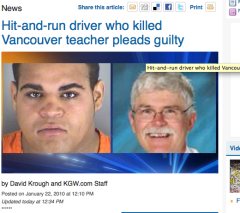
The Columbian was at the sentencing hearing for Antonio Cellestine at the Clark County Courthouse in Vancouver today. According to their report, Cellestine was sentenced to 5 years in prison for driving his car into 50-year old Gordon Patterson back in September. A commenter who was at the hearing today, said Cellestine’s attorney plea bargained with the judge to not have the offense become his client’s first strike.

The Columbian also reports that court documents reveal Cellestine was texting at the time of the collision. According to KGW, Cellestine, who was 18 when the crash occurred, was driving with a suspended license at the time of the crash and his record includes two instances of driving with a suspended license, as well as driving without insurance.

In court today, Cellestine was quoted in The Columbian as saying:

“I feel no one knows how I really feel deep down inside and how I feel about things… This was not intentional; this was an accident…He (Patterson) will always have a special place in my heart.”

This tragic chain of events comes as the U.S. Department of Transportation has ratcheted up their focus on distracted driving and one week after The Oprah Winfrey Show featured victims of distracted driving on her show. It will take a lot more than snazzy slogans and some PR to deal with the issues this case so readily illustrates.

On that note, here’s a comment left below by a former transportation planner for the City of Vancouver that I felt was worth more attention:

“Sadly … this is a case influenced by what must be the very low regard that our law enforcement authorities and political leadership place on motor vehicle operators being certified and insured. There is a too common problem – motor vehicle operation on public streets is not a right but a responsibility…

… A plea to our state legislators this session…please make it less easy to buy insurance in order to get license tags and then cancel the account…

Another related legislative issue would be to strengthen the state law about cell phone/texting use [aka distracted driving].

As a bicyclist who has not owned a car for 22 years – this case and many too similar makes me wonder if I need to start driving again for more protection.”

Continue reading “Man driving in fatal hit and run was texting; gets five years”

National Household Travel Survey

Highlights the 2009 National Household Travel Survey, released on January 8th, 2010
Mode Share
• Biking and walking make up 11.9 percent of all trips made in this country. This is up from 9.5 percent in 2001, a 25 percent increase.
o Biking is 1 percent, up 25 percent from 0.8 percent in 2001.
o Walking is 10.9 percent, up 25 percent from 8.7 percent in 2001.
Short Trips
• 28 percent of all trips are 1 mile or less.
o 40 percent of all trips are 2 miles or less.
o 50 percent of all trips are 3 miles or less.
• Of those trips 1 mile or less, 2.25 percent are biked.
o 35 percent are walked.
o 60 percent are driven.
• Of all trips 2 miles of less, 2 percent are biked.
o 26 percent are walked.
o 68 percent are driven.
• Of all trips 3 miles or less, 1.8 percent are biked.
o 21 percent are walked.
o 72 percent are driven.
Mode of Short Trip
• Of all biking trips, 59 percent are 1 mile or less.
o 78 percent are 2 miles or less.
o 85 percent are 3 miles or less.
• Of all walking trips, 87 percent are 1 mile or less.
o 97 percent are 2 miles or less.
o 98 percent are 3 miles or less.
• Of all driving trips, 20 percent are 1 mile or less.
o 33 percent are 2 miles or less.
o 43 percent are 3 miles or less.
Urban v. Rural Short Trips
• In non-urban areas, 20 percent of trips are 1 mile or less.
o 30 percent are 2 miles or less.
o 37 percent are 3 miles or less.
• In urban areas, 30 percent or all trips are 1 miles or less.
o 44 percent are 2 miles or less.
o 53 percent are 3 miles or less.
Source: NHTS 2009, FHWA Office of Policy
Continue reading “National Household Travel Survey”

New bikes to make North Side police more mobile, visible

COPBIKES_cops & bikesby
Luke X. Martin,
Jan 20, 2010

The Chicago Police
Department is teaming up with Lincoln
Park business owners and residents to give new mobility
to local police efforts.

The Lincoln Park
Chamber of Commerce, along with the Clark Street Special Service Area, donated
18 mountain bikes to Chicago police this week. Police said the bikes
will help them stay more visible.

Sgt. Mike
Neckermann of Chicago police’s Central Command Group said the
bikes should hit the streets in a couple of weeks. He said the bicycles
will go to officers in the 18th, 19th and 23rd districts, which stretch
from the Chicago River to Lawrence
Avenue .  The districts are bound by the North
Branch Chicago River to the west and the lakefront to the
east.

“It’s more of what
we like to call a curb-to-curb approach,” Neckermann said. “In a car,
you’re somewhat limited as to your areas of patrol. Sometimes you’re boxed in in
a car. You miss out on things you can see, smell,
whatever.”

Neckermann, who
estimated the department already uses about 500 bikes, said the new
bicycles will provide a welcome upgrade to officers already patrolling on
two wheels.

Clark Street SSA
Director Bruce Longanecker Sr. said many business owners were looking for ways
to improve safety along the Lincoln
Park ’s Clark
Street corridor. The commission came up
with the idea of donating the bikes about six months ago.  “Talking to the police officers we found
that the bikes that they have were cannibalized,” or put together from parts of
other bicycles, he said.

Longanecker said
he hopes the new bikes help police protect Lincoln Park homes and businesses.  “It’s
to make the street more inviting for the businesses and for the residents,” he
said.  Cmdr. Ken Angarone said
bicycles also make police more mobile.  “A bike can move in and out of
traffic,” Angarone said. “If they have to, they can use the
sidewalk.”

Angarone, who
heads the police department’s 18th District, said the bicycles also help break
down physical barriers between police and those they protect.
 

”Members of the
community have no problem speaking to an officer riding by on a bike,” Angarone
said.  “Sometimes they’ll get information on a crime trend or something
that’s going on that they weren’t aware of.”

The
extra bikes also help police cover more ground.  Angarone mentioned Oz
Park, at the corner of Lincoln and Webster avenues, as one place police can
better patrol on a bike.

A press release
from the Lincoln Park Chamber of Commerce said the donation was valued at
$25,000.  The money came from Lincoln Park SSA’s 2010 budget, which is
drawn from the area’s property taxes.

“The commission
that oversees Clark Street SSA wanted to do something to improve security,” said
Loren Dinneen, director of special projects for the Lincoln Park Chamber of
Commerce.  “(The police) have had a tremendous need for additional bikes,
so we were happy to donate them.”

Continue reading “New bikes to make North Side police more mobile, visible”

Secure Parking for Bikes in Pittsburgh

Pittsburgh Bike Center
Pittsburgh will soon offer a secure parking situation for commuters who cycle rather than drive into town.
The Bicycle Commuter Center has been built on the northern side of the Century Building in the Cultural District. The concept is simple: Two shipping containers have been converted into indoor bicycle storage with space for 26 bikes. The bikes in the facility will be safe from vandalism, theft, rain and snow–elements to which they may be vulnerable with on-street parking. Annual leases will begin April 1, and are available for $100, with a $10 key deposit. There are also 21 wall-racks and official BikePGH racks outside, available for free for short-term Cultural District parking.
Originally found at POPCity.com