
Bikes on Board: The Latest Research on Bicycle/Transit Integration

image
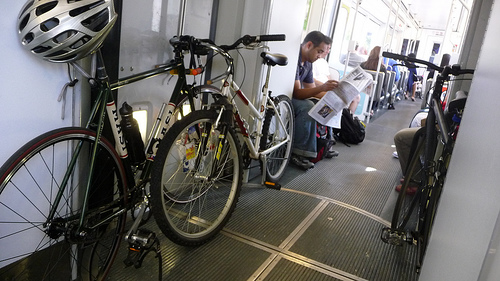
Bikes on Los Angeles County Metro’s Gold Line. Photo by Nate Baird.


Kevin Krizek and Eric Stonebraker’s paper Bicycling and Transit: A Marriage Unrealized summarizes the latest trends on the issue, and reports that several studies suggest that recent growth in transit and bicycling modes may be in small part a result of synergy between the two modes. That marriage, still very much in its infancy, can work via at least five broad possibilities:

1. transporting a transit customer’s bicycle aboard (inside or outside) a transit vehicle (see photo above!);

2. using and parking a transit customer’s bicycle at a transit access (or origin) location;

3. sharing a bicycle (publicly or privately provided), primarily based at the transit access point;

4. using a transit customer’s bicycle at the egress (or destination) location;

5. sharing a bicycle (again), but primarily based, this time, at the transit egress point.

The authors focus on four factors that affect the mode share percentage of cycling-transit users (CTUs): 1) transport mode, 2) location in the urban fabric, 3) egress catchment area, and 4) trip purpose.

Their review suggests that transit services that quickly transport users relatively long distances—30 miles plus—with relatively few stops (i.e. commuter rail or express buses) tend to draw larger shares of CTUs than slower and shorter-distance routes. Catchment areas (the area that a transit stop serves) tend to shrink or expand depending on the speed of the transit mode, with bicyclists willing to ride farther for a faster service. Finally, research confirms the obvious observation that most trips are work- and education-related. As such, CTUs often bypass inefficient feeder systems, to save time, while also preferring fastest, most efficient transit services.


Continue reading “Bikes on Board: The Latest Research on Bicycle/Transit Integration”

Back to Bicycling Basics in Beijing

According to The Guardian, 20 years ago, four out of five Beijing residents pedaled around China’s capital in some of the world’s best bike lanes. However, this number has decreased as private car ownership has gone up. From 1995 to 2005, China’s bike fleet declined by 35 percent while private car ownership more than doubled. Beijing is currently home to four million cars. Last year, China overtook the U.S. in auto sales, with a 46 percent increase in sales over the previous year. As cities in China have grown, bike lanes have also been eliminated to accommodate more traffic lanes for cars and buses. By all indications, it’s seemed that Beijing was well on its way to usher in a new king – the automobile.
But is the city of 17 million ready for king car? Perhaps not, as Beijing’s air quality continues to be poor (last week BeijingAir’s monitoring station reported a few ‘hazardous’ air quality days). Liu Xiaoming, the director of the Municipal Communications Commission, said in a Xinhua article that the government will “revise and eliminate” regulations that discourage bicycle use and impose greater restrictions on car drivers. Beijing already has limitations to reduce the number of vehicles on the road, continuing the odd-even license plate policy after its successful implementation during the 2008 Olympics. (And read my post about Beijing’s ban on “yellow label” vehicles here.)
The government also plans to restore bicycle lanes that were torn down, as well as to build more parking lots for bicycles at bus and subway stations to encourage additional cycling.

Continue reading “Back to Bicycling Basics in Beijing”

More to eat and die for…..!

"Heinz supposedly spent years developing the container–years! Their rigorous R&D even included user-testing in cars. Statistics are unclear on how many of the 100+ car deaths every day are caused by eating, but the National Highway Traffic Safety Administration says about 80% are due to driving distracted–and that includes fry- and nugget-dunking. While it’s clearly not Heinz’s responsibility to police people who might enjoy their savory accoutrement while, say, whipping around a convoy on the New Jersey Turnpike, it does come across as a potentially controversial distraction."[1]
"’The packet has long been the bane of our consumers,’ said Dave Ciesinski, vice president of Heinz Ketchup. ‘The biggest complaint is there is no way to dip and eat it on-the-go.’
Designers found that what worked at a table didn’t work where many people use ketchup packets: in the car.
So two years ago, Heinz bought a used people carrier for the design team members so they could give their ideas a real road test.
The team studied what each passenger needed. The driver wanted something that could sit on the armrest. Passengers wanted the choice of squeezing or dunking. Mothers everywhere wanted a packet that held enough ketchup for the meal and didn’t squirt onto clothes so easily."
Continue reading “More to eat and die for…..!”

Freiker (FREquent bIKER, rhymes with biker)

by JIM BERGAMO / KVUE News
The Round Rock School District is rolling out a new way to make fitness fun. The program combines biking and computers.
Friday afternoon, the Patsy Sommer Elementary School will become the first school in Texas to join a unique bike to school to program. By then, something will sit at the top of a pole in the schoolyard that the kids will think is really cool. It’s called a RFID reader, and its "readin’, ‘ritin’ and ‘rithmetic" is designed to help cut down on the obesity epidemic.
"It is really an epidemic of inactivity, kids need an hour a day minimum and they do not get that in PE," said Leslie Luciana, the Director of Advocacy and Community relations at Bicycle Sport Shop.
Continue reading “Freiker (FREquent bIKER, rhymes with biker)”

The End of the Cul-de-sac?

The cul-de-sac is perhaps the quintessential symbol of suburban America. Perhaps millions of them have paved over greenways throughout the country. Hailed for their safety (no traffic that can run over kids) and prized by developers because they allow more houses to be built into oddly shaped tracts and right up to the edges of rivers and property lines, planners and town officials are beginning to realize their downside.

Early last year the state of Virginia became the first state to severely limit cul-de-sacs from future development.  Similar actions have been taken in Portland Oregon, Austin, Texas, and Charlotte, North Carolina. What they are beginning to realize is that the cul-de-sac street grid uses land inefficiently, discourages walking and biking, and causes an almost complete dependence on driving, with attendant pollution and energy use. Furthermore, town officials are beginning to realize that unconnected streets cost more money to provide services to and force traffic onto increasingly crowded arterial roads, which then, in many cases, need to be widened (more tax money).

Continue reading “The End of the Cul-de-sac?”

Plainclothes Police Enforcing Safety

NU’UANU — Police officers were out in force yesterday morning at Pali Highway and Dowsett Avenue, primarily ticketing drivers who failed to exercise due care in the presence of pedestrians.
The "pedestrians" in this case were police officers assigned to HPD’s Traffic Division. They wore civilian plainclothes and took turns venturing across the six-lane highway in a marked crosswalk at an intersection where there is no stoplight.
It is the same intersection where Hideno Matsumoto, 81, of Nu’uanu, was fatally injured Jan. 12 while trying to cross the busy thoroughfare .
"We try to do this once or twice a month," said Capt. Keith Lima of HPD’s Traffic Division . "We had four pedestrian fatalities (on O’ahu) last month alone. That’s four too many." [Note: Maryland averages over 9 pedestrian fatalities a month and maybe an enforcement once a year.]

Continue reading “Plainclothes Police Enforcing Safety”

No sooner had Yale University posted a news release saying it had earned platinum-level LEED certification

No sooner had Yale University posted a news release saying it had earned platinum-level LEED certification for its new forestry building, Kroon Hall, than the Yale Daily News uncovered a dirty little secret about two other LEED-certified buildings at Yale: They were built with showers and changing rooms for bike commuters, which helped them earn their LEED certification, but bike commuters had never been given access to them. Nor had anyone else.
Continue reading “No sooner had Yale University posted a news release saying it had earned platinum-level LEED certification”

Add ticket to injury


According to Medlock, who writes under the name Jim Treacher, he was struck at about 7:15 p.m. on Wednesday, while crossing M Street in downtown Washington. Medlock says he was walking within the bounds of the crosswalk, toward a blinking white signal, when a government SUV suddenly turned left and plowed into him, knocking him to the ground.
Bystanders tended to Medlock, collected his crushed glasses and called an ambulance. McGuinn, meanwhile, called The Daily Caller’s offices from the scene to tell Medlock’s colleagues about the incident. But he did not identify himself to them or to Medlock.
Medlock was taken to Georgetown University Hospital with a broken left knee, lacerations and bruises. He will undergo surgery later this week.
At the hospital, DC police officer John Muniz arrived to issue Medlock a $20 jaywalking ticket. Medlock was lying sedated on a gurney, so Muniz delivered the ticket to a Daily Caller colleague, who was at the hospital with Medlock. He looked embarrassed as he did so. Behind him stood a man dressed in a dark suit who identified himself as a “special agent.” He said nothing but wrote in a notebook.

The question is: Did the federal agent driving the SUV, faced with potential liabilities from the accident, encourage local police to issue some sort – any sort – of citation to Medlock, to establish his culpability?

Continue reading “Add ticket to injury”

Traffic Injustice, Part II

By Bob Mionske

It was only a few short weeks ago, as the year changed, that somebody, somewhere, fired off a gun to ring in the New Year. The bullet rocketed skyward, until the inexorable pull of gravity slowed its ascent, and it arced back to earth. A mile away, it slammed into an innocent New Year’s reveler, killing him instantly.
Police recovered the bullet, and based on tips, apprehended the shooter. Ballistics tests confirmed that the bullet came from the shooter’s gun. The only question now was whether the shooter should be charged with a noise complaint, or if he should be let go, perhaps with a warning to be more quiet in the future.
Improbable? Of course it is.
The “incident” described is fictitious, but that’s not what makes it improbable. No, what makes this depiction impossible to buy is that no law enforcement agency, and no District Attorney’s office, would treat this unintentional death as “just an accident” unworthy of serious charges; no chorus of apologists would assure us that the shooter’s regret is “punishment enough”; and if brought to trial, no jury of his peers would acquit him, thinking, “There but for the grace of God go I.”
And yet, when the instrument of injury and death is an automobile in the hands of a careless driver, that is often exactly what happens.
Each year more than 700 cyclists are killed by drivers on our nation’s roads while another 62,000 are injured. In the United States, the total annual death toll inflicted by drivers averages in excess of 40,000 people. It’s the equivalent of two jumbo jets crashing every single week, all year long, every single year, or entire towns being wiped off the face of the Earth. Salem, Massachusetts last year; Hoboken, New Jersey this year, and Twin Falls, Idaho next year. Every single year.
When 2,750 people lost their lives in the collapse of the World Trade Center, we went to war, invading two nations at a total cost to date approaching $1 trillion. When 2,750 people lose their lives on our nation’s highways every three weeks, month in, month out, every single year, we do nothing.

The basic problem we face is that in most states there are appropriate penalties for drivers who commit minor offenses like failure to yield, and there are appropriate penalties for drivers who commit the most egregious offenses, like killing somebody while driving drunk. But there’s no middle ground—no appropriate penalties for those who kill through carelessness, and no justice for those who were killed because somebody else shirked their duty to exercise due care.

As Andy Thornley notes, when drivers who injure or kill are not held accountable, we send all drivers the wrong signal about what is expected of them, and consequently, they have less incentive to be careful. By filling in the missing pieces of the vehicle code, we send the right signals to drivers about what is expected of them while operating potentially lethal machinery.

Continue reading “Traffic Injustice, Part II”

If riders don’t feel safe, they’ll leave bikes at home

In Vancouver, the Bermuda triangle for cyclists is the downtown peninsula.
In neighbourhoods such as Kitsilano or Commercial Drive, bike trips account for 10 per cent or more of travel.
But those numbers drop to about half of that as cyclists are asked to cross bridges and enter the downtown’s busy streets, where there is nothing more than painted lanes separating them from buses, cars and trucks.
"We have a good network downtown, but they’re narrow spaces.
"They’re daunting," said Geoff Meggs, the Vision councillor who sits on the city’s bicycle advisory committee. "We haven’t produced as much bike share as we’d like."
Vancouver engineers and cycling enthusiasts want to change all that by creating at least one route through the peninsula where cyclists are physically protected from vehicular traffic, arguing that they’re never going to attract the silent majority of potential cyclists if they don’t.

"Point Grey Road may be an excellent idea. But my concern is that we avoid spending money on disconnected pieces of a network. We want to start building fixes where we get the biggest bang for our dollars."
Continue reading “If riders don’t feel safe, they’ll leave bikes at home”