

Bikes on trains – us vs them
from BikeHacks by Matt
I travel a lot by train. Prior to moving to the East Coast I didn’t, but part of my job involves quite a bit of travel to D.C. and I have found the train a much more pleasant experience than flying from NYC to D.C. In all liklihood the time it takes is probably the same or less when you figure in getting to the airport in the first place and having to pass through security.
I live about a 10 minute walk from the Penn Station so it’s convenient, you don’t have to pass through security (yet), and on the train is a pretty laid back environment. Most trains even have quiet cars so you can get away from annoying loud mobile phone talkers. What is it with these people? Don’t they know that you could practically whisper into their phone and have the person on the other end of the line hear them? Quite the opposite it seems, they feel the need to talk twice as loud as they normally would with little regard for the sanity of those around them . . . but I digress.
Back when I wrote some posts about bike camping I squaked about the fact that public transit is not too bike friendly in the eastern corridor. I will be traveling to the west coast this fall and will need to travel from Portland to Seattle.
In the past I would not have blinked twice and booked an air ticket. My new affinity for train travel had me checking out train ticket prices. I was pleasantly surprised on many fronts.
First, the train drops you off a few blocks from downtown Seattle so I will not have to worry about transit from the airport up the dreadedly clogged I-5.
Second, take a look at the first ticket reservation for a train from NYC to D.C. . . .
And then check out the Portland to Seattle option . . .
“Add Bike to Trip” is an option on every freaking train I looked into! How dope is that? If you click further you get to this:
On the NYC to D.C. trip there are only about two trains per day that allow bikes and you have to box them up. Tyranny I tell you! Portlanders, count your blessings. And if you have not traveled by train recently and don’t need to go too far, check it out. I’m a convert for sure.
Now if only we could get national high speed rail . . .
Mollusks on Wheels
Reading the various stories recently about driving on beaches, as vexing for safety reasons as environmental and simple quality of life factors, I couldn’t help but think back to Edward Abbey’s classic reproach, in Desert Solitaire, to those tourists who traveled via car in the national park at which he was stationed. I know Abbey the man is something of a thorny subject but the book is one of those rare titles that leaves an incendiary impression, the date and place of first reading forever fixed in one’s mind.
What can I tell them? Sealed in their metallic shells like mollusks on wheels, how can I pry the people free? The auto as tin can, the park ranger as opener. Look here, I want to say, for godsake folks get out of them there machines, take off those fucking sunglasses and unpeel both eyeballs, look around; throw away those goddamned idiotic cameras! For chrissake folks what is this life if full of care we have no time to stand and stare? Take off your shoes for a while, unzip your fly, piss hearty, dig your toes in the hot sand, feel that raw and rugged earth, split a couple of big toenails, draw blood! Why not? Jesus Christ, lady, roll that window down! You can’t see the desert if you can’t smell it! Dusty! Of course it’s dusty – this is Utah! But it’s good dust, good red Utahn dust, rich in iron, rich in irony. Turn that motor off. Get out of that piece of iron and stretch your varicose veins, take off your brassiere and get some hot sun on your old wrinkled dugs! You sir, squinting at the map with your radiator boiling over and your fuel pump vapor-locked, crawl out of that shiny hunk of GM junk and take a walk – yes, leave the old lady and those squawling brats behind for a while, turn your back on them and take a long quiet walk straight into the canyons, get lost for a while, come back when you damn well feel like it, it’ll do you and her and them a world of good. Give the kids a break too, let them out of the car, let them go scrambling over the rocks hunting for rattlesnakes and scorpions and anthills – yes sir, let them out, turn them loose; how dare you imprison little children in your goddamned upholstered horseless hearse? Yes sir, yes madam, I entreat you, get out of those motorized wheelchairs, get off your foam rubber backsides, stand up straight like men! like women! like human beings! and walk – walk – WALK upon our sweet and blessed land!
The 3,300 calories diet for the 165-lb. male cyclocross racer
While this is a bit shy of the average American diet I hope that it shows that exercise can really help offset those calories. And there is nothing like cycling to help motivate you to get that intense workout needed, at least in my humble opinion. If you are a cyclocross racer more diet info after the fold…
Continue reading “The 3,300 calories diet for the 165-lb. male cyclocross racer”
Read This Everyday.
Finally a road built to the same "high" quality standards of bike trails

Sad but true comments on ‘Child Playing’ Optical Illusion To Slow Drivers
Despite fears that drivers may stop suddenly or swerve into actual 3D children, David Duane of the BCAA Traffic Safety Foundation told CTV news that the bump was meant to bring attention to driver-caused pedestrian injuries, and that the fake girl should not cause accidents: "It’s a static image. If a driver can’t respond to this appropriately, that person shouldn’t be driving…."
Geekologie says: "Listen: I hate to break it to you, Captain Traffic, BUT AT LEAST HALF THE PEOPLE DRIVING SHOULDN’T BE. …"
Continue reading “Sad but true comments on ‘Child Playing’ Optical Illusion To Slow Drivers”
Traffic Death Experts Ignore the Role of Dangerous Streets
by Angie Schmitt
When it comes to preventing traffic fatalities, are the country’s leading authorities missing the point?
Scientists at the Center for Disease Control told the New York Times last week that the key to preventing traffic deaths is strong seat belt laws, speeding enforcement, car seat promotion, drunk driving prevention and restrictions for teenage drivers. Traffic collisions claim 40,000 lives annually in the United States.

A wheelchair user struggles to navigate a wide road. Research indicates that street design plays a significant role in the crash rates on our roads. Photo: Transportation for America
Urbanists like Phil Langdon, writing for the New Haven Safe Streets Coalition, wonder why perilous streets fail to warrant discussion, given the wealth of research linking specific road designs to traffic fatalities:
It seems strange that an epidemiologist at the CDC — which recently has shown a strong interest in the effects of community design — would not point out the role played by roadways that practically invite motorists to speed.
Planning consultant Peter Swift and others, in a study that was first presented to the Congress for New Urbanism in 1997, amplified in 2002, and amplified again in 2006, identified an important reason for serious traffic accidents: Many residential streets are too wide.
After studying the conditions under which nearly 20,000 accidents occurred over eight years in Longmont, Colorado, Swift and his co-authors came to an unambiguous conclusion: “narrow streets are safer.” They declared: “Clear relationships are evident between accident frequency and street width.” In the Longmont study, the difference between a typical 36-foot-wide residential street and a 24-foot-wide street was found to be “a 487 percent increase in accident rates.”
Additional research has linked suburban-style street patterns to increased traffic fatalities, as well, Langdon writes. The CDC’s failure to mention these factors highlights the inconsistent signals from public health leaders when it comes to traffic deaths. While some CDC studies have mentioned the need to reduce driving, officials don’t seem to be in the habit of promoting that message the same way they urge the public to buckle up or avoid driving drunk.
Elsewhere on the Network: Vote with Your feet Chicago wonders whether the Windy City has lost its momentum when it comes to promoting cycling; Missouri Bicycle and Pedestrian Federation celebrates the enormous turn out for an Open Streets event in Madison; and Crossroads explores how Transit Oriented Development could reduce residential segregation.
Continue reading “Traffic Death Experts Ignore the Role of Dangerous Streets”
Clever Crosswalk Squashes Jaywalking, by Making it Legal
Jaywalking: Everyone does it, so you might as well legalize it. But is there any way to make it less dangerous?
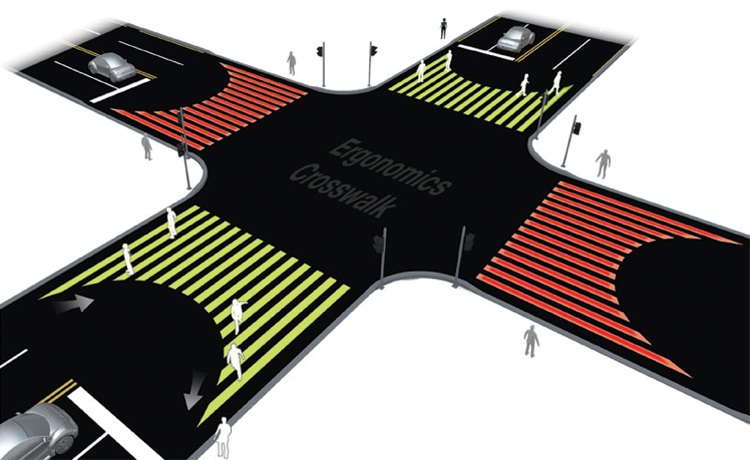
Design to the rescue! Korean designer Jae Min Lim has the clever idea to turn crosswalks into, well, “J”s. By curving the typical Zebra crossing to take up a wider swath of road, you carve out a nice, safe path for pedestrians — one that reflects how they actually walk.
…
Continue reading “Clever Crosswalk Squashes Jaywalking, by Making it Legal”
Note From a Non-Free-Range 16-Year-Old
from FreeRangeKids by lskenazy
Dear Free-Range Kids: I wish I had been raised Free-Ranged. What parents don’t seem to realize is that when your parents are constantly hovering, it’s like being told No You Can’t every single day.
I am sixteen years old. I am sixteen years old, I don’t drink, I don’t even LIKE parties, and I have never even seen a real joint. I am a straight A student who is currently taking more college courses than a college freshman. I am also, apparently, too irresponsible to ride my bike to school. Or to my best friend’s house (which is about halfway down my would-be bike route to school).
I had this really odd realization the other day. I noticed that when I go bike riding with my dad, I tend to be less competent than when I go by myself. The days when I do my homework without being told are the days when no one is there to tell me to do it. When there is someone there to “hover” over me and make sure I’m okay, I become less capable. One time, while riding my bike, I went past the “boundary lines” for where I’m allowed to ride, and instead explored another part of my neighborhood (by the way, my neighborhood’s definition of “youth crime spree” was when a kid spray painted a p***s on a fence two and a half years ago). When I decided to head back, I was able to remember which streets I had taken without a problem. This took me completely by surprise.
I think what happens for a lot of kids is that when our parents keep denying us the chance to look after ourselves, we eventually stop trying, which our parents see and take as evidence that we’re not ready yet.
Continue reading “Note From a Non-Free-Range 16-Year-Old”