
Highlights from TheWashCycle by washcycle
A California cyclist was hit in a right hook…. But the driver’s lawyer argued that "if we had a video camera on every driver in Southern California, you probably wouldn’t see one who turns around and looks over at the curb and behind them. Why would you? There’s no reason to, okay?" and the jury agreed.
***
In one study in which drivers were asked how they feel about cyclists, one of the recurring labels was "unpredictable." When asked to elaborate, drivers often blamed the "attitudes and limited competence" of the cyclists themselves, rather than the "difficulty of the situations that cyclists are often forced to face on the road." When asked to describe their own actions or those of other drivers, however, they blamed only the situation. Psychologists call this the "fundamental attribution error."
So drivers, perhaps already stressed out from being late for work or stuck in traffic, then have to negotiate their way around a vehicle they essentially don’t understand, causing even more stress, which they tend to attribute to something about cyclists. It’s a vicious cycle—most vicious, in terms of actual harm, for cyclists.
***
Virginia (1.5%) and DC (0%) had cyclist fatality rates below the national average of 1.9%. Maryland was slightly higher (2%).
***
Moving Beyond the Automobile: Biking from Streetfilms on Vimeo.
Continue reading “Tour de Links – Vanderbilt”
OP-ED ON BIKE SAFETY: By Morgan Andriulli:
By John Peck, The Huntsville Times
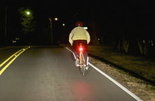 Bicyclist uses light to improve visibility.
HUNTSVILLE, Ala. _ Look closely at this picture. This is what the motorist failed to see when he hit Ernie Wu at 6:30 a.m. Wednesday, Dec. 29. Wu, CEO and president of ERC Inc., was riding to work in the pre-dawn darkness when the motorist struck him on a stretch of Drake Avenue with a quarter mile of visibility, no rain, no fog, street lights and no other traffic on the road.
The cyclist in the picture is running a $300 lighting system and wearing an IllumiNITE™ jacket, identical to those used by Wu that morning and far exceeding the minimum required illumination required for cyclists by law. That particular light system can be seen up to a mile away. So one wonders, what was this driver doing when he hit Wu? Apparently it does not matter because, according to the account in The Times, “The driver of the car, who has not been charged, told police he did not see Wu before he hit him.”
‘Not Been Charged…’ What is it going to take before motorists face some legal consequences for injuring and killing cyclists?
…
Continue reading “OP-ED ON BIKE SAFETY: By Morgan Andriulli:”
Mass civil disobedience
I’ll highlight this bit from The View From the Cycle Path:
In this case (see picture below) the green line (about 100 meters/yards) would be the logical route. There is ample room for a cycle path there, but curiously cyclists are required to take the route represented by the red line. This includes going up and down and even an extra level crossing of a light rail line that would otherwise be crossed on the overpass. There is a shortcut (red dots) using the pedestrian stairs. But all in all the red route is at least double the length of the desired green route.
It is clear from the video that this man is not the only one who feels this is wrong. Many cyclists find a short cut by riding over the grass. The city council doesn’t like that but instead of tackling the problem by making the cycle path more direct, they put up a fence to protect the grass. The fence is of course consequently damaged. Another option is to ride against traffic on the opposite side of the road. Which is not a good solution either.
But it could be fixed: a bridge in this road (just left of the picture and seen in the beginning of the video) is due for maintenance. The man in the video urges the city to correct the mistake while they’re changing the bridge.
Too often when faced with civil disobedience government will try to come down on behavior that if understood is very reasonable, when it should be looking for solutions.
Scoff law cyclists – adopt the Idaho Stop Law and the bulk of the problem goes way.
J-walking pedestrains – provide more opportunities for safe and convenient crossing and the problem goes away.
Instead government vilifies reasonable behavior. They build fences to keep the prisoners from escaping, they enforce rules designed to break peoples spirit like, ticketing peds for not using the government sanctioned half hour detour.
We need solutions not vilification.
Continue reading “Mass civil disobedience”
Trust Funds Must be Adapted Over Time
By Deron Lovaas
Federal Transportation Policy Director, Natural Resources Defense Council
Working with transportation exposes you to some very strong feelings about trust funds. On the one hand, there are those who espouse a strict doctrine of "highways-only" when delimiting investments from the fund since federal gas tax receipts ("user fees") fill the fund (and who appear to assume that such users derive little or no benefit from other components of the transportation system). At the other extreme are those who agree with Winston Churchill, who argued that gas taxes should be treated as "general revenue" during a debate in 1926: "Entertainments can be taxed; public houses may be taxed; racehorses may be taxed…and the yield devoted to general revenue. But motorists are to be privileged for all time to have the whole yield of the tax on motors devoted to roads? Obviously this is all nonsense…such contentions are absurd, and constitute an outrage upon the sovereignty of Parliament and on common sense."
As you can tell by my quoting him at length, my sympathies lie more with Churchill. Trust funds aren’t holy writ. Having said this, it’s indisputable that they are one of the more clever policy inventions of the past century. As Eric Patashnik writes in his excellent history of trust funds, as of 1995 there were more than 150 trust funds comprising nearly 40 percent of federal revenues, including of course the highway trust fund or, as the Administration proposes, the "Transportation Trust Fund." He notes there are "four main reasons for creating trust funds: (1) to make users pay; (2) to maximize agency budgets; (3) to reduce uncertainty; and (4) to safeguard the Treasury." These functions make trust funds exceedinlgy useful policy tools.
I think what the Administration proposes could split the difference neatly between what Churchill preferred, a model adopted by other industrialized nations, and the too-narrow, non-systemic doctrinal stringency of "highways-only." I say "could" because as Greg notes we need more details about how this new version of the trust fund would work. But even without these details, conceptually it seems sound — expand the trust fund to benefit the functioning of the whole transportation system, not just one mode, but don’t expand it too far and instead keep it in the "transportation system users" camp.
…
Continue reading “Trust Funds Must be Adapted Over Time”
Unsung Heroes project in need of funds
By Elly Blue (Portland Cycling Advocate)
– A tantalizing glimpse into the world of women bicycle racers 100 years ago. Replete with colorful characters, helpful men, and exposed ankles
– The classic, true-life fable of the hero who doesn’t realize it—she’s just going to work
– A battle hymn of the bicycle vs the terminal diagnosis, as chronicled many years and miles later
– A freewheeling activist maps the connections between bicycling, dance, zen, and project management strategies. She wants the next generation to know that it’s going to be better than you think
Continue reading “Unsung Heroes project in need of funds”
When being in full compliance of the law is not good enough
From Bike Portland and I will highlight this bit:
"Given the circumstances, it seems like issuing a citation would probably not stand up in court. Any person could go in and say, ‘It’s dark, rainy, there’s this little red light in the road’. I think any judge would toss that citation out’.
…
It probably wasn’t powerful enough or large enough to overcome the circumstances surrounding this situation
…
I could totally see how you’d miss a small red light."
— Det. Sgt. Jim Shumway, Beaverton Police Department
[B’ Spokes: What bothers me is two fold. Why do we have legal requirements that don’t stand up in court? And just because there are some low end lights and reflectors, why isn’t there a standard that can be applied that can say that the cyclists meet or exceeded visibility standards in this situation?]
Continue reading “When being in full compliance of the law is not good enough”
Sustainable transportation is not about expanding choice, but about optimality, and how to design it into the transportation net
Another great article from Rebuilding Place in the Urban Space by Richard Layman. Highlight:
"New York City’s Active Design Guidelines may represent the beginning of a strategic shift in the battle to get Americans to exercise. Instead of trying to change individual choices by using a moral appeal about what is good for us (you should walk [bike] to work because it is better for you), it’s about changing the environment to reshape the available choices (you’ll want to walk [bike] because it is easier, cheaper, faster, or more enjoyable)."
Continue reading “Sustainable transportation is not about expanding choice, but about optimality, and how to design it into the transportation net”
Design by firetruck
A topic comes up once and a while in trying to design complete streets where there is a strong desire to keep roads narrow and traffic speeds down, then someone raises an objection “But that will slow down firetruck response time.” So to accommodate the rare event of a firetruck we get larger turning radius and wider streets which results in speeding an unsafe streets most of the time. So to save the less frequent fire related death we promote the more frequent traffic injury and death.
But does it have to be this way?
In this video there is a competition between an American firetruck and a UK fire truck. Of course the UK truck wins the maneuverability course hands down.
The KME (U.S. truck) is 2 meters longer and almost a meter wider than the Volvo (U.K. truck). Fine for wide, American streets, but difficult navigating around a tight course like this.
So do our local roads really need to become freeway like to accommodate firetrucks or should firetruck change to adapt to their environment?
Continue reading “Design by firetruck”
Scorning safety advice

I seriously think there is something wrong with the general tendency to take short cuts to save milliseconds over taking an extra step for others people safety. If there was a pedestrian approaching a car from the right, a lot of times the motorist will not take the extra step to look, that is where the “fail” is at not this sign.
Continue reading “Scorning safety advice”
Dalai Lama nephew killed along A1A
By JULIE MURPHY and PATRICIO G. BALONA, Staff writer – News Journal
…
Norbu, 45, was killed during the first day of the journey on foot along Florida’s coast. He was struck about 7:30 p.m. Monday by an SUV driven by Keith O’Dell, 31, in the 5600 block of A1A, just south of Hammock Hardware and Newcastle Shipyards.
Norbu was killed instantly, according to Flagler County Fire Rescue and the Florida Highway Patrol.
O’Dell of Palm Coast was not charged and could not be reached for comment Tuesday. He and his two children in the SUV, Bradon, 3, and Bohdi, 5, were not injured.
…
Norbu was hit while walking south "in the area of the white line" along the outside of the southbound lane, according to the FHP report.
…
Continue reading “Dalai Lama nephew killed along A1A”