
By WILLIAM WHITE | Opelika-Auburn News
DADEVILLE — At 78 years of age, Betty Kriss is traveling hundreds of miles while seeing the sights across East Alabama and pedaling her bicycle.
“People think they can’t when they just need to give it a good try,” said Kriss, who is from Silverhill, during a lunch break Monday at the Horseshoe Bend National Military Park in Tallapoosa County.
…
She said staying healthy has been one of the benefits of riding since she started in the 1970s.
“I don’t have to take any medications,” she said. “And I feel great and sleep like a log.”
…
Continue reading “78 years of age, Betty Kriss rides a bike”
Five Media Myths That Perpetuate Car Culture
Short summary of Streetsblog New York City by Catherine Lutz
Americans love their cars. (Americans may need their cars in our transit-starved and poorly planned landscape, but with mind-numbing traffic and volatile gas prices, the luster is off the chrome.)
Teens can’t wait to grab the car keys. (It’s the adults that are fed up with schlepping their kids in an auto-centric world.)
The economy depends on the auto industry. [The economy depends on people buying a diverse range of goods not sinking most of their income into one thing. ]
The America car industry can return to its former glory. [ROFLMA]
We can’t fix the car system because poor people will suffer. (Of course, no group suffers under our current car system more than the poor,)
Continue reading “Five Media Myths That Perpetuate Car Culture”
NHTSA says "Share The Road Sign" sends mixed messages
[B’ Spokes: This seems rather timely after our alert that Maryland is trying to assert a third meaning behind Share the Road signs, or is that a trick question?]
To: The Motoring Community
From: Paula Bawer RN, MA
Bicycle Safety and Safe Routes to School Program Manager
National Highway Traffic Safety Administration (NHTSA)
That yellow, diamond-shaped sign with a black silhouette of a bicycle in the center and the
words, “Share the Road” is not just a sign. It’s a concept adopted to foster safety and respect
between motor vehicle operators, bicyclists, motorcyclists, and truck drivers.
However, it’s not unusual for emotionally charged comments to surface from motorists and
bicyclists.
Motorists’ perspective:
- Bicyclists need to stay off the roadway and ride on the sidewalk where they belong.
- If bicyclists want respect, they need to show respect and follow the rules of the road.
Bicyclists’ perspective:
- Bicycles are vehicles – just like cars, motorcycles and trucks. I have the right to ride on the
road. - The “Share the Road” sign means it’s okay for me to ride on roads. Vehicles are supposed
to make room for me.
These sentiments illustrate the need to heighten awareness and personal responsibility for
motorists and bicyclists. Many motorists believe bicycles belong only on sidewalks and bike
paths, when in fact bicyclists are granted the legal right to ride on a roadway even when a bike
lane or path is present. However, it’s also important to note that bicyclists must follow the same
traffic rules as drivers of motor vehicles.
The challenge lies in the lack of some road users’ understanding of the “Share the Road”
concept. Some motorists believe the term means that bicyclists should take up less space, give up
the majority of the road, or get off the road completely. Many bicyclists believe that the term
means that motorists should treat them like drivers of a vehicle, allow them space on the
roadway, and yield the right of way.Interpretations are not always clear, but on a road where the rightmost travel lane is wide enough
for a motor vehicle and bicyclist to travel side by side, the concept of “sharing” may seem
effortless and intuitive. However, in locations where the rightmost travel lane is too narrow for a
bicyclist and a motorist to safely travel side by side, the Uniform Vehicle Code and many state
laws require motorists to change lanes to pass, releasing cyclists from the need to ride “as far
right as practicable” restriction.
Share the Road initiatives are typically designed to encourage motorists to be more aware of
bicyclists, to teach bicyclists that they must obey state and local laws, and to compel motorists
and bicyclists to respectfully operate on the same roadways. Across the country, there have been
various strategies to raise public awareness about motorists and bicyclists safely sharing public
roads, including: public service announcements, billboards, pavement markings, and web-based
and public/private events.
Other successful traffic safety campaigns use a multi-prong approach: education in conjunction
with enforcement efforts, engineering changes, and the passage of state and/or local legislation.
AAA’s national effort to reach motorists with Share the Road messages offers a unique
opportunity to encourage mutual respect among all road users. AAA continues to serve as a
valued national partner with the National Highway Traffic Safety Administration (NHTSA) and
many other national organizations to save lives and prevent injuries on our nation’s roadways.
NHTSA is pleased to be included in AAA’s unveiling of a national Share the Road campaign. As
AAA members you are encouraged to act with courtesy and caution when sharing the road, to
assist in reducing the number traffic-related injuries and fatalities on our nation’s roadways.
For information related to bicycle safety, please visit NHTSA’s bicycle safety website at
https://www.nhtsa.gov/Bicycles.
Source: https://www.aaaexchange.com/Assets/Files/2011511161280.ShareTheRoad_NHTSA.pdf
This was found via TheWashCycle, which also highlights AAA Share the road page (our previous coverage) but this bares repeating:
“When a road is too narrow for cars and bikes to ride safely side by side, bicycles should take the travel lane, which means riding in or near the center of the lane.”
Wow, wonder of wonders, the SAME advice to motorists as cyclists. But what do you think of Maryland’s approach of telling cyclists to ride in the middle of the lane (See “Roadway Riding” in this video by MDOT.) but telling motorists (under “Rules for Motorists” no less) that A bicycle should be operated as close to the right side of the road as
practical and safe. ? (Note: Practical (per handbook) and practicable (per law) do not mean the same thing. That combined with the mistaken notion that “safe” means out of the way of cars and not in the center of the lane and well… it does not always work out well for the cyclists .)
This Is Your Brain on Cars—Oh, and Your Lungs and Heart and Gut, Too
from Streetsblog Capitol Hill by Catherine Lutz
Gerontologists in a laboratory at the University of Southern California exposed a group of mice to the same atmospheric conditions that humans encounter when driving along the freeway. Horrifyingly, they discovered that the mice’s brains showed the kind of swelling and inflammation associated with diseases such as Alzheimer’s. The researchers didn’t super-dose to get these results: the mice were exposed to freeway air for the equivalent of 15 hours a week– less than the 18.5 hour average Americans spend in their cars. Jokes aside about getting those darn mice off the road, the study suggests that driving less can reduce our risk of brain damage.
…
The UCLA mouse study joined other recent reports that highlight the variety of ways in which remaining overly reliant on the private automobile is self-destructive. But these reports should also make clear that changes in individual behavior can alleviate some of the problems. Here’s just a sampling:
- The obese are at increased risk of injury in a car crash, according to University of Michigan researcher Jonathan Rupp, and the percentage of the population that is obese is rising. The automotive press presented this as a problem faced by the industry, rather than exacerbated by it. Their answer, of course, is not to encourage more walking and biking but to push for improved safety equipment so that drivers can stay obese and stay on the road.
- Sitting for long stretches greatly increases the risk of heart disease – even if you exercise afterwards – according to a study in the Journal of the American College of Cardiology. It may come as no surprise that sitting isn’t good for your health, but what’s shocking is that the raft of articles following the study tended to ignore active transportation while advocating improbable solutions such as standing treadmill desks. What’s more practical than replacing some of our long hours planted in the driver’s seat with walking, biking, or getting by foot to public transit stops?
- While there was some good news in the American Lung Association’s 2011 State of the Air Report, as one commentator put it, it was “like getting a 53 on your math test after you got a 49 on your last one.” Half of Americans live in areas in which air quality is unhealthy. The ALA points out that the elderly, the young, and the sick are most vulnerable to the effects of pollution. And of course some of the sick—such as those suffering from asthma and heart disease—can trace the very causes of their conditions to air pollution.
…
Continue reading “This Is Your Brain on Cars—Oh, and Your Lungs and Heart and Gut, Too”
Are you ready for the 2 Mile Challenge?
from Welcome to the Fast Lane: The Official Blog of the U.S. Secretary of Transportation by Ray LaHood
High gas prices are hitting American families in their wallets and pockets pretty hard these days. But did you know that more than 40 percent of urban trips in the United States are less than two miles, yet 90 percent of those short trip are taken by car?
Many of these trips could easily be taken by public transit, on foot or by bicycle–saving money, helping the environment, and even affording the chance to stay fit all at the same time. At the Department of Transpoertation, we know these are the kinds of alternatives people are looking for, and we’re working to provide transportation options that don’t require getting into the car.
That’s why I was pleased to hear about a new competition called the 2 Mile Challenge that demonstrates how many car trips could be replaced by bikes.

The challenge is pretty simple. Organizers have selected three non-profit team sponsors. Each team recruits members, who log their miles traveled by bicycle from May to October. Anyone can register online and join a team–and you don’t even have to go to any meetings!
The gold team pedals for the Alliance for Biking and Walking, the blue team pedals for 350.org, and the red team pedals for the Safe Routes to School National Partnership.

Challenge organizers aim to replace 100,000 car trips, and sponsor Clif Bars will donate a total of $100,000 to bicycle advocacy and climate protection. The team with the most miles and points wins the largest grant for their particular organization.
The challenge builds a community, encourages more citizens to get out and bike, and supports nonprofits that are working to increase active transportation. But the best thing about the challenge is that every mile counts. If you only ride your bike five times a year, go ahead and sign up–those five trips will help your team. Even if you only ride once, that trip counts.
Make a commitment to saving money, getting exercise and helping the environment by riding your bike on short trips today – sign up here to be a part of the 2 Mile Challenge.
The League partners with AAA on road safety for National Bike Month
[B’ Spokes: It looks like someone got the hint from Washcycle and Baltimore Spokes.]
from Bikeleague.org Blog by Darren
Whether bicycling to work, to improve their health, save money, or to reduce their overall carbon footprint, bicycling is on the rise and the League of American Bicyclists and AAA want motorists and bicyclists to make safety on our shared roadways a priority.
“As more cyclists hit the road and trail, we welcome the opportunity to work with AAA to reinforce the safety messages that both cyclists and motorists really need to take to heart,” said Andy Clarke, President of the League of American Bicyclists. “We have a shared responsibility to share the road – and the reality is that most cyclists are also motorists at some point.”
“Education–on both sides—is key for all road users, of all ages,” said AAA’s Traffic Safety Specialist Rhonda Markos. “Despite conventional wisdom, children are not the primary victims of bicycle crashes.” Of the 630 bicyclist deaths in 2009, eight out of ten were adults over 21, so the League of American Bicyclists and AAA have partnered on a campaign to encourage adult bicyclists to take five easy steps to safer riding:
- Follow the Rules of the Road:
- Always ride with traffic, using the rightmost lane, obeying the same laws as motorists.
- Use hand and arm signals to indicate your intention to stop, merge or turn.
- Be Visible:
- Ride where drivers can see you. Do not ride on the sidewalk.
- Wear brightly colored clothing at all times. At night, use a white front light and red rear light or reflector, and wear reflective clothing.
- Be Predicable:
- Ride in a straight line and don’t swerve between parked cars.
- Make eye contact with motorists to let them know you are there.
- Anticipate Conflicts:
- Always be aware of traffic around you and be prepared to take evasive action, exercising additional caution at intersections.
- Learn braking and turning techniques to avoid crashes.
- Wear a Helmet:
- Helmets, when worn properly, are up to 85 percent effective in protecting the head and brain in the event of a crash. Should you crash, or have an impact that affects your helmet, replace it immediately.
- Fit matters: Wear your helmet level on your head, low on your forehead, with no more than two finger widths above your eyebrow.
“AAA is pleased to work with the League of American Bicyclists to remind adults about safe bicycling practices and to encourage motorists and bicyclists alike to share the road,” Markos said.
Motorists should also make an effort to reduce bicyclist injuries and fatalities.
AAA is encourages it’s members to take the following precautions when sharing the road with bicyclists:
- Stay alert, avoiding all distractions while driving.
- Yield to bicyclists when turning.
- In bad weather, give bicyclists extra passing room.
- Check mirrors and blind spots for bicyclists before entering or leaving a lane of traffic.
- Slow down and give at least 3 feet of clearance when passing.
- Reduce your speed when passing bicyclists, especially when the road is narrow.
- NEVER honk your horn at a bicyclist just to let them know you are there; it could cause them to swerve into traffic or off the roadway and crash. Save your horn for emergencies.
- Always check for bicyclists before opening your car door.
For information on bicycle safety, please visit BikeLeague.org and SharetheRoad.AAA.com

Darren Flusche
League Policy Analyst
Flusche joined the League in April 2009 and has a B.A. in history from Syracuse University and a Masters of Public Administration with a concentration in public policy analysis from New York University.
Continue reading “The League partners with AAA on road safety for National Bike Month”
Co-opting Complete Streets
from New Urban Network – The Source for Urban Planning, Walkable Communities & Smart Growth by Charles Marohn
…
The Complete Streets concept is one that is long overdue. We’ve spent two generations transforming a public realm once comprised of walkable, mixed-use neighborhoods into auto-only zones. These are places where the kids used to play ball in the street. Today a kid can’t even play safely in their own front yard.
At Strong Towns, we’ve worked to illuminate the fact that this transformation has been done at tremendous financial cost. This is not only because the construction of wider, flatter and straighter streets has been expensive, but because the auto-centric nature of the transformed public realm drives private-sector investment out of traditional neighborhoods, dislocating it to places that provide more buffering to the car.
…
I’ve now seen two projects where engineers promoted the use of "complete streets." In each I see the engineering profession co-opting the Complete Streets moniker without any thought to a Complete Neighborhood. For the engineers on these projects, the approach remains the same. I’ll quote from our piece, Confessions of a Recovering Engineer:
An engineer designing a street or road prioritizes the world in this way, no matter how they are instructed:
1. Traffic speed
2. Traffic volume
3. Safety
4. Cost
The rest of the world generally would prioritize things differently, as follows:
1. Safety
2. Cost
3. Traffic volume
4. Traffic speed
In other words, the engineer first assumes that all traffic must travel at speed. Given that speed, all roads and streets are then designed to handle a projected volume. Once those parameters are set, only then does an engineer look at mitigating for safety and, finally, how to reduce the overall cost (which at that point is nearly always ridiculously expensive).
Continue reading “Co-opting Complete Streets”
Don’t Drive Like An Asshole.
From this web site.
Inspired by NYC DOT’s Don’t Be A Jerk campaign and the hope for equal safety and enforcement of traffic laws for all New Yorkers.
Take the pledge:
I, as a driver, want to help keep New York’s streets safe for everyone. I pledge to:
- Yield to pedestrians
- Stop at red lights and stop signs
- Obey the 30MPH speed limit
- Keep bike lanes, crosswalks and intersections clear
- Give cyclists adequate space when passing
- Never make an illegal U-turn
Aftermarket Device Helps Distracted Drivers
WASHINGTON, DC (WUSA) — Many new luxury cars include high-tech devices that warn drivers heading for a collision. Now that technology can be installed in any vehicle aftermarket.
In the Metro Washington area last year, 83 people died and another 2,700 were injured in pedestrian or bike accidents involving vehicles, according to AAA.
The CEO of Mobileye, Skip Kinford, said the device costs $930.
…
Continue reading “Aftermarket Device Helps Distracted Drivers”
With Skulls and Bones, Signs That Say ‘Speed Kills’

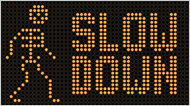
To promote pedestrian safety, New York City plans to introduce LED warning signs that feature a skeletal figure and warn drivers of the speed limit and how fast they are going.
“The idea is to get people to realize that what they’re doing can kill them or kill somebody else,” the mayor said at a news conference on Thursday. “Unless you make it graphic, people don’t get the message.”Skeletons are already a trope of the Transportation Department’s “That’s Why It’s 30” publicity campaign, which reminds drivers through bus shelter posters and television announcements that cars traveling at 40 m.p.h. are far more dangerous to pedestrians than vehicles that follow the speed limit.
[B’ Spokes: Has any one else notice that our “speed” cameras allow for near 40mph in school zones? (25+12=37mph)]
Continue reading “With Skulls and Bones, Signs That Say ‘Speed Kills’”