
[B’ Spokes: It has long been my assertion that given motorists will not properly yield for you at an intersection the safest place for you to cross is mid-block where traffic comes from a predictable and limited directions. So what does Maryland do? Ticket the jaywalkers and leave the intersections even more dangerous by not enforcing proper driver behavior.]
******************************************************************
By MATT FLEGENHEIMER, New York Times
Pedestrians struck by cars are most often hit while in the crosswalk, with the signal on their side.
…
These are among the findings of a medical study of injured pedestrians and cyclists in the city, conducted by a team of trauma surgeons, emergency physicians and researchers from NYU Langone Medical Center.
…
https://www.nytimes.com/2013/04/03/nyregion/study-details-injuries-to-pedestrians-and-cyclists-in-new-york-city.html?pagewanted=all&_r=1&#h[TaaTaa]
The 5 Best Biking and Walking April Fool’s Day Pranks
My favorite is #4 "Maryland considering mandatory helmets for drivers"
"While driving activists are split on the issue, area pedestrians say it’s about time drivers took responsibility for themselves."
Read the rundown here: https://www.peoplepoweredmovement.org/site/index.php/site/blog/4425/
Baltimore Citizen Survey 2013
Not really biking related but if you live here in Baltimore:
A quality city is…

THE WORST DRIVERS IN AMERICA
Via The Daily Beast
42, Maryland
Fatal crashes: 513
Driver’s licenses: 3,786,650
Most dangerous age: 19
Driving under the influence of alcohol or drugs: 32 out of 50
Failure to obey traffic signs or signals: 46 out of 50
Careless or inattentive driving: 18 out of 50
https://www.thedailybeast.com/galleries/2010/09/22/the-worst-drivers-in-america.html#slide42
B is for Freedom

“A few years ago, a group interested in building the Arts Community started a campaign asking folks to put a simple letter A in their home’s window. The idea was to announce your support of the Arts to those that lived around you. Our idea is not that much different. What we are hoping for is that you click this link, download the simple B (one for you and one for a friend) and place it in a street-side window of your home or place of business. Our expectation is that once this little idea makes its way around the country, we’ll hopefully grow the idea of riding a bike.”
Via https://bisforfreedom.wordpress.com/2013/03/26/b-is-for-freedom/
Bike Law University: Vulnerable Road User Laws
[B’ Spokes: I’ll note the only additional additional protection cyclists get in Maryland (nothing for pedestrians) is the prohibition of throwing objects at us and intentionally opening a door with the intent to strike or injure (full text in the read more.) While this is something, something more then a $140 fine for killing a cyclist is certainly called for. ]
By Ken McLeod, Legal Specialist, Advocacy Advance, League of American Bicyclists
The “Vulnerable Road User” concept is a new and powerful tool — and it’s taking root throughout the country.
Recent legislative successes include the “Access to Justice for Bicyclists Act of 2012” in Washington D.C., the recent endorsement of a vulnerable user ordinance by the Sonoma County Board of Supervisors (read more about that campaign here) and a statewide law in Utah. While VRU protections have proliferated in the past five years, they continue to take many shapes.
So, in this edition of Bike Law University, we explore the current laws and the concept behind them.
What are they?
Automobiles provide a shell of protection for their users — creating a safety disparity between cars and other road users. This is not to say non-automobile forms of transportation aren’t safe, but simply that there is a difference between what occurs when a car is hit at 25 miles-per-hour and what occurs when a pedestrian is hit at 25 mph. While the percentage of motorist deaths has fallen, the percentage of road fatalities that are bicyclists and pedestrians has grown in recent years (from 12 percent to 16 percent).
Vulnerable Road User laws increase protection for bicyclists and other road users who are not in cars. They are relatively new and states have chosen to protect vulnerable road users in a variety of ways. This includes usually involves 1) harsher penalties for the violation of existing laws when that violation impacts a defined set of road users or 2) the creation of new laws that prohibit certain actions directed at a defined set of road users.

Click the image above for the full chart.
Why should you care?
Safety: The vast majority of VRU laws provide for increased fines or civil liability in cases where a vulnerable road user is injured or killed because of negligence or as the result of a traffic violation. These laws increase the cost of unsafe practices that impact bicyclists and provide an incentive for safer driving practices, especially around cyclists and pedestrians. In this way the laws are much like increased fines in work zones, which promote construction worker safety. VRU laws recognize that the type of simple negligence or traffic violations that may result in minor collisions between cars can have disproportionately severe results when a vulnerable road user is involved and provide ways to address those divergent results.
Justice: In some states VRU laws include the option or mandate that a person convicted of injuring or killing a vulnerable road user attend a hearing. Without these laws, a driver who injures or kills a bicyclist may simply pay a fine through the mail — despite the severity of the impact of his or her actions. These hearings can provide a chance for both sides to meet and tell their stories, similar to victim impact panels that are a feature of DUI offenses. The League believes the experience of a hearing is a valuable tool for addressing the separateness between motorists and bicyclists — and endorses requiring a hearing as part of our Model Legislation (https://www.bikeleague.org/action/bikelaws/modellaws.php).
Messaging: VRU laws may be an important and effective part of messaging about road safety. The VRU concept is inclusive and multi-modal. It provides a messaging and legal framework for a wide range of advocates interested in road safety that highlights and increases awareness of the inherent safety disparity between road users encased in a protective shell and those who are not. As a newer concept, it has the potential to engage law enforcement, judges, and juries in a way that they have not been been before and shift perceptions. While these individuals or groups may not always understand what it is like to be a cyclist, at one time or another everyone has been a vulnerable road user.
Enforcement: A VRU law may increase access to justice. Vulnerable road users, unlike automobile users, may lack the evidence and expensive property damage that is created in a car crash. Statutory civil penalties may provide an incentive for lawyers to work with vulnerable road users to recover damages and recognize the serious of vulnerable road user crashes. Criminal penalties provide an additional enforcement tool for police and a framework for better traffic enforcement.
Who has them?
Five states – Delaware, Hawaii, Oregon, Vermont, and Washington – have VRU laws that define a set of road users as vulnerable and provide specific processes and penalties for actions directed at those users. The District of Columbia and 17 other states in some way address vulnerable road users by prohibiting certain actions — such as harassment or the throwing of objects — or by providing the ability for persons to be charged with greater penalties when their actions result in the injury or death of a vulnerable road user.
Where did they come from?
The first state to pass a vulnerable road user law, which defined a set of road users as vulnerable and provided specific penalties for actions directed at those users, was Oregon, in 2007. Many of the other laws that protect vulnerable road users from certain actions were passed in response to tragedies caused by motorist-bicyclist collisions. As of the last revision to the Uniform Vehicle Code (UVC) in 2000, there is no UVC section equivalent to vulnerable road user laws. The closest relevant section is UVC 11-1111, which deals with glass and other substances likely to injure on a roadway. Some variation of UVC 11-1111 has been adopted in a majority of states.
Spotlight State: Oregon
Oregon enacted the first Vulnerable Road User law in the U.S. in 2007. The law provides a definition of vulnerable users and sets out distinct penalties for the serious physical injury or death of vulnerable road users under the careless driving law. Careless driving is a Class A or B traffic violation — depending on whether it involves a crash — and requires a hearing when it involves the serious physical injury or death of a vulnerable road user. The penalties are significant when that careless driving results in a serious physical injury or death of a vulnerable road user: a fine that’s six times the standard maximum fine for a Class A traffic violation and a one-year suspension of driving privileges.
In addition, Oregon addresses vehicular assault against bicyclists and pedestrians as a separate Class A misdemeanor. This vehicular assault law can complement or provide an alternative to a citation for a violation of Oregon’s safe passing law, giving law enforcement options to account for different driver behavior or enforcement concerns related to the safe passing law.
Learn more about how the vulnerable road user law was developed and enacted here. Since the initial law, advocates, like the Bicycle Transportation Alliance, have worked for improvements, including an amendment in 2011.
Continue reading “Bike Law University: Vulnerable Road User Laws”
The Talking Yard – 3 Foot Bike Rule
B’ Spokes: I saw this as the evolution of a cyclist trying to promote 3 foot passing distance, 1st there is the courteous version and then comes the version that needs a caution language advisory. We really need help getting this concept across.
https://www.bikehacks.com/bikehacks/2011/12/the-talking-yard-3-foot-bike-rule.html
Bike To Work Day Last Update
Update:
|
Bike To Work Day is Friday, May 17, 2013! Bike to Work Day 2013, sponsored by the Baltimore Metropolitan Council, will be celebrated in the Baltimore region and across the nation on Friday May 17, 2013. This year marks the 16th annual event in the Baltimore region and will feature events at locations around the region.
Online Registration is Closed, but You Can Still Ride Up + Register! Online registration is now closed, but you can still ride on Friday! Just join us at one of the rallies or pit stops below and register on-site for freebies, prizes, food and more. The first 1,400 registered riders that attend an event will receive a mesh hat. Some rallies will also have free bike checks, prizes, t-shirts, and other great info and giveaways.
|
Bel Air (Harford County Govt Admin Building, 7 to 9 am)
Catonsville (Santa’s House @ Catonsville Fire Dept)
Columbia (The Mall in Columbia, 7 to 9 am)
Towson (Towson Courthouse, 7 to 9 am)
- Westminster (Carroll County office building, 12 to 1 pm)
- White Marsh (CCBC to IKEA, 8:30 to 10 am)
Don’t want to bike alone? Join a Convoy!
Volunteers from around the region are stepping up to lead convoys of Bike to Work Day riders to locations around the Baltimore area and beyond. Check out our B2W Day Convoys page for more info or, if you’d like to volunteer let us know @ b2w@baltometro.org.
Also, check out this great Facebook page by Bikemore — it is a great place to ask your questions and get some info from seasoned riders about the best route to ride for bike to work and more. Plus, get the 411 on this year’s Bike FROM Work Day Party at the Pratt Street Ale House!
>> Learn more about the Bike From Work Day Party
Why Bike To Work Day?
Bike to Work Day is an event celebrated across the United States each May to encourage and celebrate bicycling to work and promote public awareness of bicycling and bicycle safety.
Locally, B2WD promotes a “clean commute” and is part of the region’s Clean Commute Initiative, which begins in April. Late Spring is the start of the ground-level ozone season, when we hear about Code Red and Orange Ozone Action Days. On those days, the air is dangerous to breathe – especially for the young and for the elderly. Emissions from single occupancy vehicles contribute significantly to our region’s dangerous ozone levels. Bike commuting can improve the air we breathe.
Stay up-to-date with Bike to Work Day and other great bike events from around the Baltimore region through the BikePed Beacon E-Newsletter or follow us on Facebook or follow us on Twitter ! Sign-up today!
Learn more…
- Get ready for this year’s Bike to Work Day! Check out our extensive bicycle section for information on commuting by bike, bicycle safety, comfort tips, bike maintenance, and more!
- Learn more about Clean Commute Month.
- View nationwide information on Bike to Work Day, Bike to Work Week, and Bike Month from the League of American Bicylists.
- Join us on Facebook or follow us on Twitter to get the most up-to-date information about biking to work and other important news and events!
- Sign up for the BikePed Beacon E-Newsletter to stay up to date with Bike to Work Day and other great bicyle and pedestrian related events throughout the region.
For more information: Russ Ulrich, rulrich@baltometro.org, 410-732-9575
Traffic Safety is NO Laughing Matter.
[B’ Spokes: Filed under “News you will not see in Maryland” as our approach to pedestrian safety is ticket jaywalkers while not doing anything to make sure crossing at a crosswalk is safe. Seriously, if very few drivers stop where they are legally required to do before making a right-on-red what makes using a crosswalk safe?]
Via Philly’s Mayor’s Office of Transportation and Utilities
This morning 7 clowns stood guard at the corner of 15th and JFK. The clowns were on a mission: to make sure that Philadelphia drivers, pedestrians and bicyclists obeyed traffic laws. The clowns specifically targeted distracted drivers and walkers; drivers not wearing their seat belts; drivers and bicyclists impeding crosswalks; bicyclists on the sidewalk; pedestrians crossing against the light and pedestrians failing to obey no crossing signs at Dilworth Plaza construction site.
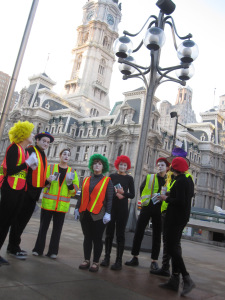
This April Fools’ Day celebration was a unique pro-bono partnership with the Pig Iron’s School for Advanced Performance Training, the Mayor’s Office of Transportation and Utilities and other Philadelphia based thespians and reminded drivers, pedestrians and cyclists to not act like fools any day of the year.
Each year about three dozen pedestrians lose their lives after being struck by cars, trucks and busses. On average, every five hours a pedestrian is sent to the hospital after being hit by a vehicle. Distracted driving and walking, running red lights in cars or on bike, jaywalking and sidewalk bike riding are no laughing matter. Better engineering, stricter enforcement and more engaging education are all parts of the solution to reducing deaths and injuries on our roads.
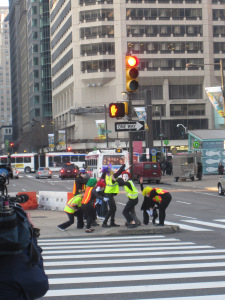
Philadelphians laughed along with the traffic clowns. However traffic safety is no laughing matter: Deputy Mayor for Transportation and Utilities Rina Cutler noted, “The financial toll of these fatalities and accidents is in the hundreds of millions each year, but the personal toll is incalculable. We need to constantly find ways to engage the public on traffic safety issues, as safety must be our top priority. This April Fools’ Day program is great opportunity to build on the nearly one thousand Drive Right, Ride Right, Walk Right ads being seen on busses, subways and transit shelters across the city this spring.”
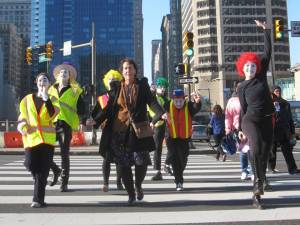
If you are interested in watching the clowns in action, check out Newsworks’s video coverage from this morning.
https://phillymotu.wordpress.com/2013/04/01/traffic-safety-is-no-laughing-matter/