Audacious Ideas – CHRIS MERRIAM

Roughly a third of Baltimore residents do not own a car, the fourth highest rate of any city in the United States. Today, Chris Merriam is one of them.

Six years ago, Merriam accepted a job in Lutherville; although he did not own a car at the time, he was told that as a condition of employment, he must buy one. He did, but as he realized the job wasn’t a good fit, he also struggled with high car and insurance payments.

Ultimately, Merriam moved on from the job, ditched the car, and let his bike guide him to a new path.

The Baltimore native enrolled in Morgan State University’s Master’s degree program in urban planning. He was determined to share his love of biking with his community while helping create a healthier, more affordable lifestyle for Baltimore residents.

https://www.audaciousideas.org/author/chrismerriam/

Maryland MVA: Bikes may use full lane so give them three feet.

By Jim Titus, The Washcycle

The brown mailing envelopes in which Maryland drivers receive their registration or drivers license renewal forms this month include the message “Give bikes THREE FEET when passing, IT’S THE LAW” along with the standard sketch showing a cyclist to the right of a compact car. The message runs about 30% of the length of the envelope, right above the address window, so alot of people will probably notice it.  Running along the bottom of the envelope the entire length of the address window is the message “Share the road,  You could save a life.”

The Motor Vehicle Administration has also created a public service message in which MVA director John Kuo explains that cyclists may use the full lane before he introduces himself.  That explanation is provided over about 18 seconds of video shot from a bicycle while cars pass safely.  Mr. Kuo goes on to explain the importance of leaving three feet while passing a bike, with more footage of cars passing bikes, including a bike in the middle of a door-zone bike lane

Although some advoates have argued that the presence of a double yellow line allows drivers to ignore the three-foot rule, that is clearly not the view of the Maryland Department of Transportation: several of the shots show drivers crossing the double yellow line to leave a safe passing distance.


Barry Childress deserves credit for regularly speaking with Mr. Kuo during 2010-2011 to get MVA to promote bike safety.  Then last year, the highway safety office was moved to MVA, which put Mr. Kuo in a position to do more. 

 (Jim Titus is on WABA’s Board of Directors and represents Prince George’s County on the Maryland Bicycle and Pedestrian Advisory Committee.  The views expressed here do not represent the official position of either WABA or MBPAC)

https://www.thewashcycle.com/2012/10/maryland-mva-bikes-may-use-full-lane-so-give-them-three-feet-1.html

Will Transportation Investments Keep Up With the Way Americans Travel?

by Phineas Baxandall, Streets Blog

Phineas Baxandall is a senior analyst at the U.S. Public Interest Research Group.

It’s now common knowledge that annual changes in the volume of driving no longer follow the old patterns.

For 60 years, the amount of vehicle miles traveled (VMT) rose steadily. Predicting more driving miles next year was like predicting that the sun would rise or that computer chips would be faster. The only direction seemed to be up.

Then, after 2004, per-capita VMT fell 6 percent, which has led to a decline in total VMT since 2007.

The most recent data are from July, traditionally America’s biggest month for driving. In July 2012, Americans clocked over 258 billion miles behind the wheel, a billion fewer miles than the previous July despite a slightly stronger economy and cheaper gasoline. In fact, you’d need to go back to 2002 to find a July when Americans drove fewer miles than July 2012.

Has America’s long increase in driving turned a corner or just taken a prolonged pause? The answer matters a lot. Consider four scenarios:

Graph: Phineas Baxandall, U.S. PIRG

  1. If the volume of annual vehicle miles traveled switches back to the average rate of increase between 1987 and 2005, then by 2025 VMT will be 27 percent greater than the 2012 level.
  2. If VMT changes at the average rate it sustained over the entire period between 1987 to 2012, then it will grow by almost 19 percent by 2025.
  3. If instead VMT changes at the average rate that has prevailed since 2004, then the number of miles driven will fall 2.3 percent by 2025.
  4. And if VMT changes at the average rate that has prevailed since 2007, then VMT would fall off by almost 8 percent by 2025

    Table: Phineas Baxandall, U.S. PIRG

The difference spanning these scenarios amounts to over a trillion vehicle miles per year. How we decide to invest in transportation should be very different, depending on which scenario we are planning for – especially since the roads, railways and other infrastructure we build today will be with us long past 2025. Continuing to build new highways at the current pace might arguably make some sense if driving were to return to pre-2005 rates of growth. But those outlays indisputably would be a colossal waste if more recent trends prevail.

https://dc.streetsblog.org/2012/10/22/will-transportation-investments-keep-up-with-travel-behavior/

Racklove Helps You Find Your Stolen Bike (and Also Buy and Sell Bikes)

image

By Melanie Pinola, Lifehacker

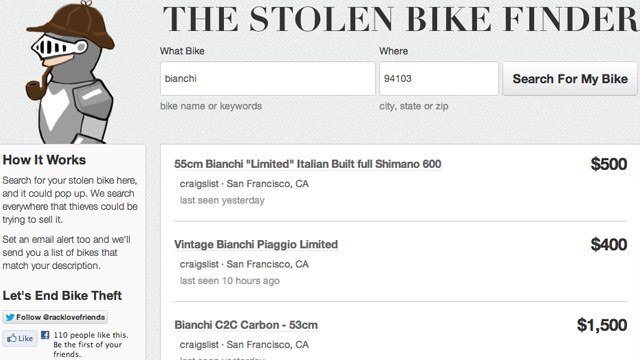
Bicycle theft is a rampant problem in this country; even if you lock your bike properly, professional thieves can still take it. Priceonomic’s new site Racklove is not only a nice place to buy and sell bikes, it’s a way to search for your stolen bike.

The stolen bike finder webapp searches everywhere thieves could be trying to sell your bike online, including Craigslist and Ebay. If you find a match for your bike, you could meet with the seller under the pretense of wanting to buy, and see if the serial number matches. (The serial number is found in your owner’s manual and usually on the underside of the bike. This site shows locations of bike serial numbers for different manufacturers.) If you’ve found your stolen bike, then get the police involved.

Racklove is also a nice community for buying and selling bikes (as opposed to Craigslist where lots of stolen bikes get flipped). The Racklove folks are trying to help end bicycle theft and encourage the ad descriptions to show you’re the owner of the bike you’re selling. You can search by bike type as well as your height. I found a couple of bike shops around the country selling old and new bicycles for decent prices (some with free shipping).

If you’re a bike lover, go ahead and check Racklove out.

https://lifehacker.com/5953230/racklove-helps-you-find-your-stolen-bike-and-also-buy-and-sell-bikes

Kamenetz Announces New Catonsville Bicycle Routes

State Grant Moves Trails Forward

Towson, Maryland (August 23, 2012) – Catonsville will have an expanded Short Line Trail and a new bike route from UMBC to the Frederick Road business district thanks to a $100,000 design grant awarded to Baltimore County from the Maryland Bikeways Program, part of the Governor’s Cycle Maryland Initiative. Catonsville Rails to Trails will be providing in-kind services to support the planning and engineering needed to extend the bike trails network..

“In this era of high gas prices, traffic congestion and a renewed emphasis on physical fitness, bike trails really make sense,” said Baltimore County Executive Kevin Kamenetz. “We thank the State for its support of Catonsville’s growing network of trails and bicycle routes.”

Short Line Trail to UMBC

With a new bike spur from the Short Line Trail to UMBC, the community will have safe bicycle commuting, more recreational options, and convenient connections to and from the university campus to the shops and restaurants along Frederick Road.

“Catonsville’s bike trails are a wonderful way for neighbors and families to connect with each other,” said Councilman Tom Quirk. “We’re proud that Catonsville Trails to Rails has been a leader in bringing this wonderful amenity to our community.”

The UMBC spur would tap into the existing Short Line Trail, which serves as the backbone of a growing network of trails and bicycle facilities that link educational, business and recreational destinations in the greater Catonsville area. Key destinations include:

  • Charlestown Retirement Community
  • Western High School
  • Bloomsbury Community Center
  • Catonsville and Paradise Village Centers
  • Maidens Choice Shopping Center
  • Catonsville High School
  • Lurman Woodland Theater

Rails to Trails

“Catonsville Rails to Trails is pleased to partner with Baltimore County and the State to build a network of trails to serve the residents of Catonsville and the entire county,” said Thomas M. Ajluni, President, Catonsville Rails to Trails.

“We’re pleased to be able to support Catonsville Rails to Trails through the state’s cycling program,” said State Senator Edward Kasemeyer.

 “Bike routes and trails truly add to our quality of life,” said Delegate Jimmy Malone.

“Catonsville bike trails and routes help bring our community even closer together – while making our environment cleaner and safer,” said Delegate Steven DeBoy.

Other Regional Projects

Other recently funded bicycle projects in the area include a signed bicycle route from UMBC to the Halethorpe MARC rail station, and bike lanes and routes on Frederick Road and Edmondson Avenue. Together with the existing number eight Streetcar Path connecting Frederick Road and Edmondson Avenue and the number nine Trolley Trail, which connects to historic Ellicott City, these projects will begin to establish a comprehensive bicycle network serving the region.

Continue reading “Kamenetz Announces New Catonsville Bicycle Routes”

The Cross-State Air Pollution Rule.

B’ Spokes: This is an interesting read if you are interested in clean air and what the EPA can do about the lack of it.
*****************************************************************************************************************************
BY MAX KENNERLY, ESQ., Litigation and Trial

The EPA finalized their plan, in August 2011, known as the Transport Rule or the Cross-State Air Pollution Rule. It’s a great program, one that will help avoid tens of thousands of premature deaths and illnesses — including over 400,000 cases of aggravated asthma over the next two years in the Eastern United States, something of not-so-slight importance to me while I sit here typing and listening to one of my daughters coughing — and reap hundreds of billions of dollars in public health benefits. Every dollar of costs in the CSAPR will be made up by a hundred dollars in public health benefits.

…As Judge Kavanaugh concluded:
[T]he Clean Air Act affords States the initial opportunity to implement reductions required by
EPA under the good neighbor provision. But here, when EPA quantified States’ good neighbor
obligations, it did not allow the States the initial opportunity to implement the required reductions
with respect to sources within their borders. Instead, EPA quantified States’ good neighbor
obligations and simultaneously set forth EPA-designed Federal Implementation Plans, or
FIPs, to implement those obligations at the State level. By doing so, EPA departed from its
consistent prior approach to implementing the good neighbor provision and violated the Act.
***
Re-read Section 110 of the Clean Air Act and see if you can figure out how on earth they reached that result. The States aren’t entitled to any “initial opportunity” at all, because the EPA can cut those three years short if it so feels. Moreover, the States already had their “initial opportunity” and they failed to use it, so the EPA did exactly what the Clean Air Act required: it made its own Federal plan. That’s what the statute says, and that’s what the Court should have followed; instead, the Court created a completely new procedure, literally two decades after the fact, to punt the case further down the field and delay the regulations even longer.

https://www.litigationandtrial.com/2012/10/articles/series/special-comment/federalist-society-judicial-activism-by-federalist-society-members-on-the-d-c-circuit/